

5 Maloti (United Nations) – Lesotho
Circulating commemorative coins
Commemoration: 50th Anniversary of the United Nations
Lesotho
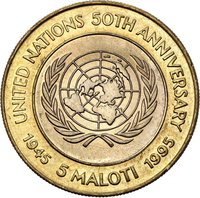
Obverse
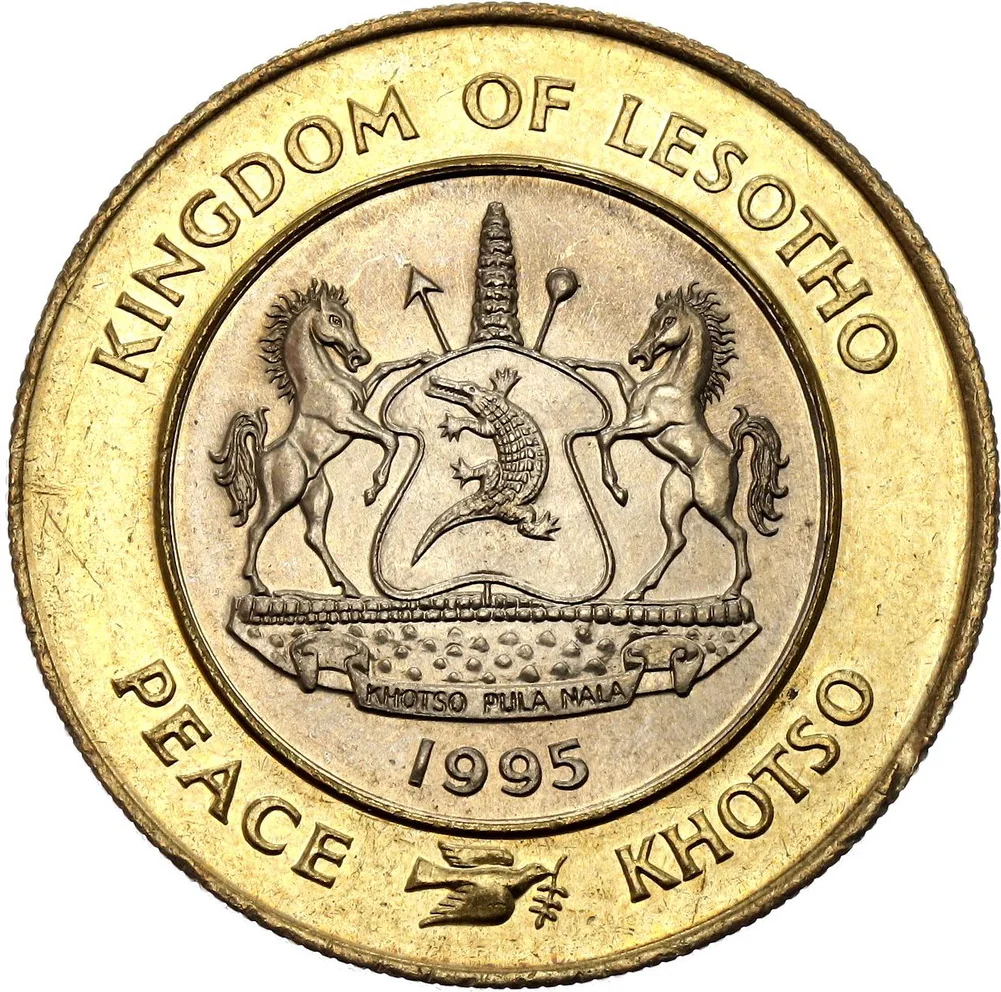
Reverse
Description:
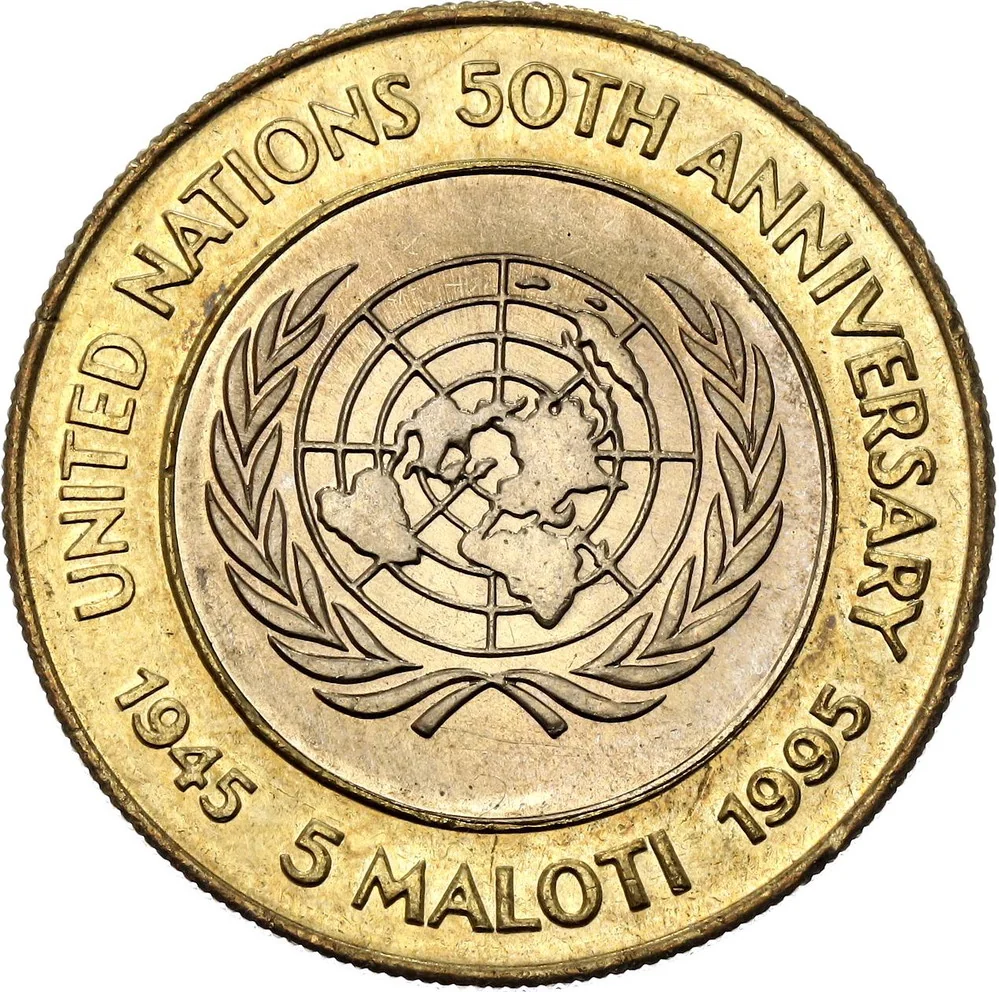
UN emblem.
Inscription:
UNITED NATIONS 50TH ANNIVERSARY
1945 5 MALOTI 1995
1945 5 MALOTI 1995
Script: Latin
Edge
Reeded
Categories
| Symbols> Coat of Arms |
| Organization> United Nations |
Mintings
| Year | Mint Mark | Mintage | Quality | Collection |
|---|---|---|---|---|
| 1995 | — | — |
Historical background
In 1995, Lesotho's currency situation was fundamentally defined by its membership in the Common Monetary Area (CMA) with South Africa. This arrangement, formalized in 1986, meant that the Lesotho loti (plural: maloti) was pegged at par (1:1) to the South African rand. The rand itself was legal tender in Lesotho, circulating alongside the loti, which gave the country a de facto dual-currency system. This peg provided critical stability by tethering Lesotho's monetary policy and exchange rate to the larger and more developed South African economy, thereby controlling inflation and facilitating cross-border trade, upon which the landlocked kingdom heavily depended.
However, this integration came with significant trade-offs, as Lesotho effectively ceded control over its independent monetary policy to the South African Reserve Bank. This meant that interest rate and money supply decisions were made in Pretoria based on South Africa's economic conditions, which did not always align with Lesotho's needs. The situation in 1995 was particularly influenced by the rand's volatility on international markets following the end of apartheid and South Africa's reintegration into the global economy. Lesotho had to passively absorb these external shocks, limiting its domestic policy tools to primarily fiscal measures.
Internally, 1995 fell within a period of relative macroeconomic stability for Lesotho, with the loti's peg providing a predictable environment. The government, under Prime Minister Ntsu Mokhehle, was focused on a post-military-rule reform agenda, and the fixed exchange rate regime helped anchor economic planning. The stability was underpinned by robust revenues from the Highlands Water Project and continued receipts from the Southern African Customs Union (SACU). Thus, while the currency arrangement constrained sovereign monetary control, it was generally viewed in 1995 as a necessary framework that provided credibility and reduced transaction costs for an economy deeply integrated with its dominant neighbor.
However, this integration came with significant trade-offs, as Lesotho effectively ceded control over its independent monetary policy to the South African Reserve Bank. This meant that interest rate and money supply decisions were made in Pretoria based on South Africa's economic conditions, which did not always align with Lesotho's needs. The situation in 1995 was particularly influenced by the rand's volatility on international markets following the end of apartheid and South Africa's reintegration into the global economy. Lesotho had to passively absorb these external shocks, limiting its domestic policy tools to primarily fiscal measures.
Internally, 1995 fell within a period of relative macroeconomic stability for Lesotho, with the loti's peg providing a predictable environment. The government, under Prime Minister Ntsu Mokhehle, was focused on a post-military-rule reform agenda, and the fixed exchange rate regime helped anchor economic planning. The stability was underpinned by robust revenues from the Highlands Water Project and continued receipts from the Southern African Customs Union (SACU). Thus, while the currency arrangement constrained sovereign monetary control, it was generally viewed in 1995 as a necessary framework that provided credibility and reduced transaction costs for an economy deeply integrated with its dominant neighbor.
🌱 Fairly Common