


5 dollars – Eastern Caribbean States
Add to wishlist
Non-circulating coins
Commemoration: Queen's Diamond Jubilee
Context
Year: 2012
Issuer: Eastern Caribbean States
Issuing organization: Eastern Caribbean Central Bank
Ruler: Elizabeth II
Currency:
(since 1965)
Material

References
KM: #
Numista: #95726
Value
Exchange value: 5 XCD
Bullion value: $65.62
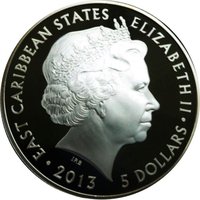
Obverse
Description:
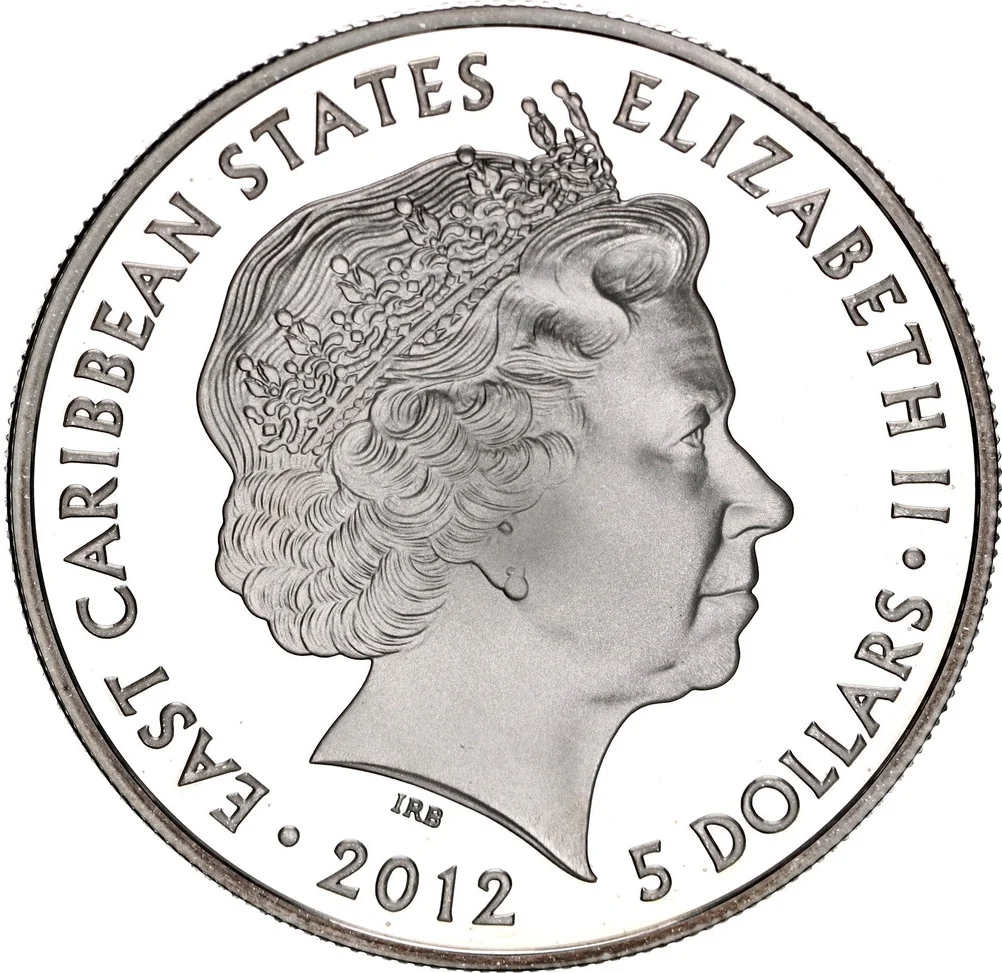
Portrait of Queen Elizabeth II in profile.
Inscription:
EAST CARIBBEAN STATES ELIZABETH II
IRB
2012 5 DOLLARS
IRB
2012 5 DOLLARS
Translation:
EAST CARIBBEAN STATES ELIZABETH II
IRB
2012 5 DOLLARS
IRB
2012 5 DOLLARS
Script: Latin
Language: English
Engraver: Ian Rank-Broadley
Reverse
Description:
Flag and trumpets left; legend and aircraft right.
Inscription:
‘THE
COLOURS
THAT
I AM
PRESENTING
TO YOU’
ha
COLOURS
THAT
I AM
PRESENTING
TO YOU’
ha
Script: Latin
Edge
Reeded
Mints
| Name | Mark |
|---|---|
| Royal Mint | — |
Mintings
| Year | Mint Mark | Mintage | Quality | Collection |
|---|---|---|---|---|
| 2012 | — | — | Proof |
Historical background
In 2012, the eight member states of the Eastern Caribbean Currency Union (ECCU)—Anguilla, Antigua and Barbuda, Dominica, Grenada, Montserrat, Saint Kitts and Nevis, Saint Lucia, and Saint Vincent and the Grenadines—continued to operate under the long-standing arrangement of a common currency, the Eastern Caribbean Dollar (XCD). This currency has been pegged to the US Dollar at a fixed rate of XCD 2.70 to USD 1.00 since 1976, a regime managed by the Eastern Caribbean Central Bank (ECCB). The primary monetary policy objective remained the unwavering defense of this peg, which provided a critical anchor for price stability and investor confidence in these small, open, and tourism-dependent economies.
The year was characterized by the ongoing challenges of recovering from the global financial crisis of 2008-2009, which had severely impacted tourism and foreign direct investment—the region's economic lifeblood. While some stability had returned, growth remained fragile and uneven across member states. High public debt burdens, notably in countries like Antigua and Barbuda, Grenada, and Saint Kitts and Nevis, posed a significant systemic risk to the currency union. These debt distress situations strained national finances and underscored the vulnerability of the fixed exchange rate regime to fiscal imbalances within member countries.
Consequently, the ECCB's focus in 2012 was on navigating this delicate balance between maintaining strict currency stability and supporting economic recovery. The Bank continued to advocate for and monitor structural reforms under the ECCB's Eight-Point Stabilization and Growth Program, emphasizing fiscal consolidation, debt management, and improving competitiveness. The resilience of the peg itself was not in doubt, but the underlying economic pressures highlighted the imperative for greater fiscal discipline and regional coordination to ensure the long-term sustainability of the Eastern Caribbean Dollar.
The year was characterized by the ongoing challenges of recovering from the global financial crisis of 2008-2009, which had severely impacted tourism and foreign direct investment—the region's economic lifeblood. While some stability had returned, growth remained fragile and uneven across member states. High public debt burdens, notably in countries like Antigua and Barbuda, Grenada, and Saint Kitts and Nevis, posed a significant systemic risk to the currency union. These debt distress situations strained national finances and underscored the vulnerability of the fixed exchange rate regime to fiscal imbalances within member countries.
Consequently, the ECCB's focus in 2012 was on navigating this delicate balance between maintaining strict currency stability and supporting economic recovery. The Bank continued to advocate for and monitor structural reforms under the ECCB's Eight-Point Stabilization and Growth Program, emphasizing fiscal consolidation, debt management, and improving competitiveness. The resilience of the peg itself was not in doubt, but the underlying economic pressures highlighted the imperative for greater fiscal discipline and regional coordination to ensure the long-term sustainability of the Eastern Caribbean Dollar.

✨ Legendary