

8 dollars (OECS Economic Union) – Eastern Caribbean States
Add to wishlist
Non-circulating coins
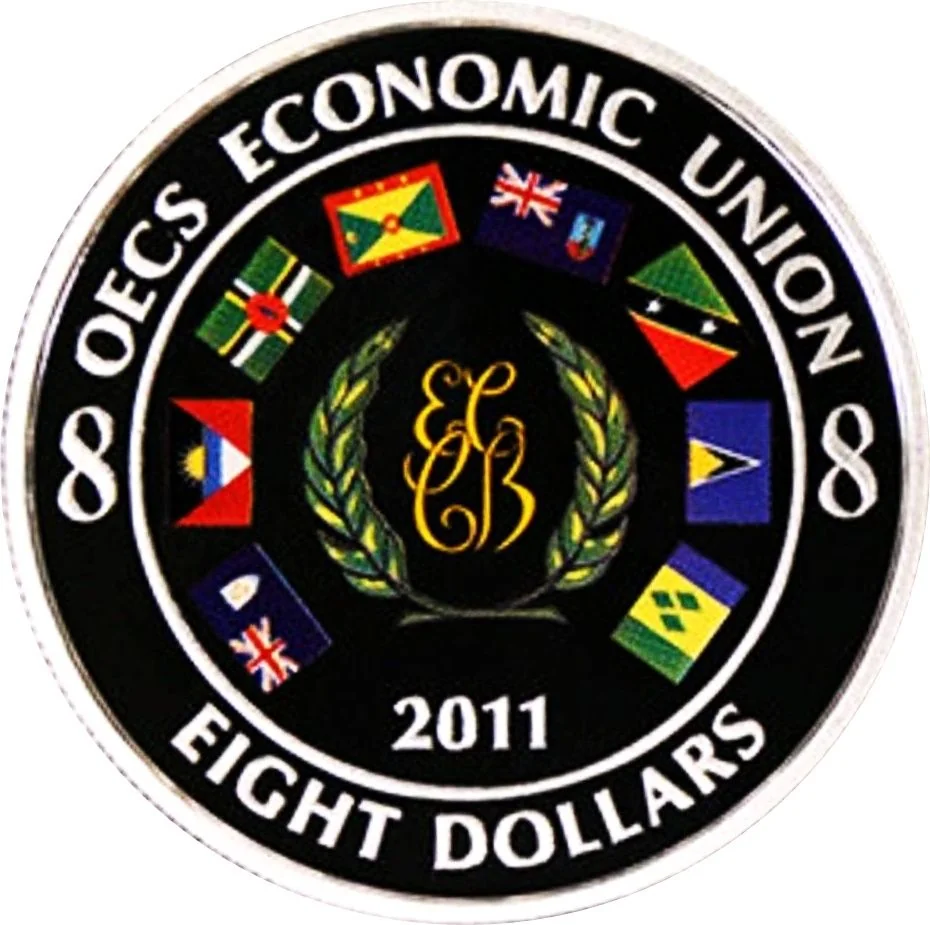
Commemoration: Establishment of the OECS Economic Union
Context
Year: 2011
Issuer: Eastern Caribbean States
Issuing organization: Eastern Caribbean Central Bank
Ruler: Elizabeth II
Currency:
(since 1965)
Total mintage: 500
Material
References
KM: #
Numista: #53475
Value
Exchange value: 8 XCD
Bullion value: $58.05
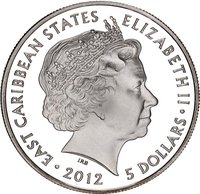
Obverse
Description:
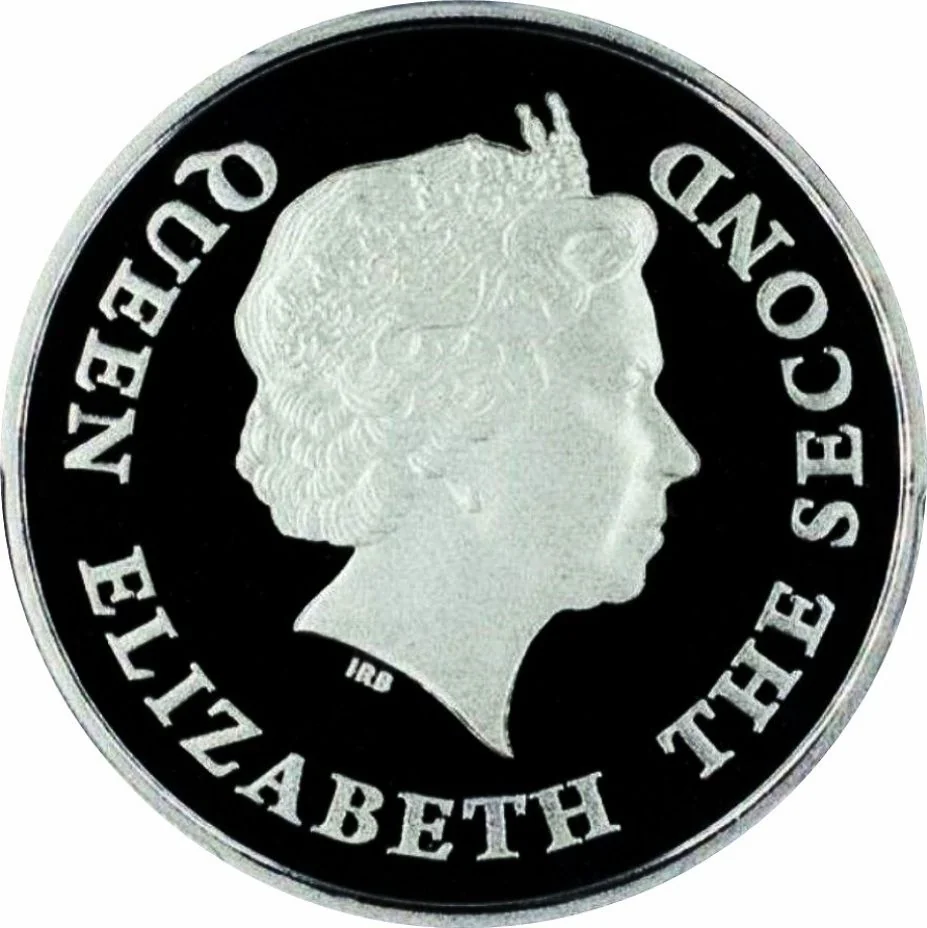
Queen Elizabeth II in tiara, facing right.
Inscription:
QUEEN ELIZABETH THE SECOND
IRB
IRB
Script: Latin
Engraver: Ian Rank-Broadley
Reverse
Edge
Reeded
Mints
| Name | Mark |
|---|---|
| Royal Canadian Mint of Ottawa | — |
Mintings
| Year | Mint Mark | Mintage | Quality | Collection |
|---|---|---|---|---|
| 2011 | — | 500 | Proof |
Historical background
In 2011, the member states of the Eastern Caribbean Currency Union (ECCU) continued their long-standing and stable monetary arrangement anchored by the Eastern Caribbean Central Bank (ECCB). The region's common currency, the Eastern Caribbean dollar (XCD), remained pegged at a fixed rate of XCD 2.70 to USD 1.00, a parity maintained since 1976. This peg provided a crucial anchor for price stability and investor confidence, particularly important for economies heavily reliant on tourism and foreign direct investment. The ECCB's primary mandate in 2011 was to safeguard this arrangement, manage foreign reserves, and ensure the stability of the financial sector across its eight member countries.
The year was characterized by the ongoing challenges of recovering from the global financial crisis of 2008-2009. While the worst of the immediate shocks had passed, ECCU economies faced persistent headwinds including high public debt burdens, sluggish economic growth, and vulnerability to external shocks. The tourism sector, a critical economic driver, was in a fragile recovery phase, sensitive to economic conditions in key source markets like North America and Europe. Consequently, the ECCB maintained a cautious monetary policy, focusing on ensuring adequate liquidity in the banking system while continuing to advocate for fiscal consolidation and structural reforms among member governments to address high debt-to-GDP ratios.
Overall, the currency situation in 2011 was one of entrenched stability in the exchange rate mechanism but underlying economic fragility. The fixed peg to the US dollar remained a non-negotiable cornerstone of monetary policy, successfully insulating the region from currency volatility. However, the ECCB and regional governments were acutely aware that the sustainability of this monetary arrangement depended not just on foreign reserve levels, but on achieving broader fiscal discipline and improved economic competitiveness to withstand future global economic pressures.
The year was characterized by the ongoing challenges of recovering from the global financial crisis of 2008-2009. While the worst of the immediate shocks had passed, ECCU economies faced persistent headwinds including high public debt burdens, sluggish economic growth, and vulnerability to external shocks. The tourism sector, a critical economic driver, was in a fragile recovery phase, sensitive to economic conditions in key source markets like North America and Europe. Consequently, the ECCB maintained a cautious monetary policy, focusing on ensuring adequate liquidity in the banking system while continuing to advocate for fiscal consolidation and structural reforms among member governments to address high debt-to-GDP ratios.
Overall, the currency situation in 2011 was one of entrenched stability in the exchange rate mechanism but underlying economic fragility. The fixed peg to the US dollar remained a non-negotiable cornerstone of monetary policy, successfully insulating the region from currency volatility. However, the ECCB and regional governments were acutely aware that the sustainability of this monetary arrangement depended not just on foreign reserve levels, but on achieving broader fiscal discipline and improved economic competitiveness to withstand future global economic pressures.

✨ Legendary