


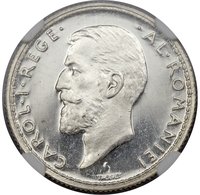
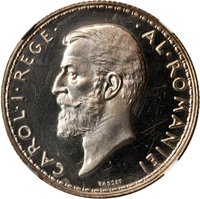
Obverse
Description:
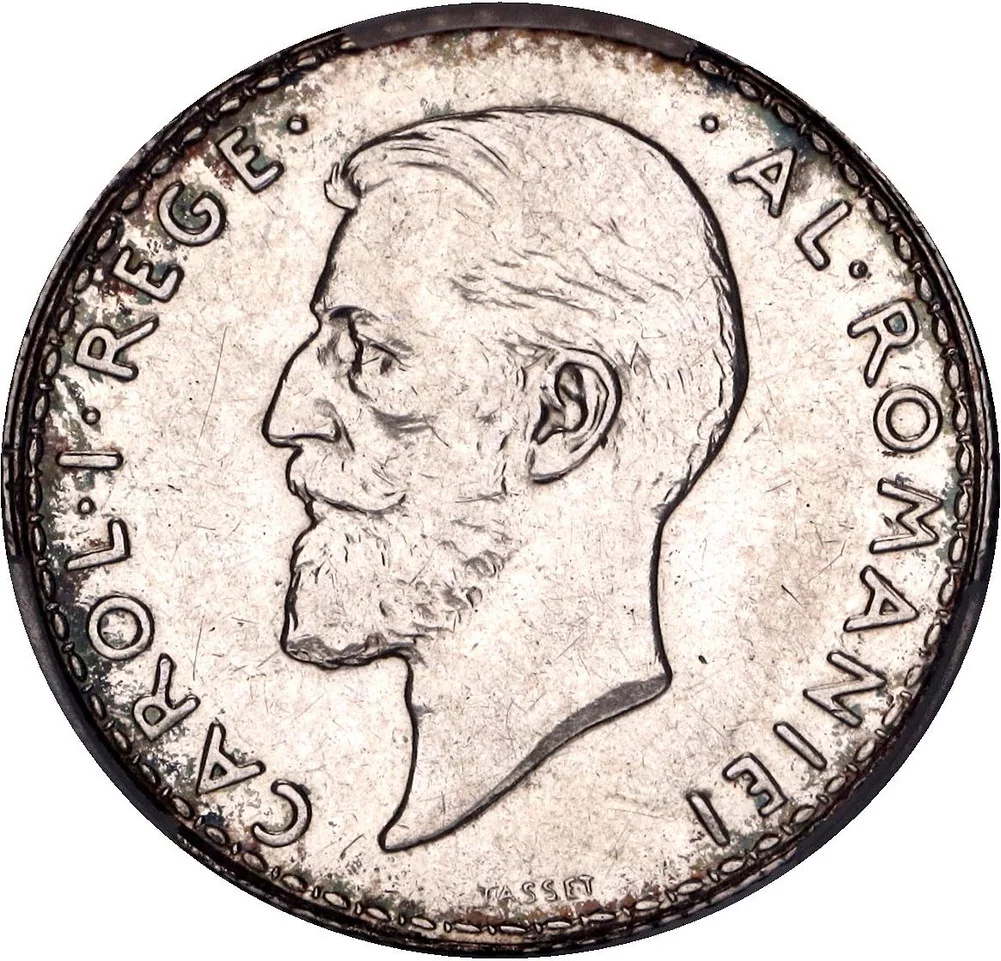
Bearded man facing left.
Inscription:
CAROL·I·REGE· ·AL·ROMANIEI
TASSET
TASSET
Translation:
CAROL I KING OF ROMANIA
TASSET
TASSET
Script: Latin
Engraver: Ernest Paulin Tasset
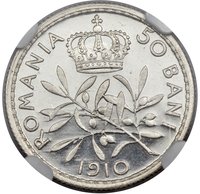
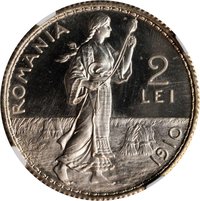
Reverse
Description:
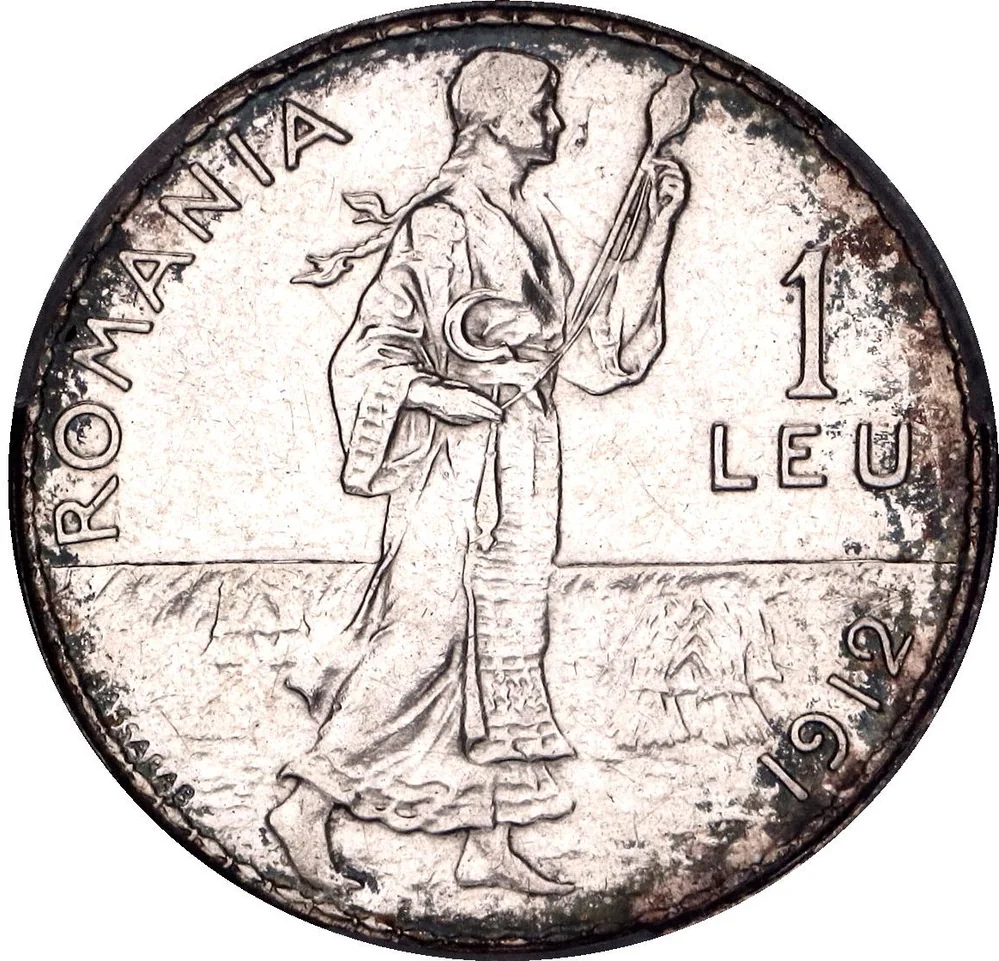
Figure walking right
Inscription:
ROMANIA
1
LEU
1914
Bassarab
1
LEU
1914
Bassarab
Script: Latin
Engraver: Costache Bassarab
Edge
Reeded
Mints
| Name | Mark |
|---|---|
| Hamburgische Münze | — |
| Royal Mint of Belgium | — |
Mintings
| Year | Mint Mark | Mintage | Quality | Collection |
|---|---|---|---|---|
| 1910 | — | — | ||
| 1910 | — | 4,600,000 | BU | |
| 1911 | — | 2,573,065 | BU | |
| 1912 | — | 3,540,000 | ||
| 1914 | — | 4,282,935 | BU | |
| 1914 | — | — |
Historical background
In 1910, Romania operated under a complex and somewhat fragile monetary system, reflecting its recent independence and ongoing economic development. The official currency was the Romanian Leu (Leu Românesc), which was part of a bimetallic system theoretically based on both gold and silver. However, in practice, the country was striving to adhere to the gold standard, a goal formalized by law in 1890. The National Bank of Romania, established in 1880, held the sole right of note issue, but its paper leu was not yet fully convertible into gold, leading to occasional public distrust in banknotes compared to hard metal coin.
The period was characterized by a chronic shortage of small-denomination metallic currency in circulation, which hampered everyday commerce. To fill this gap, a wide array of foreign coins, particularly Austrian-Hungarian crowns, Russian rubles, and Turkish gold lira, circulated freely alongside domestic issues. This monetary pluralism was officially tolerated and created a practical, if messy, system for trade. Furthermore, the state's finances were heavily reliant on foreign loans, primarily from France and Germany, which were often negotiated to stabilize the currency and fund large infrastructure projects, linking the leu's stability to international confidence and capital flows.
Ultimately, the pre-World War I currency situation was one of transition and vulnerability. While institutions were modernizing and gold reserves were being accumulated to shore up the leu, the system was not yet robust. The reliance on foreign coins and credit exposed the economy to external shocks, a weakness that would be catastrophically revealed during the Great War. The pressures of wartime financing would soon lead to the suspension of gold convertibility, ushering in a prolonged period of inflation and monetary instability that defined the following decade.
The period was characterized by a chronic shortage of small-denomination metallic currency in circulation, which hampered everyday commerce. To fill this gap, a wide array of foreign coins, particularly Austrian-Hungarian crowns, Russian rubles, and Turkish gold lira, circulated freely alongside domestic issues. This monetary pluralism was officially tolerated and created a practical, if messy, system for trade. Furthermore, the state's finances were heavily reliant on foreign loans, primarily from France and Germany, which were often negotiated to stabilize the currency and fund large infrastructure projects, linking the leu's stability to international confidence and capital flows.
Ultimately, the pre-World War I currency situation was one of transition and vulnerability. While institutions were modernizing and gold reserves were being accumulated to shore up the leu, the system was not yet robust. The reliance on foreign coins and credit exposed the economy to external shocks, a weakness that would be catastrophically revealed during the Great War. The pressures of wartime financing would soon lead to the suspension of gold convertibility, ushering in a prolonged period of inflation and monetary instability that defined the following decade.
🌱 Common