

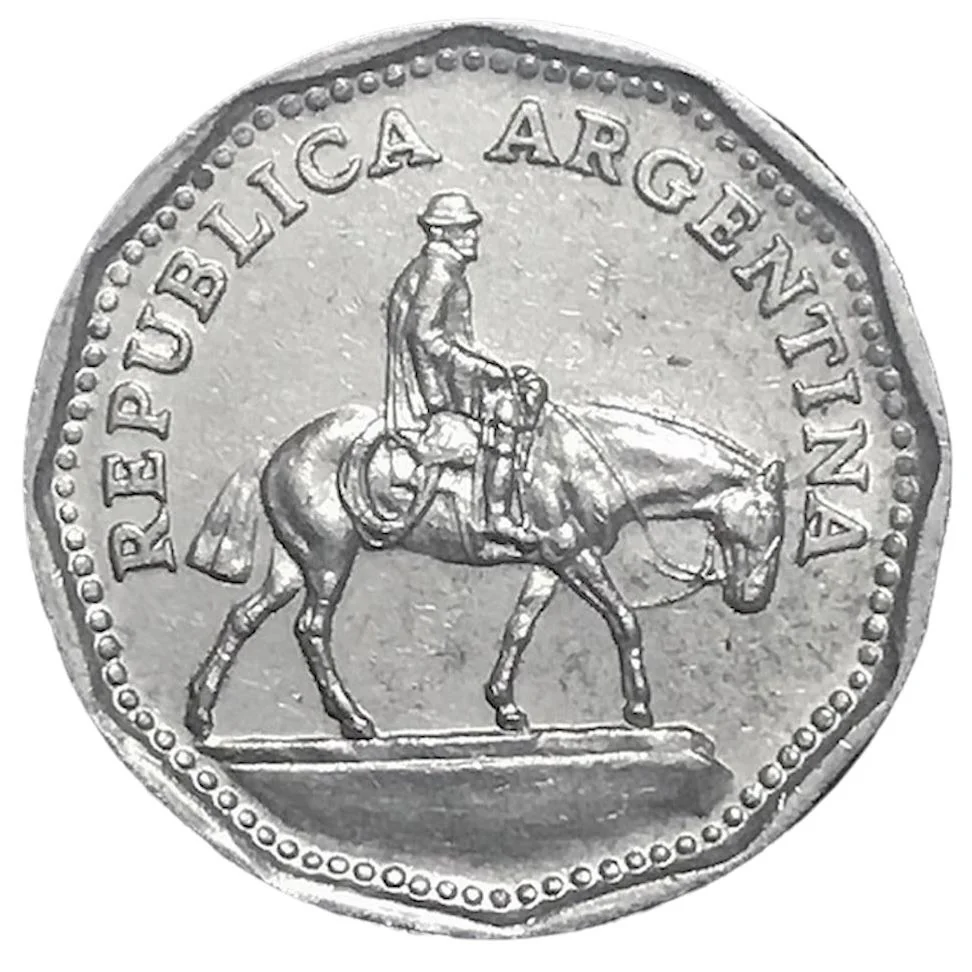
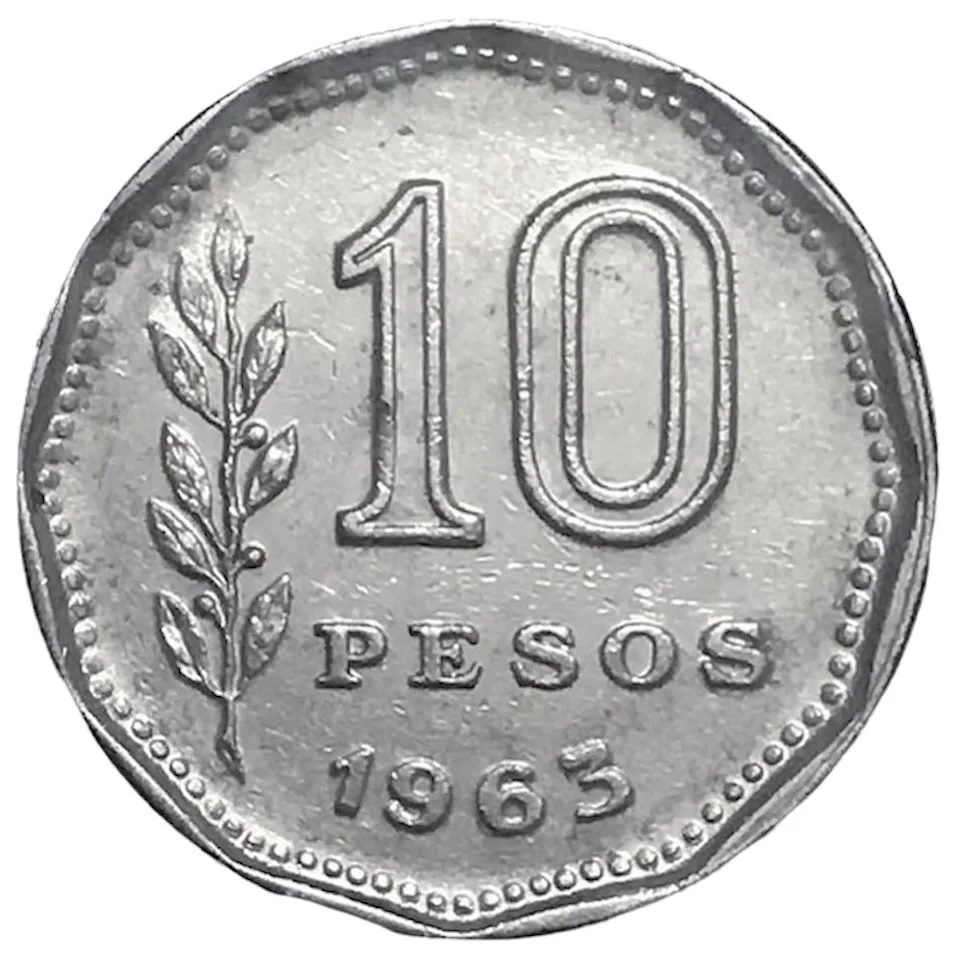
10 Pesos – Argentina
Argentina
Context
Years: 1962–1968
Issuer: Argentina 
Period:
(since 1861)
Currency:
(1881—1969)
Demonetization: 1 January 1970
Total mintage: 411,780,297
Material
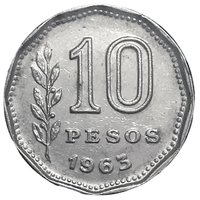
Diameter: 23 mm
Weight: 4.9 g
Thickness: 1.8 mm
Shape: Dodecagonal
Technique: Milled
Alignment: Coin alignment
flip
References
KM: #Click to copy to clipboard60
Numista: #955
Value
Exchange value: 10 ARM
Obverse
Reverse
Edge
Plain
Mintings
| Year | Mint Mark | Mintage | Quality | Collection |
|---|---|---|---|---|
| 1962 | — | 57,401,000 | ||
| 1963 | — | 136,791,843 | ||
| 1964 | — | 46,576,000 | ||
| 1965 | — | 40,640,000 | ||
| 1966 | — | 50,733,315 | ||
| 1967 | — | 43,050,000 | ||
| 1968 | — | 36,588,139 |
Historical background
Argentina's currency situation in 1962 was a chapter in the nation's long struggle with inflation, fiscal deficits, and political instability. The year fell within the presidency of José María Guido, who assumed power after a military coup ousted President Arturo Frondizi. The economic landscape was dominated by the policies of Frondizi's "Developmentalist" program, which had ended the previous decade's monetary stability by financing ambitious industrialization through deficit spending and foreign borrowing. This led to a severe balance of payments crisis and rampant inflation, setting the stage for the turmoil of 1962.
The immediate currency crisis was triggered by a massive devaluation in late 1961, which saw the official peso devalued from 83 to 130 to the US dollar. By 1962, inflation was running at an annual rate of approximately 30%, severely eroding purchasing power. The government attempted to manage the crisis through a complex system of multiple exchange rates—a "bureaucratic" or "controlled" rate for essential imports and a much less favorable "free" rate for other transactions. This created a thriving black market for dollars (mercado paralelo), where the peso traded at a significant discount, reflecting a profound lack of confidence in the currency and the government's economic management.
Ultimately, the 1962 currency instability was as much a political crisis as an economic one. The military's intervention in politics and the ousting of Frondizi created a climate of uncertainty that deterred investment and complicated any coherent policy response. Attempts at stabilization under Minister Álvaro Alsogaray faced immense social and political resistance. Consequently, the peso remained under intense pressure throughout the year, with devaluation and inflation becoming entrenched features of the Argentine economy, foreshadowing the deeper crises that would mark the coming decades.
The immediate currency crisis was triggered by a massive devaluation in late 1961, which saw the official peso devalued from 83 to 130 to the US dollar. By 1962, inflation was running at an annual rate of approximately 30%, severely eroding purchasing power. The government attempted to manage the crisis through a complex system of multiple exchange rates—a "bureaucratic" or "controlled" rate for essential imports and a much less favorable "free" rate for other transactions. This created a thriving black market for dollars (mercado paralelo), where the peso traded at a significant discount, reflecting a profound lack of confidence in the currency and the government's economic management.
Ultimately, the 1962 currency instability was as much a political crisis as an economic one. The military's intervention in politics and the ousting of Frondizi created a climate of uncertainty that deterred investment and complicated any coherent policy response. Attempts at stabilization under Minister Álvaro Alsogaray faced immense social and political resistance. Consequently, the peso remained under intense pressure throughout the year, with devaluation and inflation becoming entrenched features of the Argentine economy, foreshadowing the deeper crises that would mark the coming decades.
🌱 Very Common