

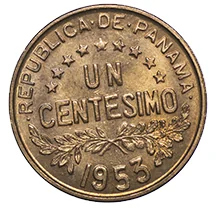
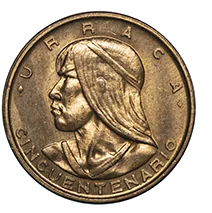
1 centesimo (Republic of Panama) – Panama
Add to wishlist
Circulating commemorative coins
Commemoration: 50th anniversary of the Republic of Panama
Panama
Context
Material
Diameter: 19.05 mm
Weight: 3.11 g
Thickness: 1.5 mm
Shape: Round
Composition: Bronze
Standard: Gold tenth ounce
Magnetic: No
Technique: Milled
Alignment: Coin alignment
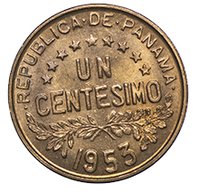
flip
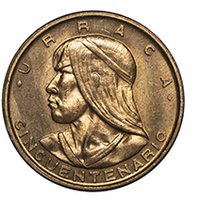
References
KM: #
Numista: #9549
Value
Exchange value: 0.01 PAB
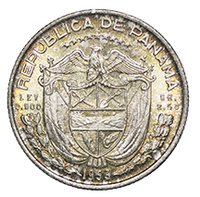
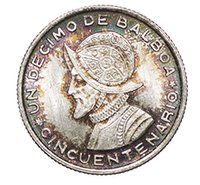
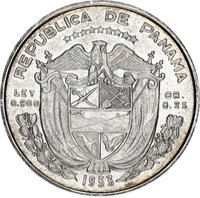
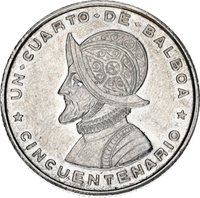
Obverse
Reverse
Edge
Plain
Mints
| Name | Mark |
|---|---|
| Mexican Mint | — |
Mintings
| Year | Mint Mark | Mintage | Quality | Collection |
|---|---|---|---|---|
| 1953 | — | 1,500,000 |
Historical background
In 1953, Panama's currency situation was unique and defined by its long-standing relationship with the United States dollar. Since its independence in 1903, Panama had used the US dollar as its official paper currency under the terms of the monetary agreement in its constitution. The country minted its own subsidiary coinage, the Balboa, which was pegged at absolute parity (1:1) with the dollar and circulated interchangeably. This system provided exceptional monetary stability and low inflation, as Panama effectively outsourced its monetary policy to the United States Federal Reserve.
This dollarized economy was deeply intertwined with the geopolitical and economic presence of the United States, most notably through the operation of the Panama Canal and the Canal Zone. The US dollar was the lifeblood of the Canal's operations and the spending by US military and civilian personnel stationed there, which significantly bolstered the Panamanian economy. Consequently, Panama did not have, nor feel the need for, a central bank or an independent monetary policy. The National Bank of Panama, established in 1904, functioned primarily as a commercial and development bank rather than a monetary authority.
The arrangement in 1953 was largely viewed as successful and uncontroversial within Panama, providing a stable financial foundation for a developing economy. However, it also meant the nation had no mechanism to control its money supply or act as a lender of last resort during banking crises. This foundational dependence on US economic policy would remain a constant for decades, with the full dollarization (and the absence of a central bank) persisting as the defining characteristic of Panama's monetary system long after the political tensions of the 1960s and the eventual transfer of the Canal at the century's end.
This dollarized economy was deeply intertwined with the geopolitical and economic presence of the United States, most notably through the operation of the Panama Canal and the Canal Zone. The US dollar was the lifeblood of the Canal's operations and the spending by US military and civilian personnel stationed there, which significantly bolstered the Panamanian economy. Consequently, Panama did not have, nor feel the need for, a central bank or an independent monetary policy. The National Bank of Panama, established in 1904, functioned primarily as a commercial and development bank rather than a monetary authority.
The arrangement in 1953 was largely viewed as successful and uncontroversial within Panama, providing a stable financial foundation for a developing economy. However, it also meant the nation had no mechanism to control its money supply or act as a lender of last resort during banking crises. This foundational dependence on US economic policy would remain a constant for decades, with the full dollarization (and the absence of a central bank) persisting as the defining characteristic of Panama's monetary system long after the political tensions of the 1960s and the eventual transfer of the Canal at the century's end.
🌱 Common