

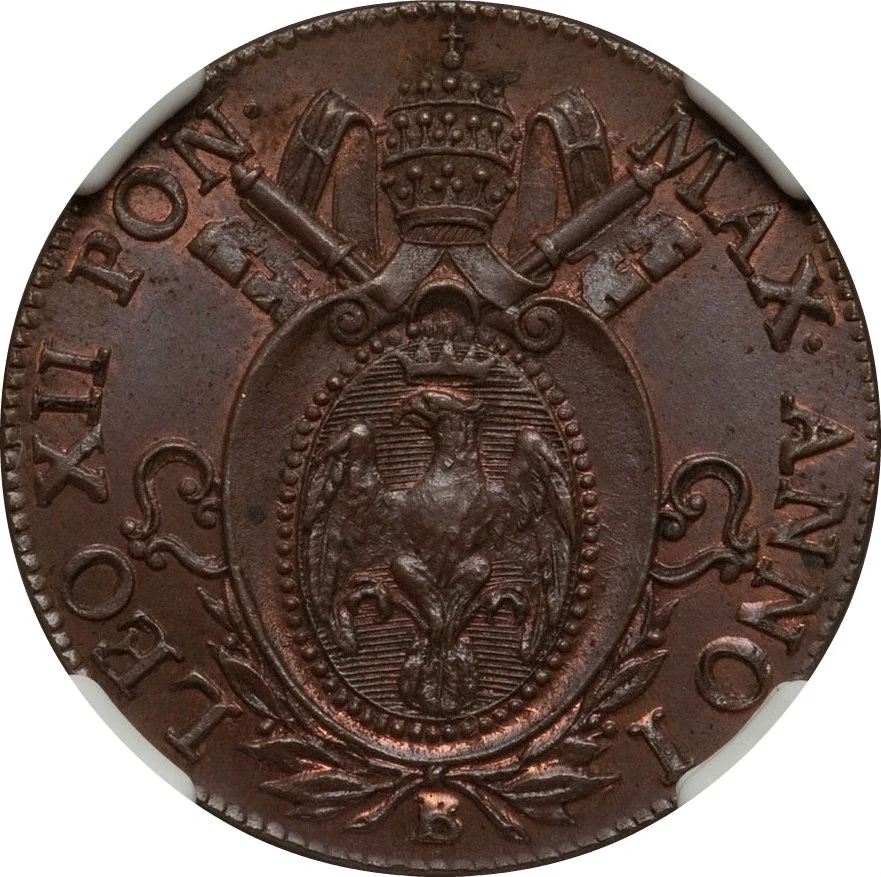
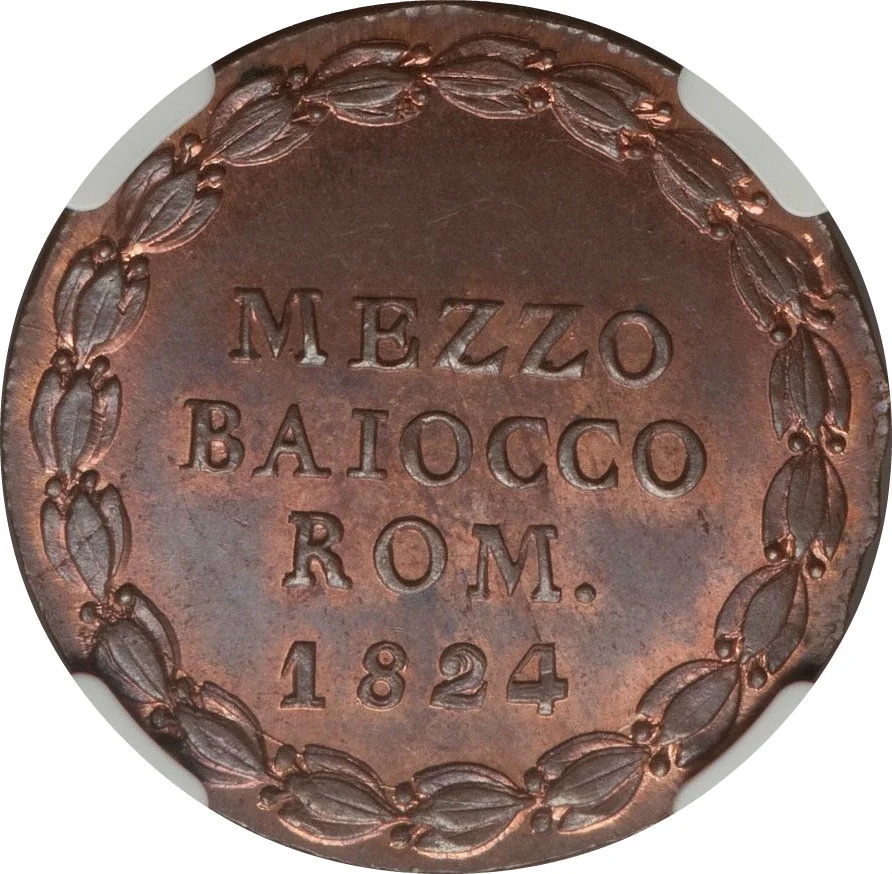
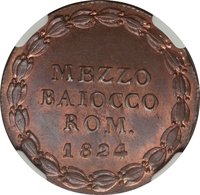
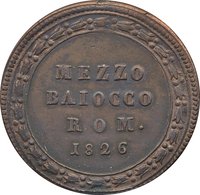
½ Baiocco – Papal States
Vatican City
Context
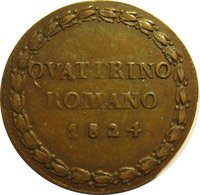
Year: 1824
Country: Vatican City 
Issuer: Papal States
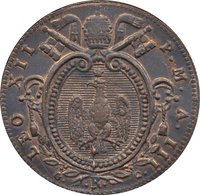
Ruler: Leo XII
Currency:
(1534—1835)
Demonetized: Yes
Total mintage: 647,600
Material
References
KM: #Click to copy to clipboard1295
Numista: #95403
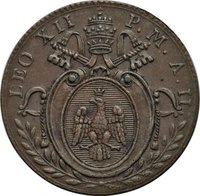
Obverse
Reverse
Edge
Plain
Mints
| Name | Mark |
|---|---|
| Bologna | B |
Mintings
| Year | Mint Mark | Mintage | Quality | Collection |
|---|---|---|---|---|
| 1824 | B | 647,600 |
Historical background
In 1824, the Papal States' monetary system was a complex and fragmented relic of its medieval and early modern past, reflecting the temporal and economic challenges of the restored papal government following the Napoleonic upheavals. There was no single, unified papal currency. Instead, the scudo (specifically the scudo romano) served as the primary unit of account, but it existed alongside a multitude of circulating coins from various eras and issuing authorities. These included older papal coinage, coins from other Italian states, and even foreign currencies like the French franc and the Austrian lira, which had entered circulation during the recent occupations. This created a chaotic environment for commerce, requiring constant reference to exchange lists and subjecting transactions to arbitrage and confusion.
The physical coinage in circulation was itself problematic. The papal mint struggled with inconsistent standards, and the system was based on a bimetallic standard of gold and silver with a fixed legal ratio. However, fluctuations in the international market value of these metals often caused one type of coin to be hoarded or exported, leading to shortages and a de facto reliance on the remaining metal. Furthermore, the scarcity of small-denomination coins for everyday transactions posed a significant burden on the common people, often forcing them to accept clipped or debased coins at face value or resort to barter.
This monetary disarray was symptomatic of the broader administrative and economic stagnation within the Papal States under Pope Leo XII. His conservative and austerity-focused regime was hesitant to undertake the modernizing reforms necessary to create a centralized banking system or a uniform, state-controlled currency. Consequently, the currency situation of 1824 remained an inefficient patchwork, hindering internal trade and integration into the growing commercial networks of 19th-century Europe, and it would persist as a chronic problem until the final dissolution of the Papal States in 1870.
The physical coinage in circulation was itself problematic. The papal mint struggled with inconsistent standards, and the system was based on a bimetallic standard of gold and silver with a fixed legal ratio. However, fluctuations in the international market value of these metals often caused one type of coin to be hoarded or exported, leading to shortages and a de facto reliance on the remaining metal. Furthermore, the scarcity of small-denomination coins for everyday transactions posed a significant burden on the common people, often forcing them to accept clipped or debased coins at face value or resort to barter.
This monetary disarray was symptomatic of the broader administrative and economic stagnation within the Papal States under Pope Leo XII. His conservative and austerity-focused regime was hesitant to undertake the modernizing reforms necessary to create a centralized banking system or a uniform, state-controlled currency. Consequently, the currency situation of 1824 remained an inefficient patchwork, hindering internal trade and integration into the growing commercial networks of 19th-century Europe, and it would persist as a chronic problem until the final dissolution of the Papal States in 1870.
⭐ Rare