

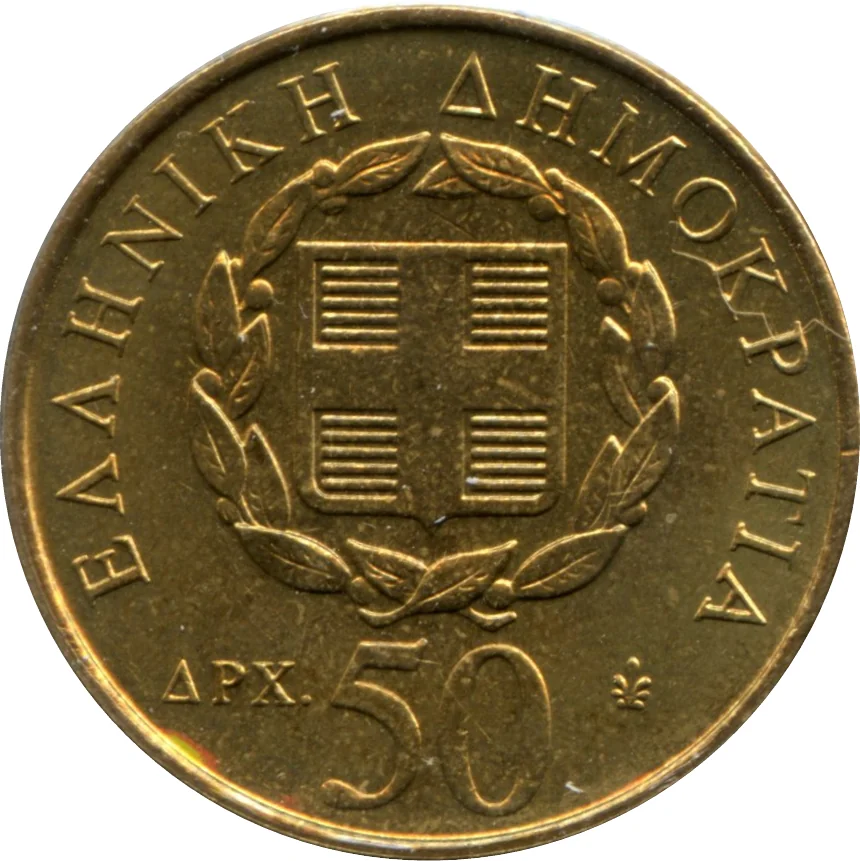
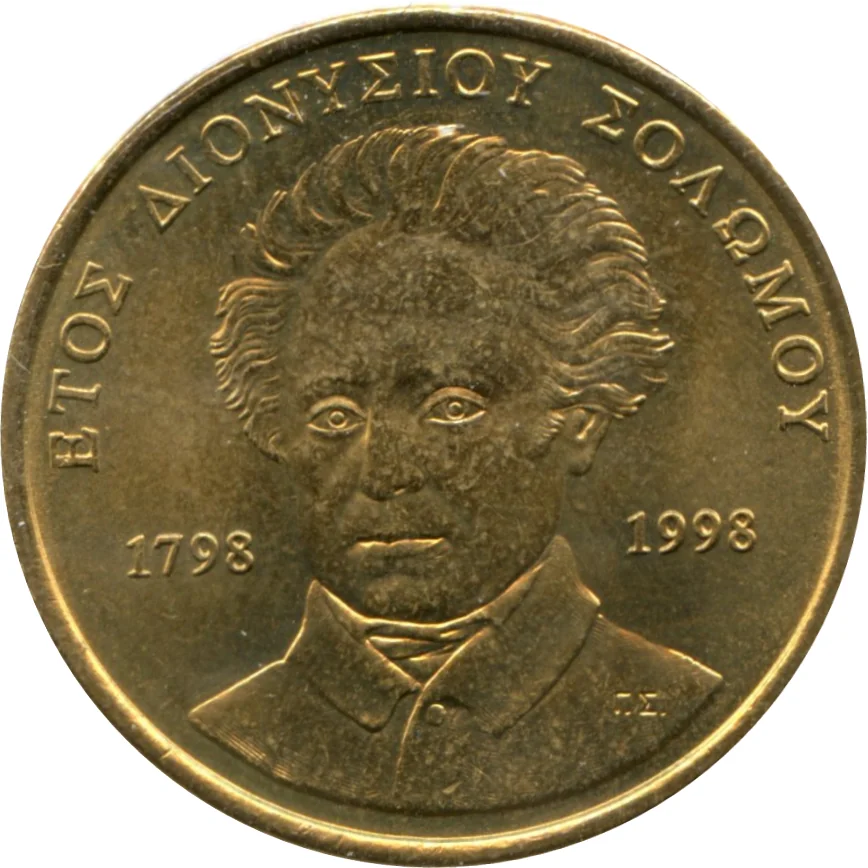
50 Drachmai (Dionysios Solomos) – Greece
Circulating commemorative coins
Commemoration: 200th Birthday Dionysios Solomos
Greece
Context
Year: 1998
Issuer: Greece 
Period:
(since 1974)
Currency:
(1954—2001)
Demonetization: 28 February 2002
Total mintage: 2,500,000
Material
Diameter: 27.5 mm
Weight: 9 g
Shape: Round
Composition: Aluminium bronze
Magnetic: No
Technique: Milled
Alignment: Medal alignment
flip
References
KM: #Click to copy to clipboard172
Numista: #9536
Value
Exchange value: 50 GRD
Inflation-adjusted value: 91.54 GRD
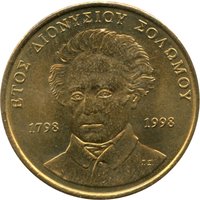
Obverse
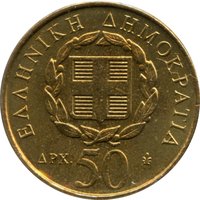
Reverse
Description:
Arms in wreath, value beneath.
Inscription:
ΕΤΟΣ ΔΙΟΝΥΣΙΟΥ ΣΟΛΩΜΟΥ
1798 1998
1798 1998
Translation:
YEAR OF DIONYSIOS SOLOMOS
1798 1998
1798 1998
Script: Greek
Language: Greek
Engraver: Geórgios Stamatópoulos
Edge
Reeded
Categories
| Art> Literature |
| Event> Birth anniversary |
| Symbols> Coat of Arms |
| Person> Artist |
| Symbol> Wreath |
Mints
| Name | Mark |
|---|---|
| National Mint of the Bank of Greece | — |
Mintings
| Year | Mint Mark | Mintage | Quality | Collection |
|---|---|---|---|---|
| 1998 | — | 2,500,000 |
Historical background
In 1998, Greece was in a critical and determined phase of its journey toward adopting the euro. The country had formally applied to join the European Economic and Monetary Union (EMU) but faced significant hurdles, as it did not meet the Maastricht Treaty's convergence criteria on inflation, budget deficits, public debt, and exchange rate stability. The situation was characterized by intense pressure and sweeping austerity measures imposed by the government of Prime Minister Costas Simitis, who prioritized "modernization" and European integration. His administration implemented strict fiscal policies, including cuts to public spending and increased taxes, in a rigorous effort to rein in the budget deficit and bring key economic indicators within the required limits.
The currency situation was inherently dual-faceted: the official currency remained the Greek drachma, but its management was entirely subordinated to the goal of euro accession. Since 1994, the drachma had participated in the European Exchange Rate Mechanism (ERM II), which pegged it within a narrow band against the European Currency Unit (ECU), the precursor to the euro. This required the Bank of Greece to maintain strict monetary discipline to prevent devaluation. The central focus was on achieving macroeconomic stability and convincing European partners, particularly a skeptical Germany, that Greece's convergence was sustainable and not merely a short-term statistical manipulation.
Ultimately, 1998 was a year of suspense that ended in disappointment. In May of that year, the European Commission and the European Monetary Institute assessed that Greece had not fulfilled the necessary conditions for inclusion in the first wave of the eurozone, set to launch in January 1999. The primary obstacles were an inflation rate still above the reference value and concerns over the sustainability of its fiscal adjustment and the high public debt, which remained well over 100% of GDP. Consequently, Greece was excluded from the initial membership, a setback that further galvanized the government's efforts, which would ultimately prove successful for entry in 2001.
The currency situation was inherently dual-faceted: the official currency remained the Greek drachma, but its management was entirely subordinated to the goal of euro accession. Since 1994, the drachma had participated in the European Exchange Rate Mechanism (ERM II), which pegged it within a narrow band against the European Currency Unit (ECU), the precursor to the euro. This required the Bank of Greece to maintain strict monetary discipline to prevent devaluation. The central focus was on achieving macroeconomic stability and convincing European partners, particularly a skeptical Germany, that Greece's convergence was sustainable and not merely a short-term statistical manipulation.
Ultimately, 1998 was a year of suspense that ended in disappointment. In May of that year, the European Commission and the European Monetary Institute assessed that Greece had not fulfilled the necessary conditions for inclusion in the first wave of the eurozone, set to launch in January 1999. The primary obstacles were an inflation rate still above the reference value and concerns over the sustainability of its fiscal adjustment and the high public debt, which remained well over 100% of GDP. Consequently, Greece was excluded from the initial membership, a setback that further galvanized the government's efforts, which would ultimately prove successful for entry in 2001.
🌱 Common