

100 Drachmai – Greece
Circulating commemorative coins
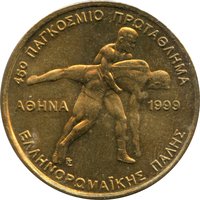
Commemoration: 45th Championship of Greco-Roman Wrestling 1999 in Athens
Greece
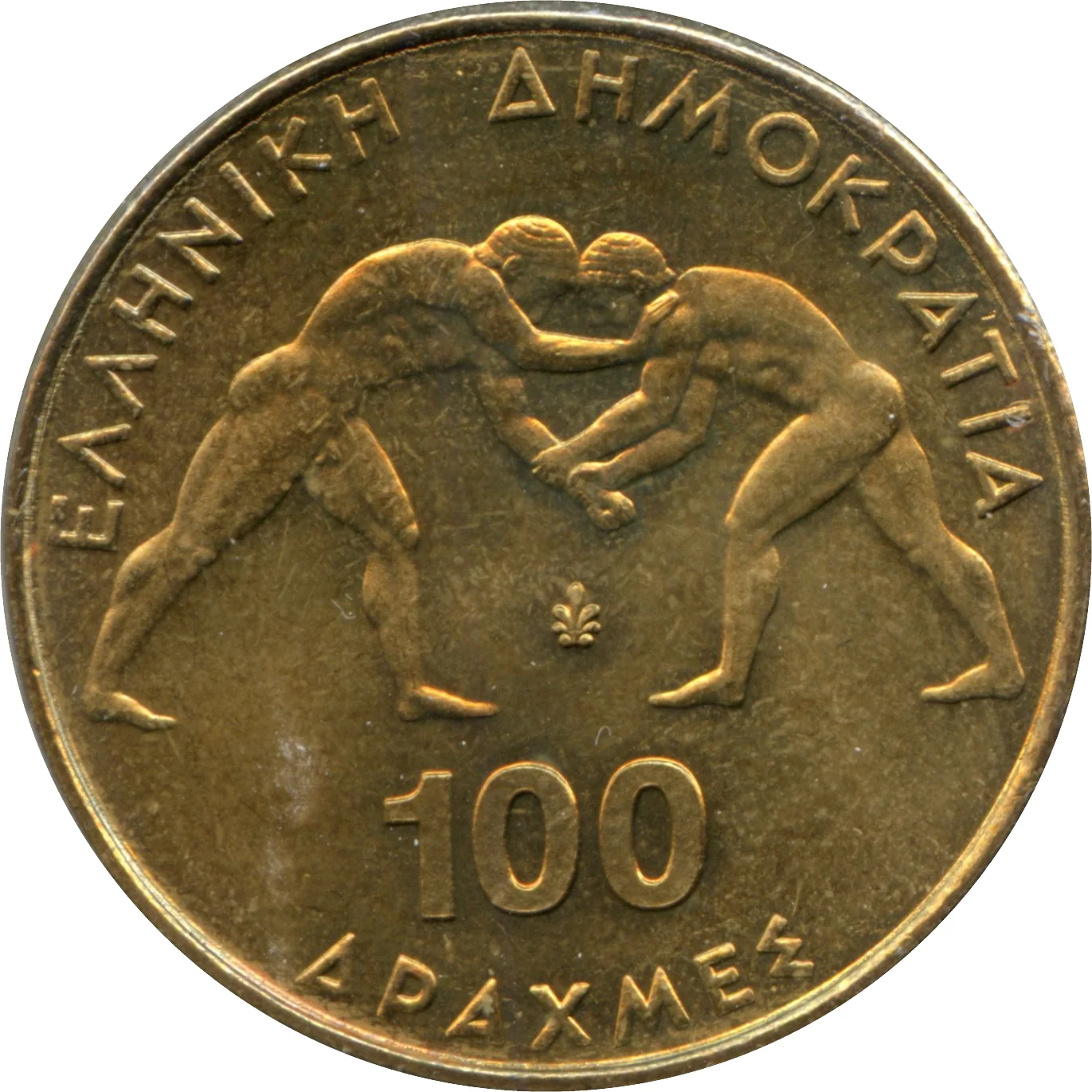
Obverse
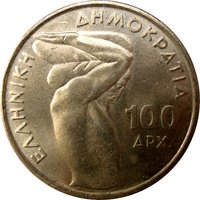
Description:
Wrestlers face off
Inscription:
ΕΛΛΗΝΙΚΗ ΔΗΜΟΚΡΑΤΙΑ
100
ΔΡΑΧΜΕΣ
100
ΔΡΑΧΜΕΣ
Translation:
HELLENIC REPUBLIC
100
DRACHMAS
100
DRACHMAS
Script: Greek
Language: Greek
Engraver: Geórgios Stamatópoulos
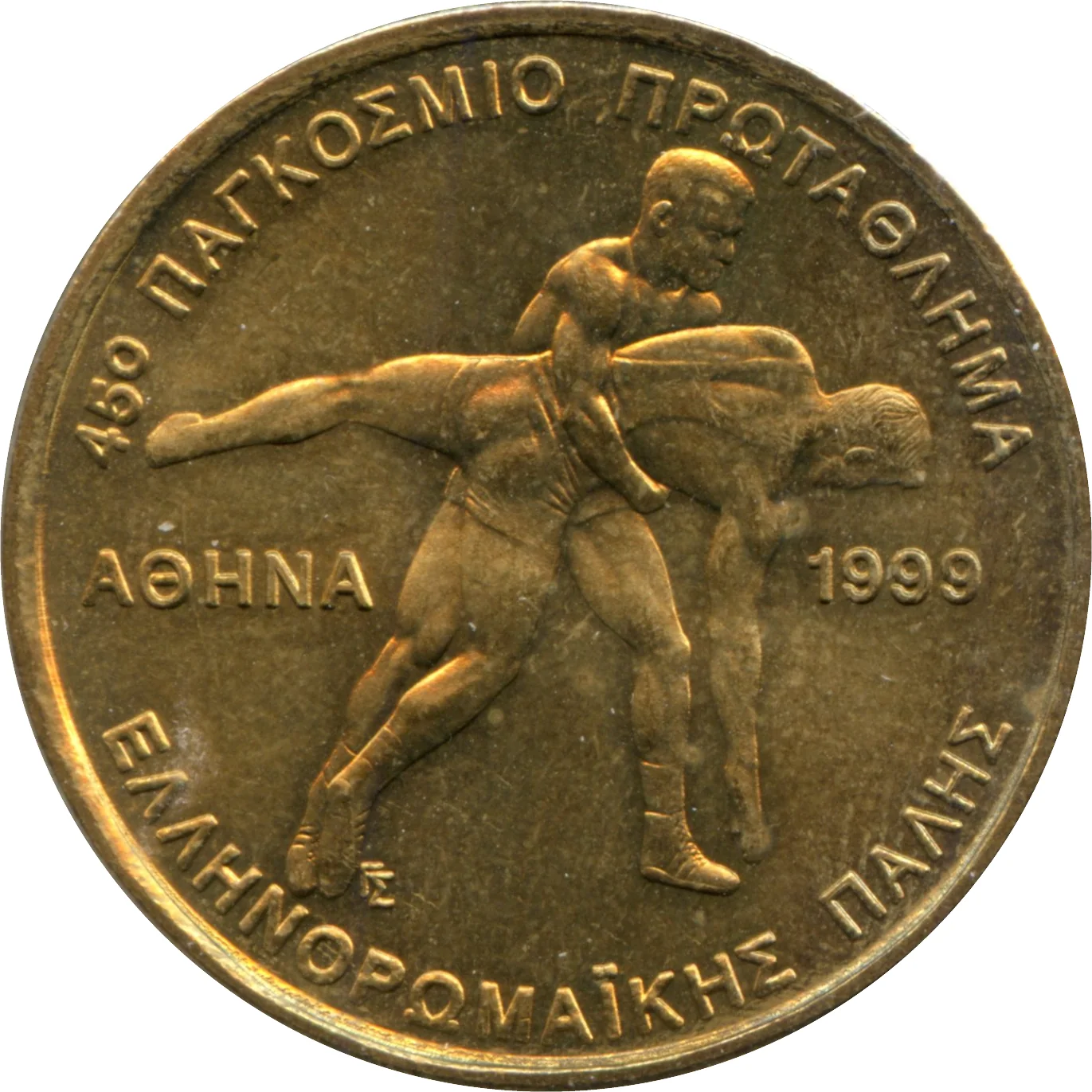
Reverse
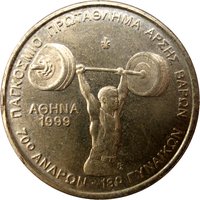
Description:
Throwing an opponent.
Inscription:
45Ο ΠΑΓΚΟΣΜΙΟ ΠΡΩΤΑΘΛΗΜΑ
ΑΘΗΝΑ 1999
ΓΣ
ΕΛΛΗΝΟΡΩΜΑΪΚΗΣ ΠΑΛΗΣ
ΑΘΗΝΑ 1999
ΓΣ
ΕΛΛΗΝΟΡΩΜΑΪΚΗΣ ΠΑΛΗΣ
Translation:
45th World Championship
Athens 1999
GS
Greco-Roman Wrestling
Athens 1999
GS
Greco-Roman Wrestling
Script: Greek
Language: Greek
Engraver: Geórgios Stamatópoulos
Edge
Alternating smooth and reeded segments
Categories
| Sport> Boxing or wrestling |
Mints
| Name | Mark |
|---|---|
| National Mint of the Bank of Greece | — |
Mintings
| Year | Mint Mark | Mintage | Quality | Collection |
|---|---|---|---|---|
| 1999 | — | — |
Historical background
In 1999, Greece's currency situation was defined by its determined but unfulfilled push to join the newly launched Eurozone. While eleven other European Union members, including economic powerhouses like Germany and France, adopted the euro as their common currency on January 1st, Greece was conspicuously absent. This exclusion was a direct result of its failure to meet the strict convergence criteria (the Maastricht Treaty criteria) for inflation rates, budget deficits, public debt, interest rates, and exchange rate stability. Greece's economy was still grappling with the structural reforms needed to align with the stability-oriented policies of the European Central Bank.
The primary obstacle was Greece's high public debt, which far exceeded the Maastricht limit of 60% of GDP, and its history of fiscal deficits. Throughout the 1990s, successive Greek governments had implemented austerity measures and economic reforms with the singular political goal of euro adoption. However, by 1999, the country's economic data, as reported to the EU, was still not deemed sufficient. Consequently, the Greek drachma remained the national currency, though it was now part of the new Exchange Rate Mechanism II (ERM II), which pegged it to the euro with a central rate. This was a mandatory "waiting room" designed to ensure exchange rate stability before full euro membership.
The year 1999, therefore, was one of intense preparation and renewed commitment for Greece. The government, led by Prime Minister Costas Simitis, redoubled its efforts to tighten fiscal policy, curb inflation, and accelerate privatization. Crucially, a major statistical revision was underway that would, by 2000, retrospectively show Greece had met the deficit criterion in 1999. This controversial data revision paved the way for the European Council to grant Greece membership in June 2000, setting the stage for its formal adoption of the euro on January 1, 2001, with euro banknotes and coins entering circulation a year later.
The primary obstacle was Greece's high public debt, which far exceeded the Maastricht limit of 60% of GDP, and its history of fiscal deficits. Throughout the 1990s, successive Greek governments had implemented austerity measures and economic reforms with the singular political goal of euro adoption. However, by 1999, the country's economic data, as reported to the EU, was still not deemed sufficient. Consequently, the Greek drachma remained the national currency, though it was now part of the new Exchange Rate Mechanism II (ERM II), which pegged it to the euro with a central rate. This was a mandatory "waiting room" designed to ensure exchange rate stability before full euro membership.
The year 1999, therefore, was one of intense preparation and renewed commitment for Greece. The government, led by Prime Minister Costas Simitis, redoubled its efforts to tighten fiscal policy, curb inflation, and accelerate privatization. Crucially, a major statistical revision was underway that would, by 2000, retrospectively show Greece had met the deficit criterion in 1999. This controversial data revision paved the way for the European Council to grant Greece membership in June 2000, setting the stage for its formal adoption of the euro on January 1, 2001, with euro banknotes and coins entering circulation a year later.
🌱 Very Common