

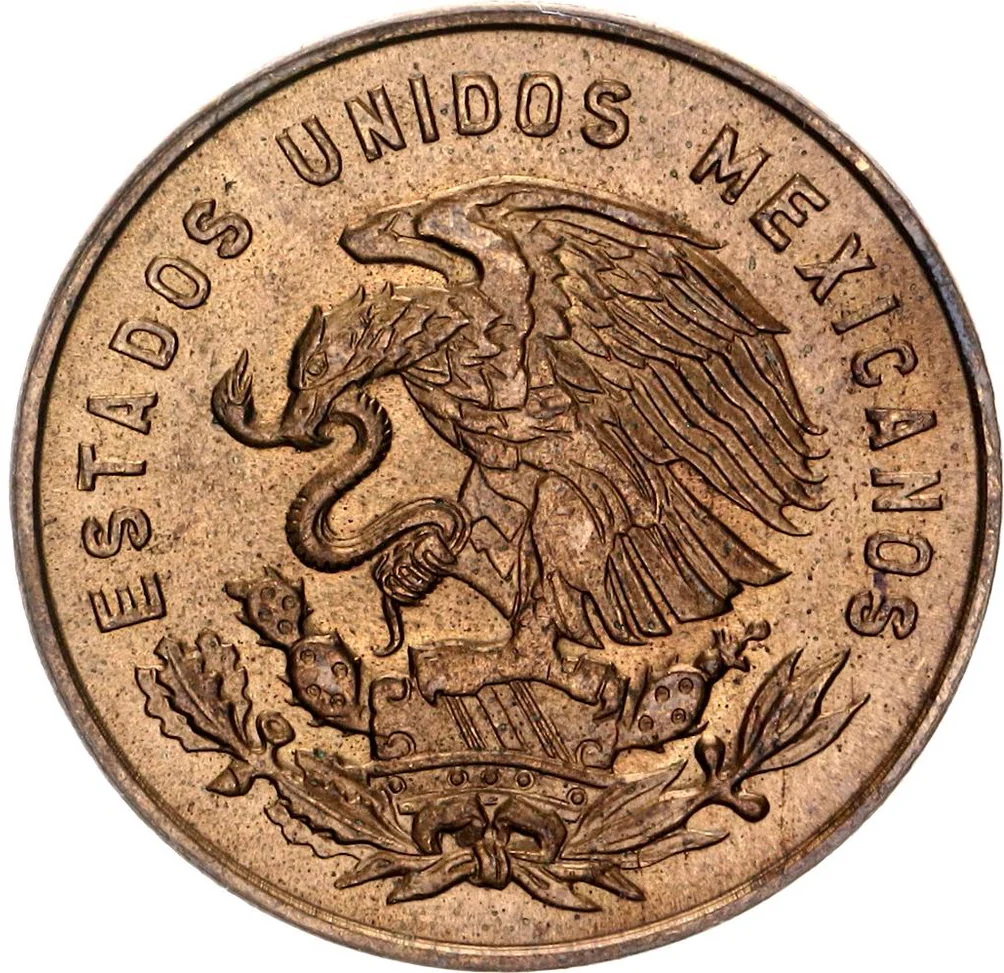
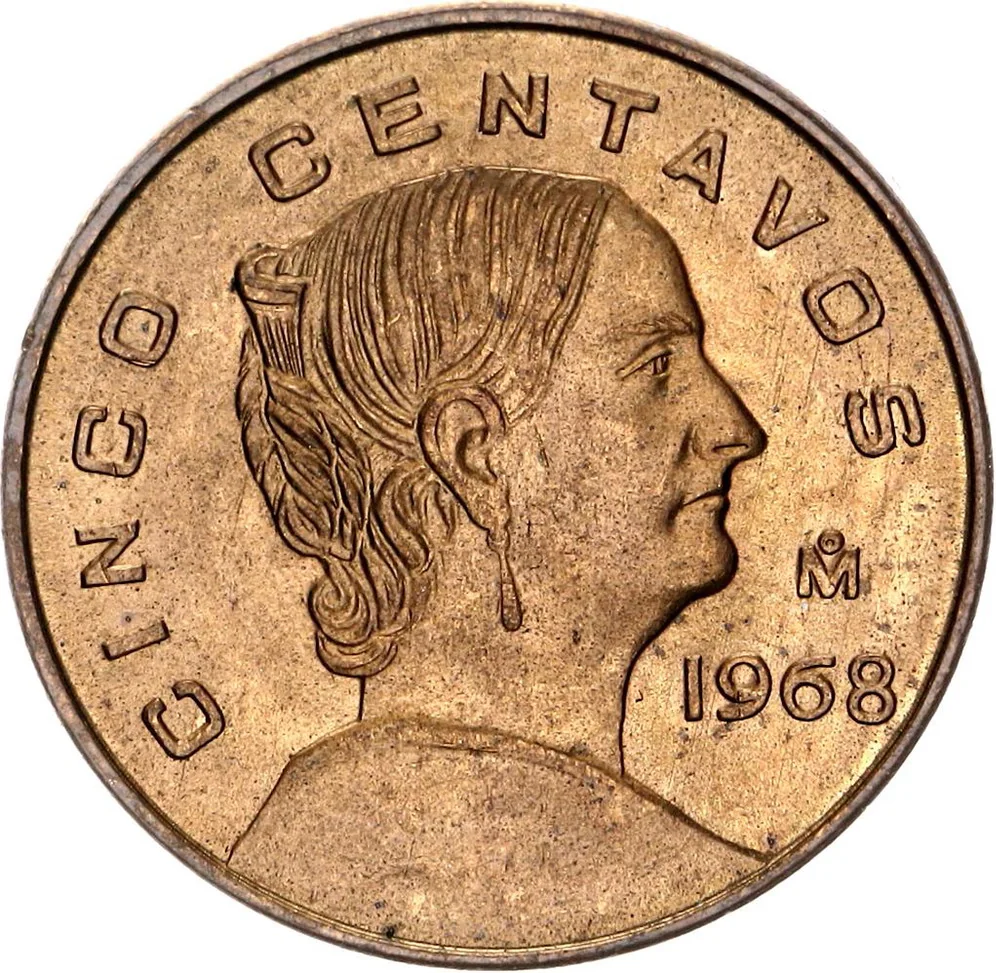
5 centavos – Mexico
Add to wishlist
Mexico
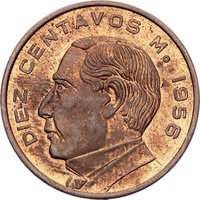
Obverse
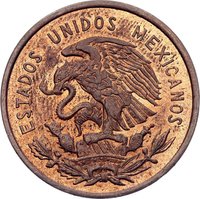
Reverse
Edge
Plain
Mints
| Name | Mark |
|---|---|
| Mexican Mint | Mo |
Mintings
| Year | Mint Mark | Mintage | Quality | Collection |
|---|---|---|---|---|
| 1954 | Mo | — | ||
| 1955 | Mo | 12,136,000 | ||
| 1956 | Mo | 60,216,000 | ||
| 1957 | Mo | 55,288,000 | ||
| 1958 | Mo | 104,624,000 | ||
| 1959 | Mo | 106,000,000 | ||
| 1960 | Mo | 99,144,000 | ||
| 1961 | Mo | 61,136,000 | ||
| 1962 | Mo | 47,232,000 | ||
| 1963 | Mo | 156,680,000 | ||
| 1964 | Mo | 71,168,000 | ||
| 1965 | Mo | 155,720,000 | ||
| 1966 | Mo | 124,944,000 | ||
| 1967 | Mo | 118,816,000 | ||
| 1968 | Mo | 189,588,000 | ||
| 1969 | Mo | 210,492,000 |
Historical background
In 1954, Mexico faced a severe currency crisis rooted in persistent balance of payments deficits and a loss of confidence in the peso. Following World War II, the government of President Miguel Alemán (1946-1952) had pursued aggressive industrialization and infrastructure spending, financed largely by borrowing and monetary expansion. This led to high inflation, which the government tried to control through a fixed exchange rate of 8.65 pesos per U.S. dollar, established in 1949. However, the overvalued peso made Mexican exports expensive and encouraged imports, draining foreign reserves and creating a unsustainable economic imbalance.
The situation came to a head under President Adolfo Ruiz Cortines. By early 1954, Mexico's foreign exchange reserves were nearly exhausted, and speculative pressure against the peso intensified. Despite assurances from the government that a devaluation would not occur, the economic fundamentals made it inevitable. On April 17, 1954, the Mexican government announced a sharp, one-time devaluation, moving the fixed rate to 12.50 pesos per dollar—a devaluation of approximately 44%. This decisive action was intended to resolve the crisis permanently and restore stability.
The 1954 devaluation proved to be a pivotal and successful economic adjustment. By making Mexican goods more competitive, it corrected the external imbalance and laid the groundwork for a period of sustained growth known as "Desarrollo Stabilizador" (Stabilizing Development). For the next 22 years, the peso maintained its fixed parity at 12.50 to the dollar, becoming a symbol of Mexico's economic stability and a key anchor for the country's remarkable industrial expansion during the 1950s and 1960s.
The situation came to a head under President Adolfo Ruiz Cortines. By early 1954, Mexico's foreign exchange reserves were nearly exhausted, and speculative pressure against the peso intensified. Despite assurances from the government that a devaluation would not occur, the economic fundamentals made it inevitable. On April 17, 1954, the Mexican government announced a sharp, one-time devaluation, moving the fixed rate to 12.50 pesos per dollar—a devaluation of approximately 44%. This decisive action was intended to resolve the crisis permanently and restore stability.
The 1954 devaluation proved to be a pivotal and successful economic adjustment. By making Mexican goods more competitive, it corrected the external imbalance and laid the groundwork for a period of sustained growth known as "Desarrollo Stabilizador" (Stabilizing Development). For the next 22 years, the peso maintained its fixed parity at 12.50 to the dollar, becoming a symbol of Mexico's economic stability and a key anchor for the country's remarkable industrial expansion during the 1950s and 1960s.
🌱 Very Common