

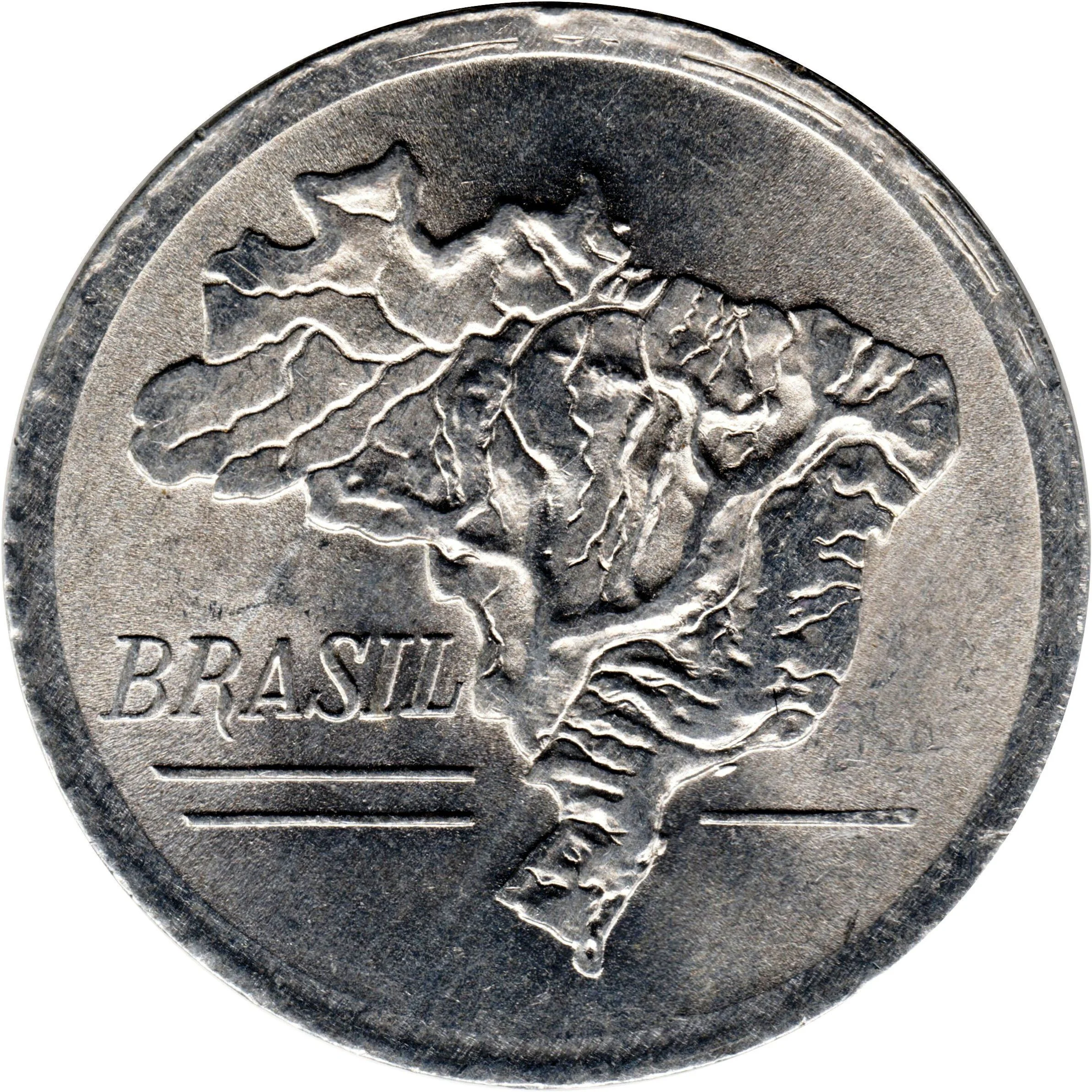

20 cruzeiros – Brazil
Add to wishlist
Brazil


Obverse
Description:
Brazil topographic map.
Inscription:
BRASIL
Translation:
BRASIL
Script: Latin
Language: Portuguese
Reverse
Edge
Plain
Categories
| Map |
Mints
| Name | Mark |
|---|---|
| Casa da Moeda do Brasil | — |
Mintings
| Year | Mint Mark | Mintage | Quality | Collection |
|---|---|---|---|---|
| 1965 | — | 52,026,000 |
Historical background
By 1965, Brazil was in the midst of a profound economic and political crisis, with its currency, the cruzeiro, at the center of the storm. The period following President João Goulart's overthrow by a military coup in 1964 was characterized by runaway inflation, which had soared to an annual rate of over 90%. This hyperinflation was deeply entrenched, stemming from years of fiscal deficits, expansive monetary policy to finance development, and indexation mechanisms that created a vicious cycle of price adjustments. The currency was rapidly losing its value and function as a reliable store of value, severely distorting the economy and eroding public confidence.
Recognizing that economic stabilization was essential to legitimize the new military regime, the government of President Castelo Branco and his appointed Finance Minister, Otávio Gouveia de Bulhões, alongside Planning Minister Roberto Campos, embarked on an ambitious stabilization program. The cornerstone of this effort was the 1964-66 PAEG (Plano de Ação Econômica do Governo - Government Economic Action Plan). This orthodox plan combined fiscal austerity, tax reforms, and wage controls with a critical focus on monetary correction (correção monetária), a formal indexation system designed to mitigate the pernicious effects of inflation on contracts and financial markets.
Therefore, the currency situation in 1965 was one of controlled transition amidst severe instability. While the cruzeiro's purchasing power continued to fall dramatically in the marketplace, the government was aggressively implementing the institutional frameworks of the PAEG to attack the root causes of inflation. The success of these measures was not yet evident to the average citizen facing high prices, but the regime was laying the groundwork for the "Brazilian Miracle" of high growth that would follow in the late 1960s, albeit at the cost of increased foreign debt and deepened social inequality.
Recognizing that economic stabilization was essential to legitimize the new military regime, the government of President Castelo Branco and his appointed Finance Minister, Otávio Gouveia de Bulhões, alongside Planning Minister Roberto Campos, embarked on an ambitious stabilization program. The cornerstone of this effort was the 1964-66 PAEG (Plano de Ação Econômica do Governo - Government Economic Action Plan). This orthodox plan combined fiscal austerity, tax reforms, and wage controls with a critical focus on monetary correction (correção monetária), a formal indexation system designed to mitigate the pernicious effects of inflation on contracts and financial markets.
Therefore, the currency situation in 1965 was one of controlled transition amidst severe instability. While the cruzeiro's purchasing power continued to fall dramatically in the marketplace, the government was aggressively implementing the institutional frameworks of the PAEG to attack the root causes of inflation. The success of these measures was not yet evident to the average citizen facing high prices, but the regime was laying the groundwork for the "Brazilian Miracle" of high growth that would follow in the late 1960s, albeit at the cost of increased foreign debt and deepened social inequality.

🌱 Very Common