

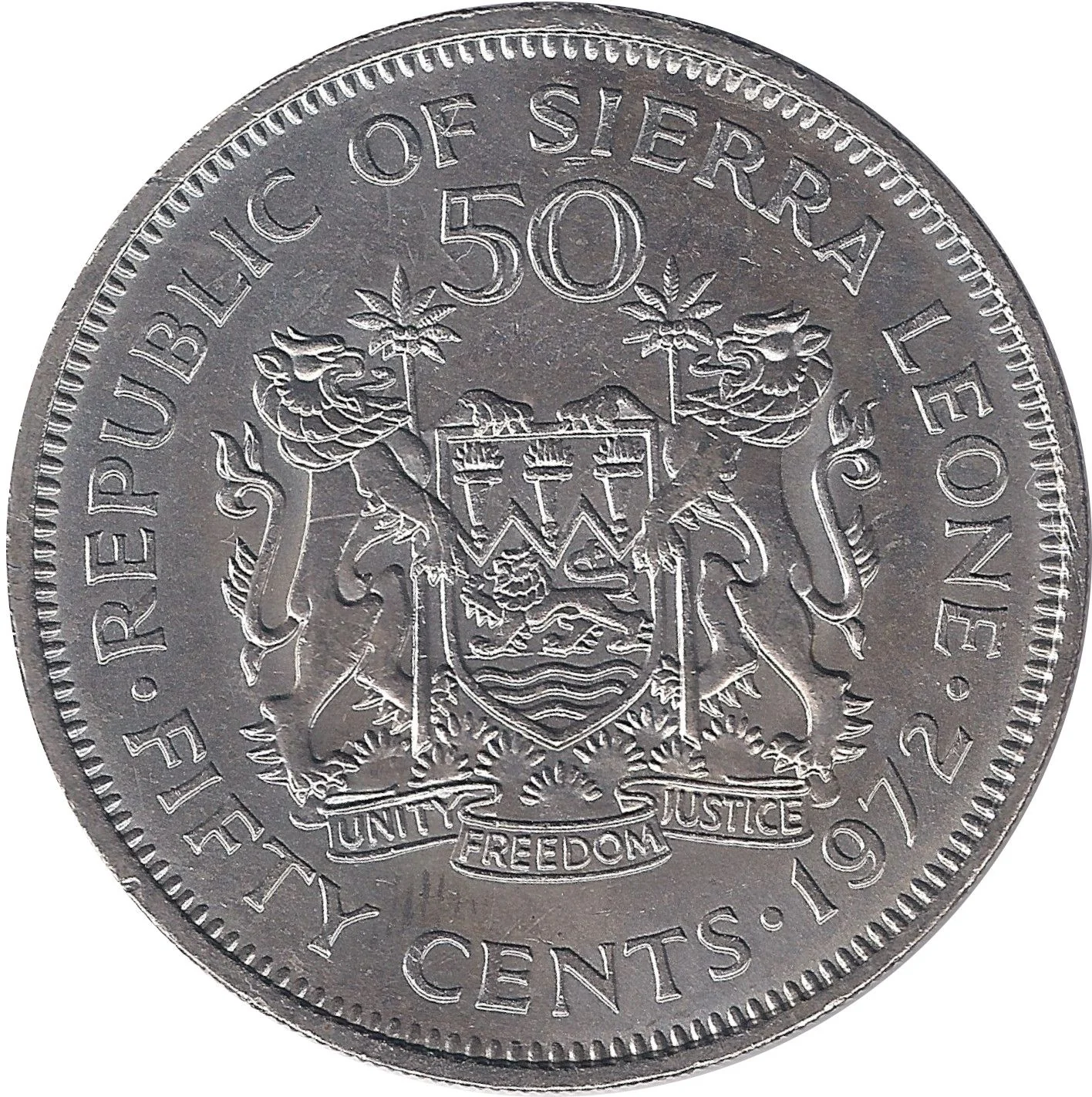
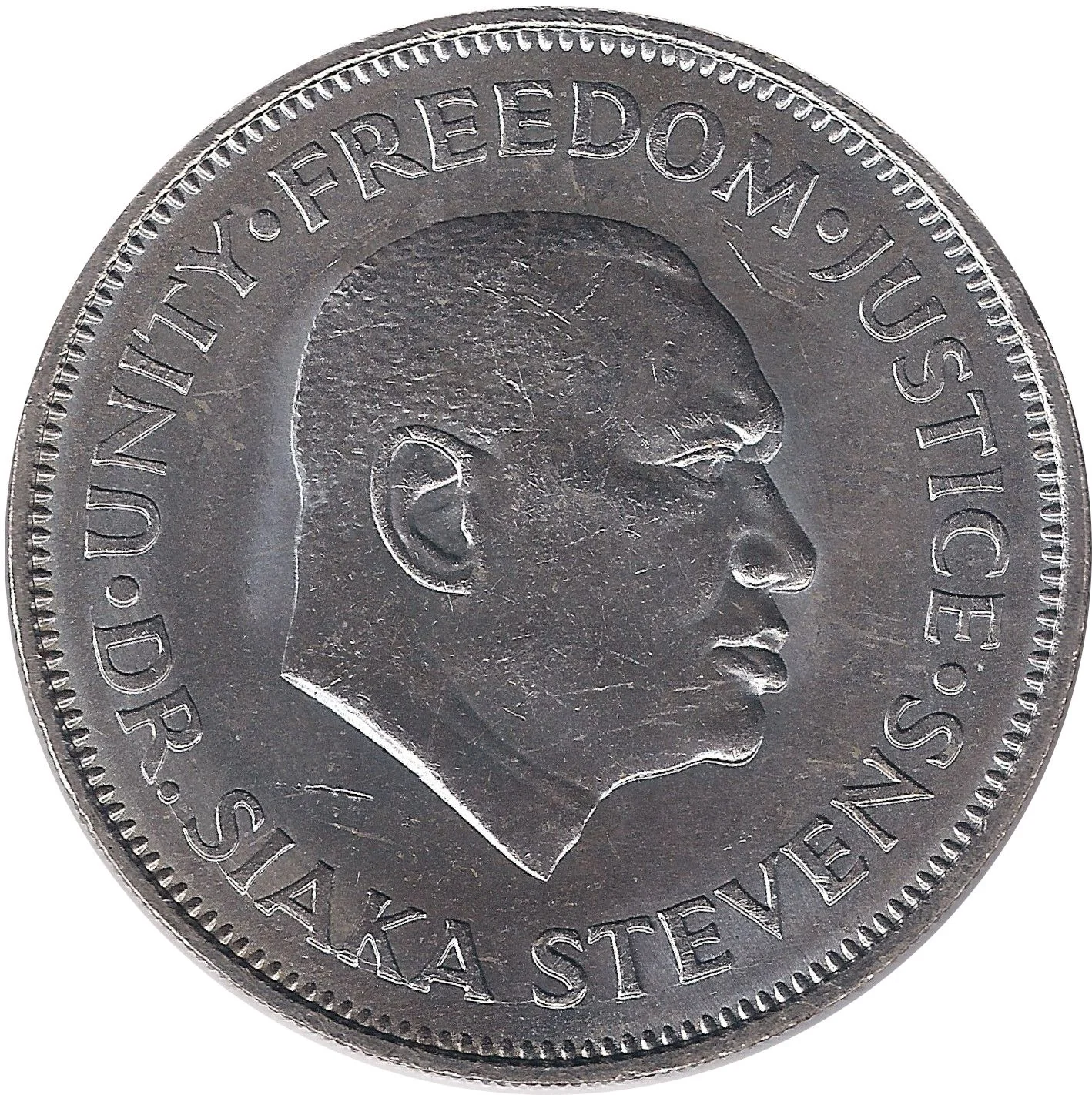
50 Cents – Sierra Leone
Sierra Leone
Context
Years: 1972–1984
Issuer: Sierra Leone 
Ruler: Siaka Stevens
Currency:
(1964—2023)
Demonetization: 1 January 2024
Total mintage: 1,012,000
Material
References
KM: #Click to copy to clipboard25
Numista: #11546
Value
Exchange value: 0.50 SLL
Obverse
Inscription:
REPUBLIC OF SIERRA LEONE
50 FIFTY CENTS.1972
50 FIFTY CENTS.1972
Script: Latin
Reverse
Inscription:
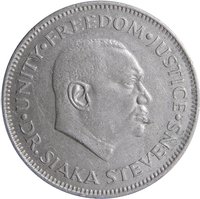
.UNITY.FREEDOM.JUSTICE.
DR.SIAKA STEVENS
DR.SIAKA STEVENS
Script: Latin
Edge
Milled
Categories
| Person> Politician |
| Symbols> Coat of Arms |
| Animal> Feline |
Mints
| Name | Mark |
|---|---|
| Royal Mint | — |
Mintings
| Year | Mint Mark | Mintage | Quality | Collection |
|---|---|---|---|---|
| 1972 | — | 1,000,000 | ||
| 1972 | — | 2,000 | Proof | |
| 1980 | — | — | ||
| 1980 | — | 10,000 | Proof | |
| 1984 | — | — |
Historical background
In 1972, Sierra Leone's currency situation was defined by its recent transition to a decimalized system and the establishment of the Leone as its sole legal tender. Just two years prior, in 1970, the country had introduced decimal coins to replace the old British West African pound system, which had been in use since colonial times. This shift to the Leone (divided into 100 cents) was a symbolic assertion of economic sovereignty following independence in 1961, creating a distinct national monetary identity separate from the broader West African currency board.
Economically, the early 1970s presented challenges. Sierra Leone's economy remained heavily dependent on the export of diamonds and iron ore, making it vulnerable to volatile global commodity prices. While the currency itself was stable in the immediate sense, underlying pressures were building. The government of Prime Minister Siaka Stevens, who had consolidated power, was increasing public spending, which would later contribute to inflationary pressures and foreign exchange shortages. The Leone was pegged to a basket of currencies, but the reliance on a narrow export base and growing fiscal deficits were early warning signs for future instability.
Furthermore, 1972 fell within a period of significant political change that would soon impact monetary policy. That very year, Sierra Leone was declared a republic, with Stevens becoming its first executive president. This centralization of power set the stage for the economic policies of the subsequent decade, including greater state intervention. While no major currency crisis occurred in 1972 itself, the year represents a calm before the storm, as the foundational vulnerabilities of a resource-dependent economy and expanding state control began to align, foreshadowing the depreciation and economic difficulties the Leone would face in the late 1970s and 1980s.
Economically, the early 1970s presented challenges. Sierra Leone's economy remained heavily dependent on the export of diamonds and iron ore, making it vulnerable to volatile global commodity prices. While the currency itself was stable in the immediate sense, underlying pressures were building. The government of Prime Minister Siaka Stevens, who had consolidated power, was increasing public spending, which would later contribute to inflationary pressures and foreign exchange shortages. The Leone was pegged to a basket of currencies, but the reliance on a narrow export base and growing fiscal deficits were early warning signs for future instability.
Furthermore, 1972 fell within a period of significant political change that would soon impact monetary policy. That very year, Sierra Leone was declared a republic, with Stevens becoming its first executive president. This centralization of power set the stage for the economic policies of the subsequent decade, including greater state intervention. While no major currency crisis occurred in 1972 itself, the year represents a calm before the storm, as the foundational vulnerabilities of a resource-dependent economy and expanding state control began to align, foreshadowing the depreciation and economic difficulties the Leone would face in the late 1970s and 1980s.
🌱 Fairly Common