

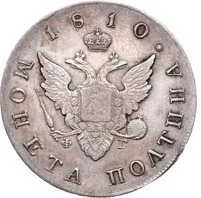
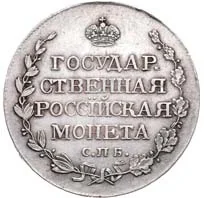
1 poltina – Russian Empire
Add to wishlist
Russia
Context
Years: 1809–1810
Country: Russia
Issuer: Russian Empire
Ruler: Alexander I
Currency:
(1700—1917)
Demonetized: Yes
Total mintage: 89,759
Material
References
Numista: #95146
Value
Bullion value: $22.01
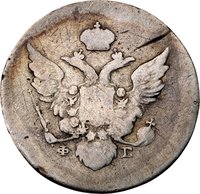
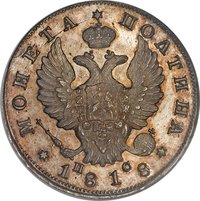
Obverse
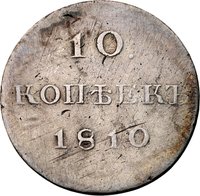
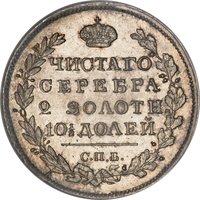
Reverse
Edge
Dotted
Categories
| Symbols> Coat of Arms |
Mints
| Name | Mark |
|---|---|
| Saint Petersburg | С.П.Б. |
Mintings
| Year | Mint Mark | Mintage | Quality | Collection |
|---|---|---|---|---|
| 1809 | СПБ | 11,000 | ||
| 1810 | СПБ | 78,759 |
Historical background
In 1809, the currency system of the Russian Empire was defined by the persistent and severe problem of paper money inflation. Since the reign of Catherine the Great, the state had financed wars and deficits by printing large quantities of assignats, unbacked paper notes nominally exchangeable for copper coin. By 1809, following the costly wars against Napoleonic France and the ongoing conflict with the Ottoman Empire, the volume of assignats in circulation had swollen dramatically, causing their market value to plummet to less than a third of their face value in silver. This created a chaotic dual-system where all significant transactions were calculated in either silver rubles or the depreciated paper assignat rubles, with an unstable exchange rate between them.
Tsar Alexander I and his advisors, notably Minister of Finance Dmitry Guryev, were acutely aware of the crisis, which eroded state finances, hindered trade, and caused economic instability. The year 1809 itself was a pivotal moment of contemplation and proposed reform. Influenced by his liberal advisor Mikhail Speransky, who presented his "Plan of Finance" in that year, the Tsar's government seriously considered a radical return to a metallic standard to restore confidence. Speransky's plan called for the stabilization of the assignat and its eventual conversion into credit notes backed by silver, a foundational idea for future reforms.
However, the immediate political and military pressures of the Napoleonic Wars ultimately postponed any decisive action. While the government ceased increasing the assignat issue in 1810 and made attempts to fund the treasury via loans and taxes, a full monetary reform would not be realized until the later reign of Nicholas I in the 1830s and 1840s. Thus, in 1809, the Empire remained trapped in a state of monetary dysfunction, with a clear recognition of the problem but with the comprehensive solution deferred by the exigencies of continental conflict.
Tsar Alexander I and his advisors, notably Minister of Finance Dmitry Guryev, were acutely aware of the crisis, which eroded state finances, hindered trade, and caused economic instability. The year 1809 itself was a pivotal moment of contemplation and proposed reform. Influenced by his liberal advisor Mikhail Speransky, who presented his "Plan of Finance" in that year, the Tsar's government seriously considered a radical return to a metallic standard to restore confidence. Speransky's plan called for the stabilization of the assignat and its eventual conversion into credit notes backed by silver, a foundational idea for future reforms.
However, the immediate political and military pressures of the Napoleonic Wars ultimately postponed any decisive action. While the government ceased increasing the assignat issue in 1810 and made attempts to fund the treasury via loans and taxes, a full monetary reform would not be realized until the later reign of Nicholas I in the 1830s and 1840s. Thus, in 1809, the Empire remained trapped in a state of monetary dysfunction, with a clear recognition of the problem but with the comprehensive solution deferred by the exigencies of continental conflict.
✨ Legendary