

200000 Zlotys – Poland
Poland

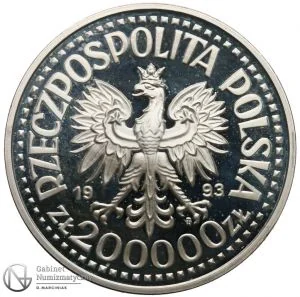
Obverse
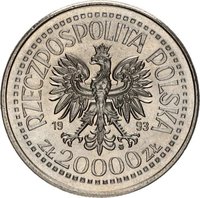
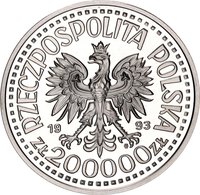
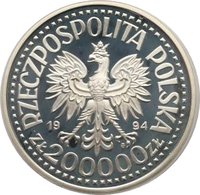
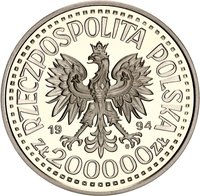
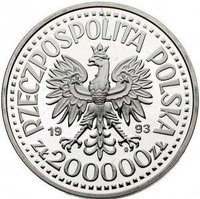
Inscription:
RZECZPOSPOLITA POLSKA
1993
mw
ZŁ 200000 ZŁ
1993
mw
ZŁ 200000 ZŁ
Translation:
REPUBLIC OF POLAND
1993
mw
200000 ZŁOTYCH
1993
mw
200000 ZŁOTYCH
Script: Latin
Language: Polish
Designer: Ewa Tyc-Karpińska
Reverse
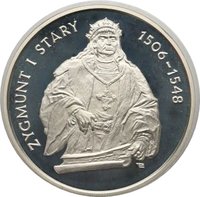
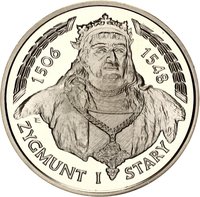
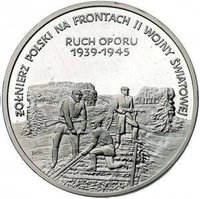
Inscription:
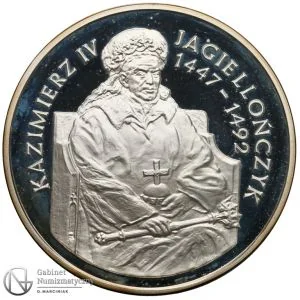
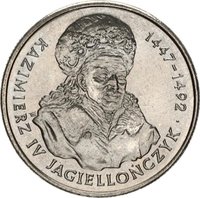
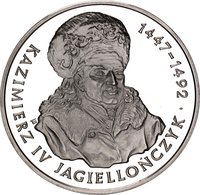
KAZIMIERZ IV JAGIELLOŃCZYK
1447-1492
1447-1492
Translation:
CASIMIR IV JAGIELLON
1447-1492
1447-1492
Script: Latin
Language: Polish
Designer: Ewa Tyc-Karpińska
Edge
Plain
Mints
| Name | Mark |
|---|---|
| Mint of Poland | (MW) |
Mintings
| Year | Mint Mark | Mintage | Quality | Collection |
|---|---|---|---|---|
| 1993 | MW | 5,000 | Proof |
Historical background
In 1993, Poland was in the midst of a transformative yet challenging period following its "shock therapy" economic reforms initiated in 1990. The currency, the złoty (PLN), was no longer subject to hyperinflation, which had been tamed from a peak of over 600% in 1990 to a more manageable, though still high, annual rate of approximately 35% in 1993. However, the economy was grappling with the social costs of the transition, including rising unemployment and industrial restructuring, which placed pressure on the currency's stability and the government's monetary policy.
A key feature of the currency situation was the managed float exchange rate regime. Since 1991, the National Bank of Poland (NBP) had operated a "crawling peg" system, where the złoty was devalued against a basket of currencies (primarily the US dollar and German mark) at a pre-announced, gradually declining monthly rate (around 1.5% per month in early 1993). This policy aimed to provide stability for trade and investment by preventing wild fluctuations, while still allowing for controlled adjustment to account for Poland's higher inflation relative to its trading partners. The stability it provided was crucial for fostering foreign direct investment, which began to trickle in.
Despite these stabilizing measures, 1993 was a year of political and economic tension that impacted currency confidence. A significant conflict emerged between the government of Prime Minister Hanna Suchocka and the NBP under President Hanna Gronkiewicz-Waltz over the pace of disinflation and interest rate policy. The government, facing social unrest, pressured for lower rates to stimulate growth, while the central bank prioritized tightening to further curb inflation and protect the złoty's value. This struggle highlighted the delicate balance between monetary discipline and political pressures, setting the stage for further institutional reforms, including granting the NBP greater independence in 1997.
A key feature of the currency situation was the managed float exchange rate regime. Since 1991, the National Bank of Poland (NBP) had operated a "crawling peg" system, where the złoty was devalued against a basket of currencies (primarily the US dollar and German mark) at a pre-announced, gradually declining monthly rate (around 1.5% per month in early 1993). This policy aimed to provide stability for trade and investment by preventing wild fluctuations, while still allowing for controlled adjustment to account for Poland's higher inflation relative to its trading partners. The stability it provided was crucial for fostering foreign direct investment, which began to trickle in.
Despite these stabilizing measures, 1993 was a year of political and economic tension that impacted currency confidence. A significant conflict emerged between the government of Prime Minister Hanna Suchocka and the NBP under President Hanna Gronkiewicz-Waltz over the pace of disinflation and interest rate policy. The government, facing social unrest, pressured for lower rates to stimulate growth, while the central bank prioritized tightening to further curb inflation and protect the złoty's value. This struggle highlighted the delicate balance between monetary discipline and political pressures, setting the stage for further institutional reforms, including granting the NBP greater independence in 1997.
Series: Polish Rulers
✨ Legendary