

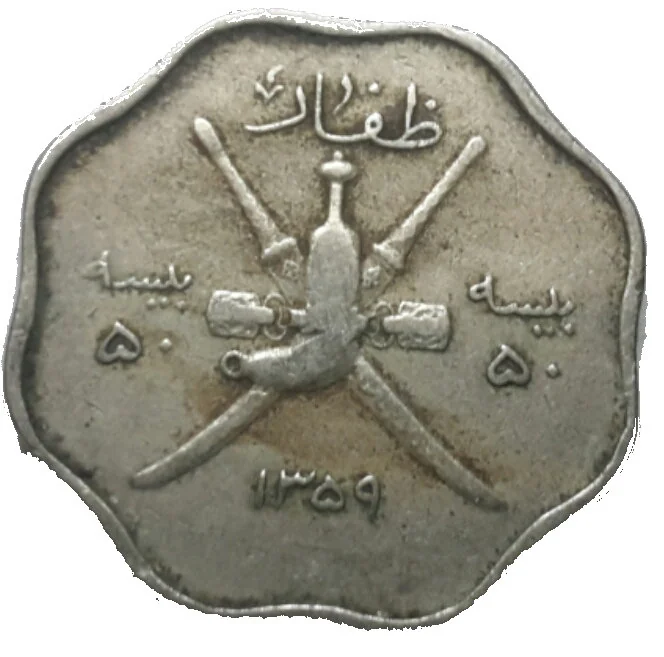
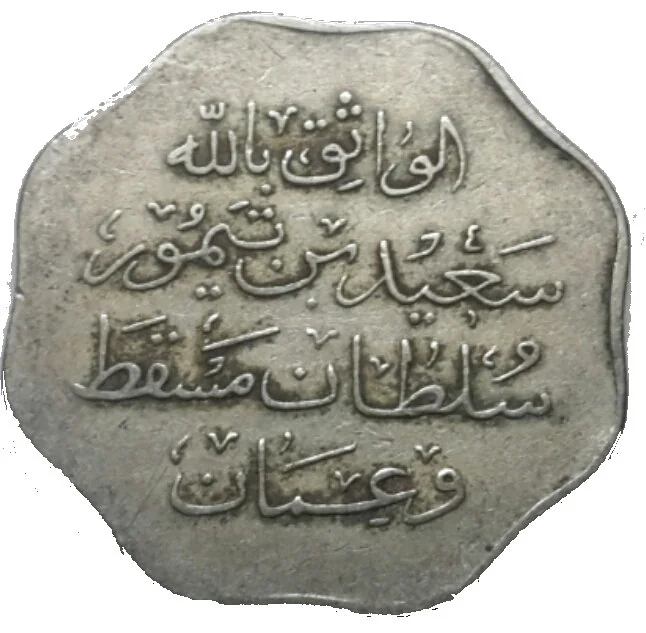
50 baisa – Dhofar Governorate
Add to wishlist
Oman
Context
Year: 1940
Islamic (Hijri) Year:: 1359
Country: Oman
Issuer: Dhofar Governorate
Ruler: Said bin Taimur
Currency:
(1940—1970)
Demonetized: Yes
Material
Diameter: 25.2 mm
Weight: 7.68 g
Thickness: 2.1 mm
Shape: Octagonal
Composition: Copper-nickel
Standard: Silver quarter ounce
Technique: Milled
Alignment: Medal alignment
flip
References
KM: #
Numista: #94164
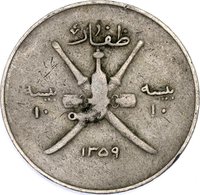
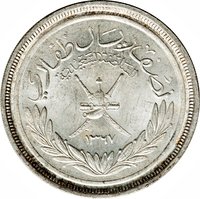
Obverse
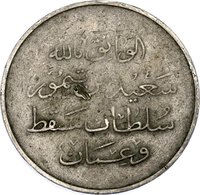
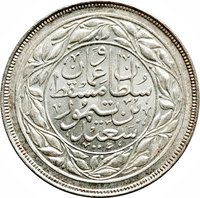
Reverse
Edge
Plain
Categories
| Symbols> Coat of Arms |
| Object> Cold weapons |
Mintings
| Year | Mint Mark | Mintage | Quality | Collection |
|---|---|---|---|---|
| 1940 | — | — | ||
| 1940 | — | — | Proof |
Historical background
In the early 1940s, the currency situation in Dhofar Governorate reflected its unique political and economic position within the wider Arabian context. Unlike northern Oman, which was more directly influenced by the Indian rupee due to its maritime trade with British India, Dhofar was a remote and largely autonomous region under the control of the Sultan of Muscat and Oman. Its economy was predominantly pastoral and subsistence-based, with a significant portion of its income derived from the annual monsoon (khareef) that allowed for agriculture and the export of valuable frankincense. Monetary transactions were limited, and the local economy still relied heavily on barter, particularly for everyday goods and services within tribal communities.
The primary circulating currencies were a heterogeneous mix, mirroring Dhofar's trade connections. The Maria Theresa Thaler (MTT), a large silver coin first minted in the 18th century, remained a trusted store of value and a key medium for larger transactions and savings, prized for its consistent silver content. Alongside it, the Indian rupee was present due to the broader British political and economic influence in the Gulf and the Sultanate's treaties with Britain. Other silver coins, such as the British sovereign and various older Arabian and Ottoman coins, also circulated. There was no formal banking system, and exchange rates were fluid, often determined by merchants in the coastal towns like Salalah based on weight and purity of metal.
This monetary patchwork was further complicated by the global events of World War II. While Dhofar was far from the main theaters of war, the conflict disrupted regional trade routes and the availability of specie. The British government, seeking to stabilize the economies of areas within its sphere of influence, introduced the Gulf rupee in the early 1940s as a replacement for the Indian rupee. Although this change was more systematically enforced in the Trucial States and Bahrain, its influence began to extend into the Sultan's territories, including Dhofar, gradually supplanting the older Indian rupee notes. Thus, by 1940, Dhofar stood at a monetary crossroads, with a traditional, silver-based system coexisting with and slowly being supplemented by paper currencies administered by external powers.
The primary circulating currencies were a heterogeneous mix, mirroring Dhofar's trade connections. The Maria Theresa Thaler (MTT), a large silver coin first minted in the 18th century, remained a trusted store of value and a key medium for larger transactions and savings, prized for its consistent silver content. Alongside it, the Indian rupee was present due to the broader British political and economic influence in the Gulf and the Sultanate's treaties with Britain. Other silver coins, such as the British sovereign and various older Arabian and Ottoman coins, also circulated. There was no formal banking system, and exchange rates were fluid, often determined by merchants in the coastal towns like Salalah based on weight and purity of metal.
This monetary patchwork was further complicated by the global events of World War II. While Dhofar was far from the main theaters of war, the conflict disrupted regional trade routes and the availability of specie. The British government, seeking to stabilize the economies of areas within its sphere of influence, introduced the Gulf rupee in the early 1940s as a replacement for the Indian rupee. Although this change was more systematically enforced in the Trucial States and Bahrain, its influence began to extend into the Sultan's territories, including Dhofar, gradually supplanting the older Indian rupee notes. Thus, by 1940, Dhofar stood at a monetary crossroads, with a traditional, silver-based system coexisting with and slowly being supplemented by paper currencies administered by external powers.
💎 Very Rare