

Obverse
Description:
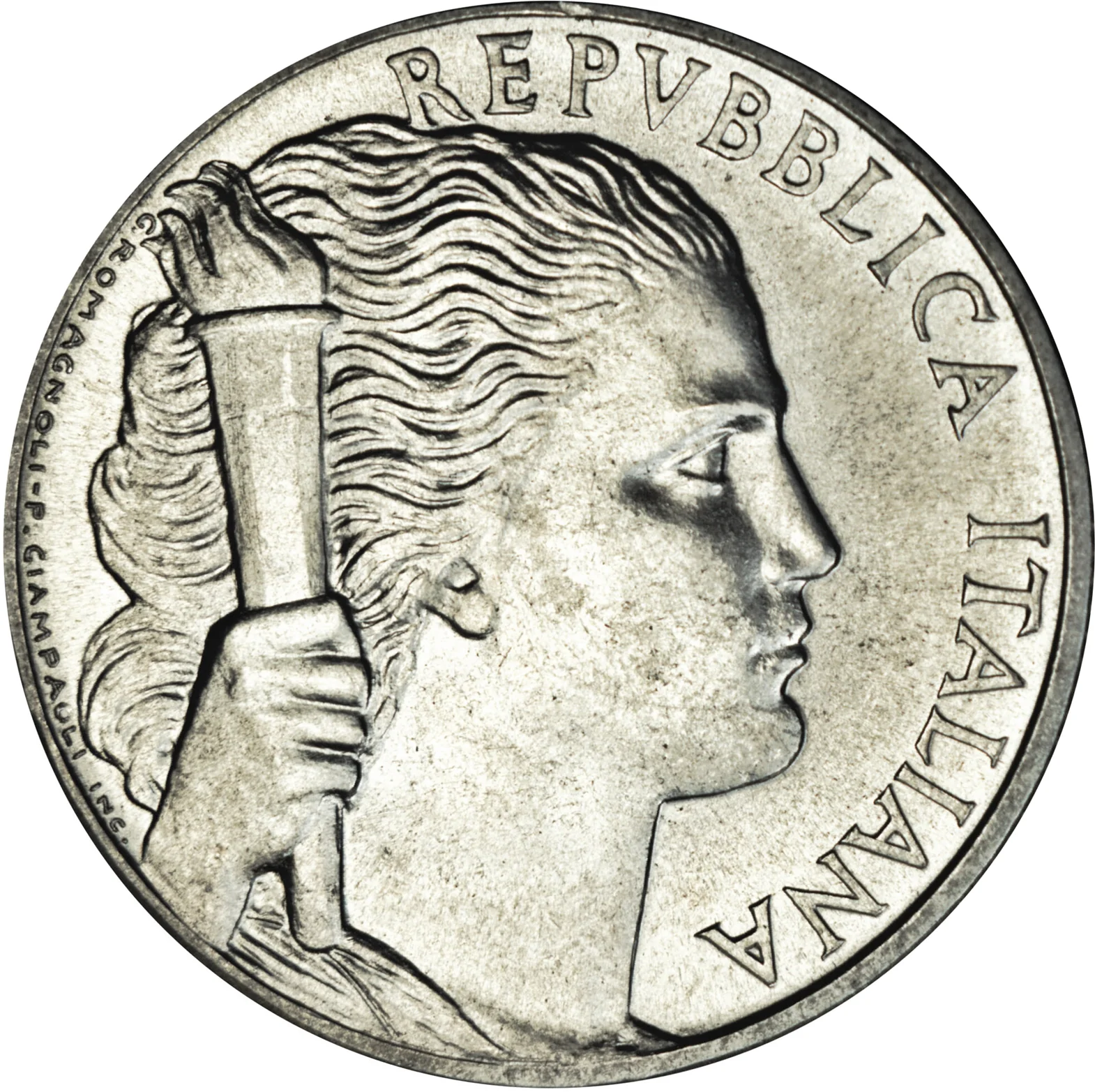
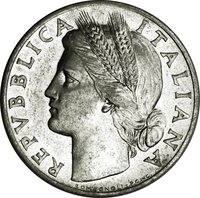
Female head facing right, holding a raised torch. Engraver and designer names below.
Inscription:
REPVBBLICA ITALIANA
G.ROMAGNOLI-P.GIAMPAOLI INC
G.ROMAGNOLI-P.GIAMPAOLI INC
Translation:
Italian Republic
G. Romagnoli - P. Giampaoli Inc.
G. Romagnoli - P. Giampaoli Inc.
Script: Latin
Engraver: Pietro Giampaoli
Designer: Giuseppe Romagnoli
Reverse
Description:
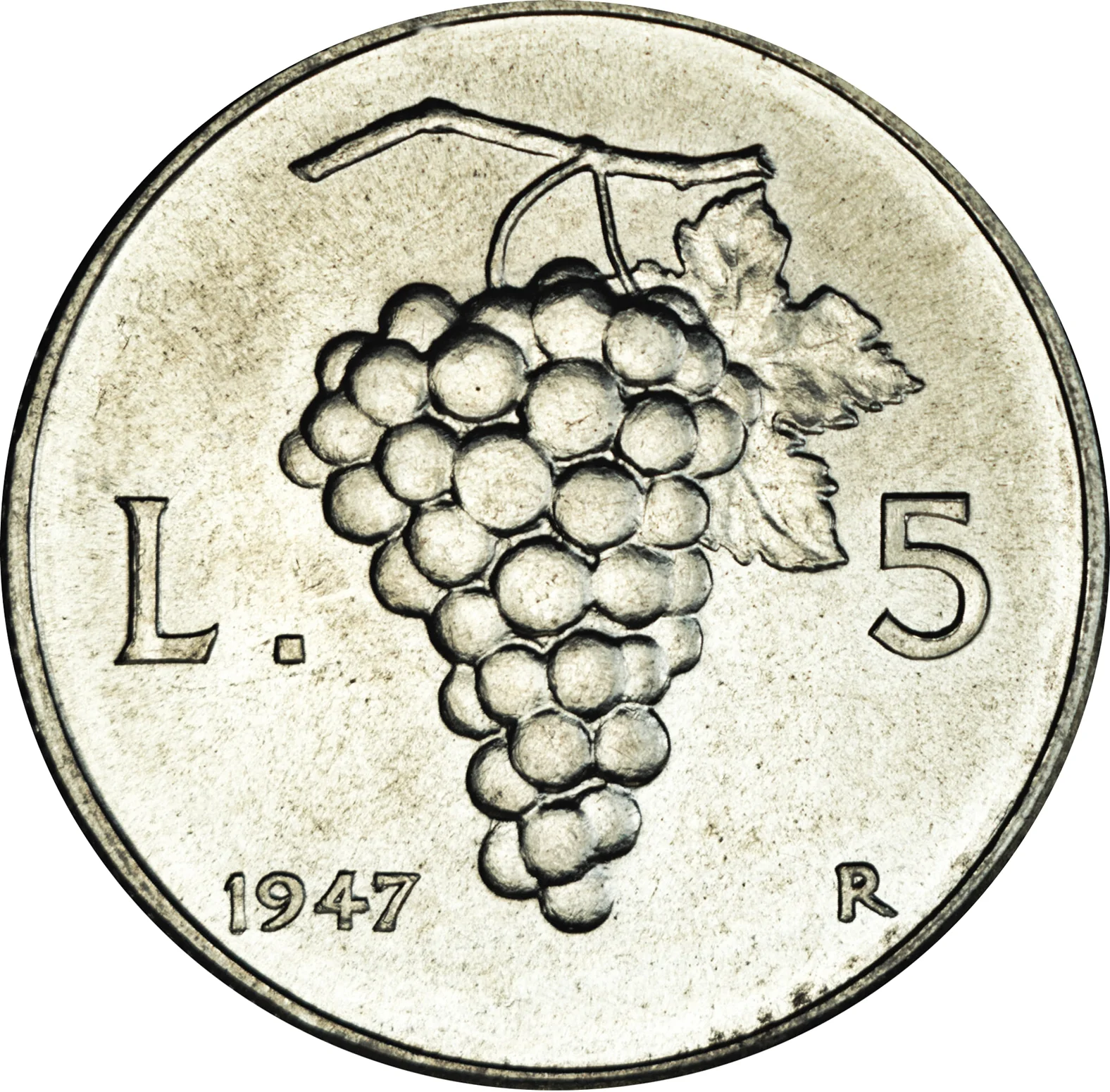
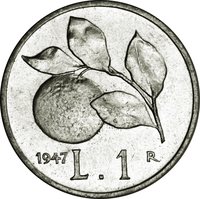
Grape cluster divides value, date, and mintmark.
Inscription:
L.5
1949 R
1949 R
Translation:
Lire 5
Year 1949 Rome
Year 1949 Rome
Script: Latin
Language: Italian
Engraver: Pietro Giampaoli
Designer: Giuseppe Romagnoli
Edge
Reeded
Mints
| Name | Mark |
|---|---|
| Rome | R |
Mintings
Historical background
In 1946, Italy’s currency situation was one of profound instability and transition, a direct legacy of the Second World War and the preceding Fascist regime. The national currency, the lira, had been severely debased by years of deficit financing, occupation, and economic collapse. Wartime inflation ran rampant, with prices in 1945 estimated at over twenty times their 1938 levels. The country was also flooded with Allied Military Currency and a patchwork of occupation notes, while the black market thrived, further undermining official monetary authority and public confidence.
The immediate post-war period saw the provisional government grappling with this crisis through a series of stopgap measures. A critical early step was the "lievitazione" (lifting) in December 1945, a complex operation that froze bank deposits and converted them into new lire at varying rates, effectively a forced currency conversion aimed at mopping up excess liquidity. However, inflation persisted into 1946, eroding savings and wages. The monetary landscape was fragmented, with different regulations sometimes applying in the north and south, reflecting the country's uneven liberation and the challenging task of re-establishing a unified national administration.
Against this turbulent backdrop, 1946 was a pivotal year of foundation. It saw the establishment of the new Republic following the June referendum and the laying of groundwork for future stability. While the famous "quota 90" lira parity was a distant memory, authorities began serious planning for a more definitive monetary reform. This planning would culminate in the 1947 stabilization plan led by Luigi Einaudi and the eventual introduction of the "Italian Republic" series of banknotes, marking the end of the wartime currency chaos and the beginning of the lira's managed integration into the post-war Bretton Woods system.
The immediate post-war period saw the provisional government grappling with this crisis through a series of stopgap measures. A critical early step was the "lievitazione" (lifting) in December 1945, a complex operation that froze bank deposits and converted them into new lire at varying rates, effectively a forced currency conversion aimed at mopping up excess liquidity. However, inflation persisted into 1946, eroding savings and wages. The monetary landscape was fragmented, with different regulations sometimes applying in the north and south, reflecting the country's uneven liberation and the challenging task of re-establishing a unified national administration.
Against this turbulent backdrop, 1946 was a pivotal year of foundation. It saw the establishment of the new Republic following the June referendum and the laying of groundwork for future stability. While the famous "quota 90" lira parity was a distant memory, authorities began serious planning for a more definitive monetary reform. This planning would culminate in the 1947 stabilization plan led by Luigi Einaudi and the eventual introduction of the "Italian Republic" series of banknotes, marking the end of the wartime currency chaos and the beginning of the lira's managed integration into the post-war Bretton Woods system.
Series: 1946 Italy circulation coins
🌱 Very Common