

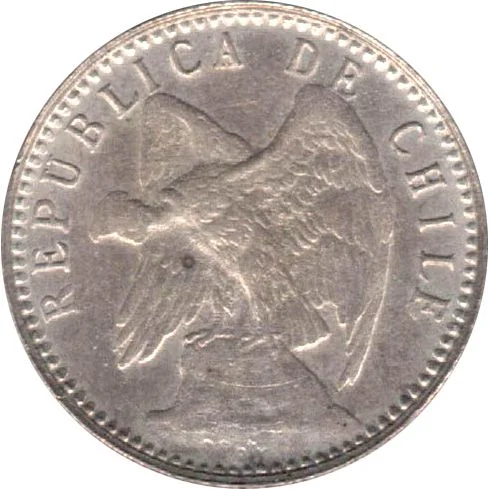
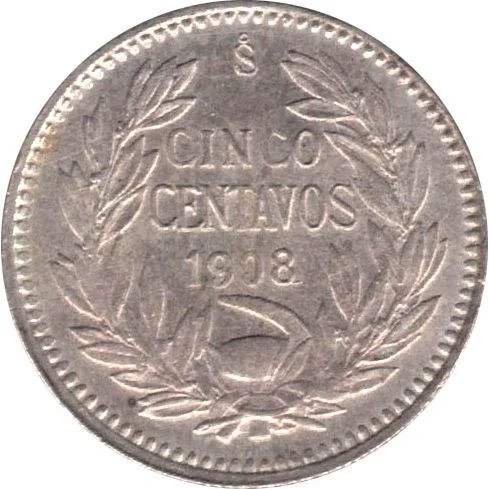
5 centavos – Chile
Add to wishlist
Chile
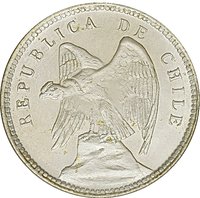
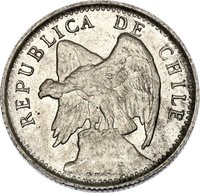
Obverse
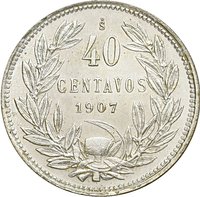
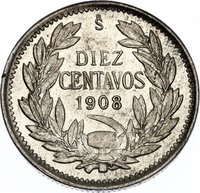
Reverse
Edge
Reeded
Categories
| Animal> Bird |
| Symbol> Hammer and sickle |
Mints
| Name | Mark |
|---|---|
| Casa de Moneda de Chile | So |
Mintings
Historical background
In 1908, Chile's currency system was in a state of transition and consolidation under the gold standard, a regime it had officially adopted in 1895. The primary unit was the peso, known specifically as the peso oro (gold peso) or condor, with one condor equal to ten paper pesos. However, the physical circulation was dominated by fiduciary (paper) money issued by private banks, notably the Banco de Chile and the Banco Español-Chile, alongside state-issued notes. This created a dual system where gold coins were used for large transactions and international trade, while paper pesos facilitated everyday commerce, though their value was legally anchored to and convertible into gold.
The period was marked by relative monetary stability following the economic turmoil of the 1891 Civil War and the earlier collapse of silver prices. The government, adhering to strict gold standard orthodoxy, maintained substantial gold reserves to back the paper in circulation, which fostered confidence and attracted foreign investment crucial for the nitrate and copper export boom. This stability, however, was carefully managed and somewhat fragile; the money supply was directly tied to the nation's gold holdings and the volatile fortunes of its key export sectors.
Despite the overall stability, underlying tensions existed. The reliance on private banknote issuance was a point of ongoing debate, with critics advocating for greater state control to ensure uniformity and security. Furthermore, Chile's economic health and thus its currency's stability were profoundly dependent on the global price of nitrate, making the system vulnerable to external shocks. This dependency would be tested just five years later with the outbreak of World War I and the advent of synthetic nitrate, events that would ultimately force Chile off the gold standard in 1932.
The period was marked by relative monetary stability following the economic turmoil of the 1891 Civil War and the earlier collapse of silver prices. The government, adhering to strict gold standard orthodoxy, maintained substantial gold reserves to back the paper in circulation, which fostered confidence and attracted foreign investment crucial for the nitrate and copper export boom. This stability, however, was carefully managed and somewhat fragile; the money supply was directly tied to the nation's gold holdings and the volatile fortunes of its key export sectors.
Despite the overall stability, underlying tensions existed. The reliance on private banknote issuance was a point of ongoing debate, with critics advocating for greater state control to ensure uniformity and security. Furthermore, Chile's economic health and thus its currency's stability were profoundly dependent on the global price of nitrate, making the system vulnerable to external shocks. This dependency would be tested just five years later with the outbreak of World War I and the advent of synthetic nitrate, events that would ultimately force Chile off the gold standard in 1932.
🌱 Fairly Common