

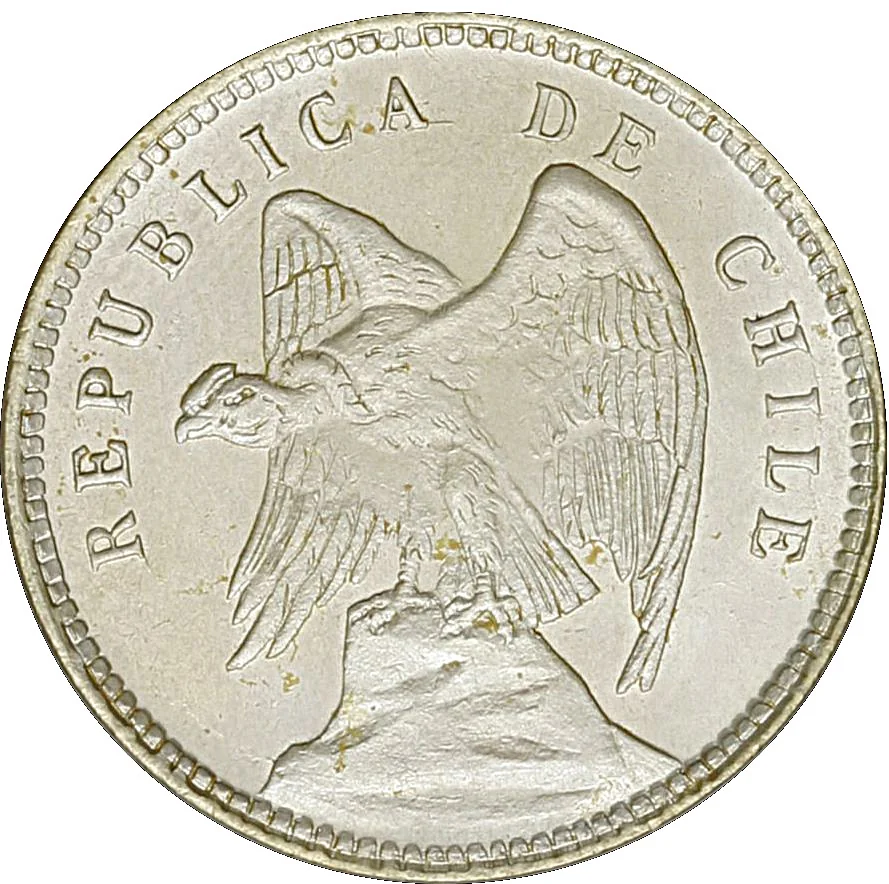
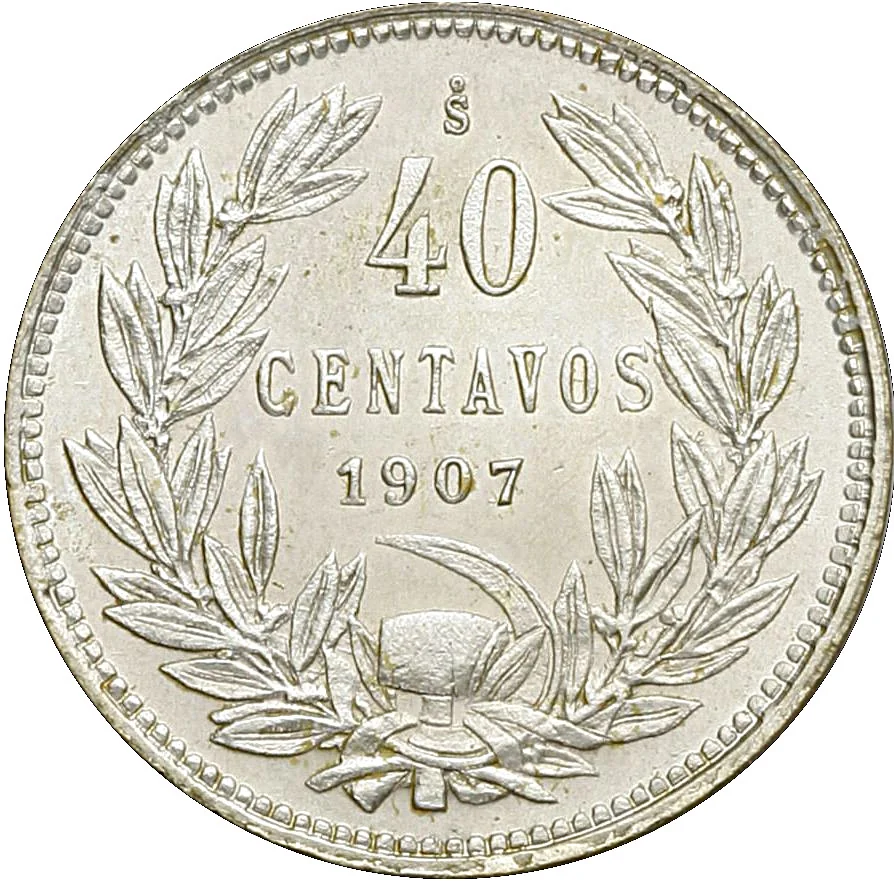
40 centavos – Chile
Add to wishlist
Chile
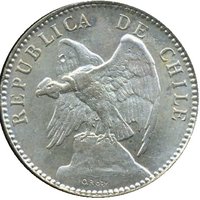
Obverse
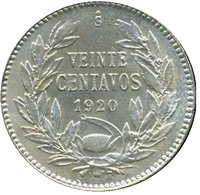
Reverse
Edge
Reeded
Categories
| Animal> Bird |
| Symbol> Hammer and sickle |
Mintings
| Year | Mint Mark | Mintage | Quality | Collection |
|---|---|---|---|---|
| 1907 | So | 56,000 | ||
| 1908 | So | 1,452,000 |
Historical background
In 1907, Chile's currency situation was defined by the Gold Standard, which had been officially adopted in 1895. The system was designed to provide monetary stability and foster international trade by pegging the Chilean peso to a fixed quantity of gold. This period followed decades of inflationary paper money, and the gold convertibility was seen as a mark of modern fiscal responsibility, helping to attract British capital for the vital nitrate and copper mining sectors. However, the system's rigidity also meant the money supply was directly tied to the nation's gold reserves, making the economy vulnerable to external shocks.
The stability of this system was heavily dependent on Chile's massive nitrate exports, which provided the state with crucial revenue and foreign exchange to maintain gold reserves. The year 1907, however, fell within a period of growing strain. While the global economy was relatively strong, social and economic tensions within the nitrate mining region itself were reaching a boiling point. The infamous Santa María School Massacre in Iquique in December 1907, where thousands of striking nitrate workers and their families were killed by the military, underscored the profound social cost of an economic model built on volatile export wealth and extreme inequality.
Consequently, while the currency itself was formally stable on the international market in 1907, the foundations of that stability were becoming increasingly precarious. The gold standard created a deflationary pressure that benefited creditors and export elites but often squeezed workers and domestic industry. The heavy reliance on a single export commodity left Chile's fiscal and monetary health exposed to future nitrate market fluctuations, a vulnerability that would be severely tested following the outbreak of World War I and the later development of synthetic substitutes, ultimately leading to the abandonment of the gold standard in 1932.
The stability of this system was heavily dependent on Chile's massive nitrate exports, which provided the state with crucial revenue and foreign exchange to maintain gold reserves. The year 1907, however, fell within a period of growing strain. While the global economy was relatively strong, social and economic tensions within the nitrate mining region itself were reaching a boiling point. The infamous Santa María School Massacre in Iquique in December 1907, where thousands of striking nitrate workers and their families were killed by the military, underscored the profound social cost of an economic model built on volatile export wealth and extreme inequality.
Consequently, while the currency itself was formally stable on the international market in 1907, the foundations of that stability were becoming increasingly precarious. The gold standard created a deflationary pressure that benefited creditors and export elites but often squeezed workers and domestic industry. The heavy reliance on a single export commodity left Chile's fiscal and monetary health exposed to future nitrate market fluctuations, a vulnerability that would be severely tested following the outbreak of World War I and the later development of synthetic substitutes, ultimately leading to the abandonment of the gold standard in 1932.
🌱 Fairly Common