

500 réis – Brazil
Add to wishlist
Circulating commemorative coins
Commemoration: Independence Centennial
Series: 100 Years of Independence
Brazil
Context
Year: 1922
Issuer: Brazil
Period:
(1889—1967)
Currency:
(1799—1942)
Demonetized: Yes
Total mintage: 13,744,000
Material
Diameter: 23 mm
Weight: 4 g
Thickness: 1.45 mm
Shape: Round
Composition: Aluminium bronze
Magnetic: No
Technique: Milled
Alignment: Coin alignment
flip
References
KM: #
Numista: #9366
Obverse
Description:
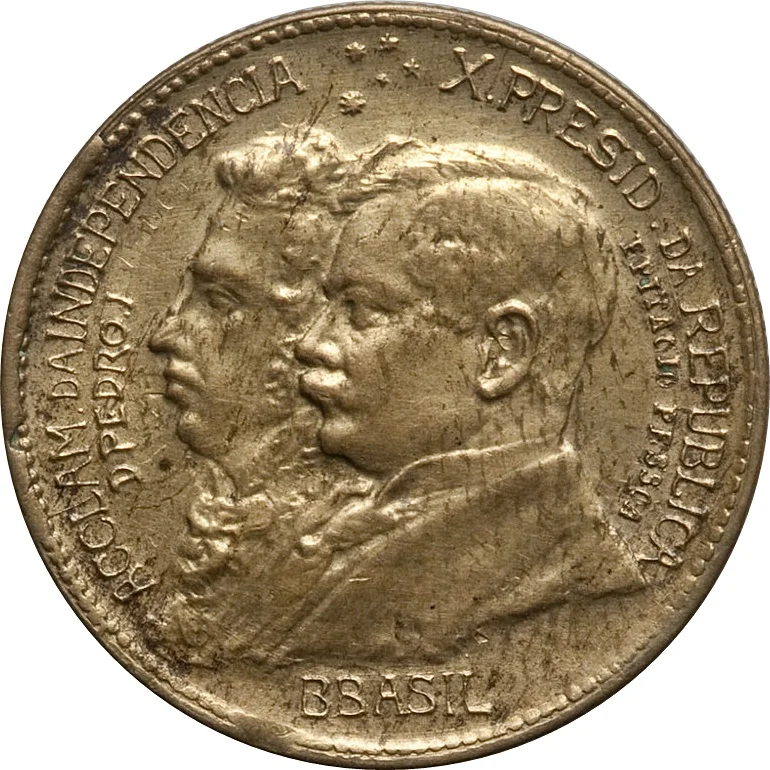
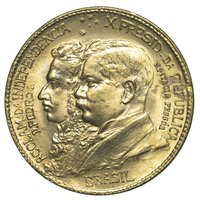
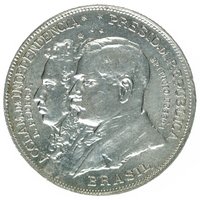
Dom Pedro and President Pessoa departed.
Inscription:
ACCLAM. DA INDEPENDENCIA X. PRESID. DA REPUBLICA
D.PEDRO I. EPITACIO PESSOA
BRASIL
D.PEDRO I. EPITACIO PESSOA
BRASIL
Translation:
Acclamation of the Independence X. President of the Republic
D. Pedro I. Epitacio Pessoa
Brazil
D. Pedro I. Epitacio Pessoa
Brazil
Script: Latin
Languages: Latin, Portuguese
Engraver: Augusto Giorgio Girardet
Reverse
Description:
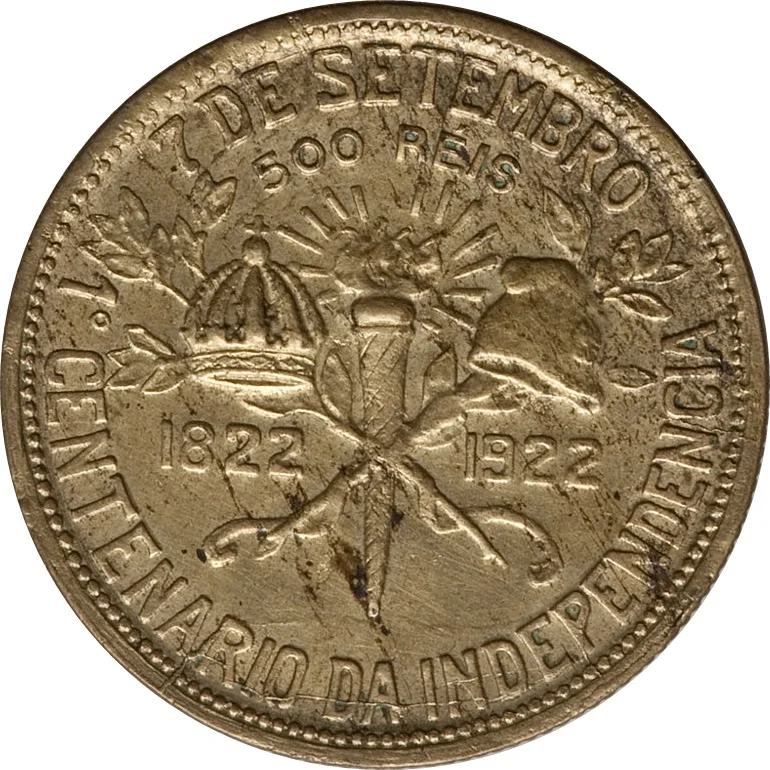
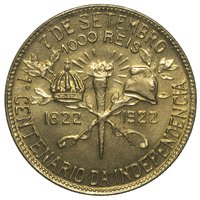
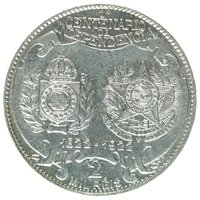
Torch with two branches: value and the dates 1822–1922.
Inscription:
7 DE SETEMBRO
500 RÉIS
1822 1922
1° CENTENARIO DA INDEPENDENCIA
500 RÉIS
1822 1922
1° CENTENARIO DA INDEPENDENCIA
Translation:
SEVENTH OF SEPTEMBER
500 RÉIS
1822 1922
1ST CENTENARY OF INDEPENDENCE
500 RÉIS
1822 1922
1ST CENTENARY OF INDEPENDENCE
Script: Latin
Language: Portuguese
Edge
Reeded/Grained
Categories
| Event> Independence |
| Person> Politician |
Mintings
| Year | Mint Mark | Mintage | Quality | Collection |
|---|---|---|---|---|
| 1922 | — | 13,744,000 |
Historical background
In 1922, Brazil's currency situation was characterized by the fragile and inflationary period of the mil-réis, the nation's currency since colonial times. The economy was heavily dependent on coffee exports, and the government's policy of valorização—buying surplus coffee to support prices—required massive foreign loans and the printing of money to cover deficits. This led to a persistent decline in the mil-réis's external value and chronic domestic inflation, eroding purchasing power and creating economic instability. The system was fundamentally vulnerable to swings in the global coffee market and the availability of foreign credit.
The year itself was a point of political and economic tension, marked by the centennial of Brazil's independence. The lavish celebrations in Rio de Janeiro, funded by money creation, stood in stark contrast to the underlying monetary fragility and social discontent, including the first tenente revolts against the oligarchic Republic. Financially, the government of President Epitácio Pessoa struggled with a large external debt burden and a balance of payments strained by the need to service loans and pay for imports. The constant need to defend the exchange rate depleted gold reserves.
This unstable environment set the stage for the major monetary reforms that would follow later in the decade. The pressures culminated in the appointment of a foreign financial mission, led by British expert Sir Edwin Montagu in 1923, to advise on stabilizing the currency. His recommendations would eventually contribute to the pivotal reforms of the 1920s, particularly the creation of the Banco do Brasil as a central bank-like institution and, ultimately, the establishment of a new currency, the cruzeiro, in 1942, which finally retired the mil-réis. Thus, 1922 represents the late, crisis-ridden phase of an old monetary order soon to be overhauled.
The year itself was a point of political and economic tension, marked by the centennial of Brazil's independence. The lavish celebrations in Rio de Janeiro, funded by money creation, stood in stark contrast to the underlying monetary fragility and social discontent, including the first tenente revolts against the oligarchic Republic. Financially, the government of President Epitácio Pessoa struggled with a large external debt burden and a balance of payments strained by the need to service loans and pay for imports. The constant need to defend the exchange rate depleted gold reserves.
This unstable environment set the stage for the major monetary reforms that would follow later in the decade. The pressures culminated in the appointment of a foreign financial mission, led by British expert Sir Edwin Montagu in 1923, to advise on stabilizing the currency. His recommendations would eventually contribute to the pivotal reforms of the 1920s, particularly the creation of the Banco do Brasil as a central bank-like institution and, ultimately, the establishment of a new currency, the cruzeiro, in 1942, which finally retired the mil-réis. Thus, 1922 represents the late, crisis-ridden phase of an old monetary order soon to be overhauled.
🌱 Very Common