

10 centavos (Republic of Cuba) – Cuba
Add to wishlist
Circulating commemorative coins
Commemoration: 50th Anniversary of the Republic of Cuba
Cuba
Obverse
Description:
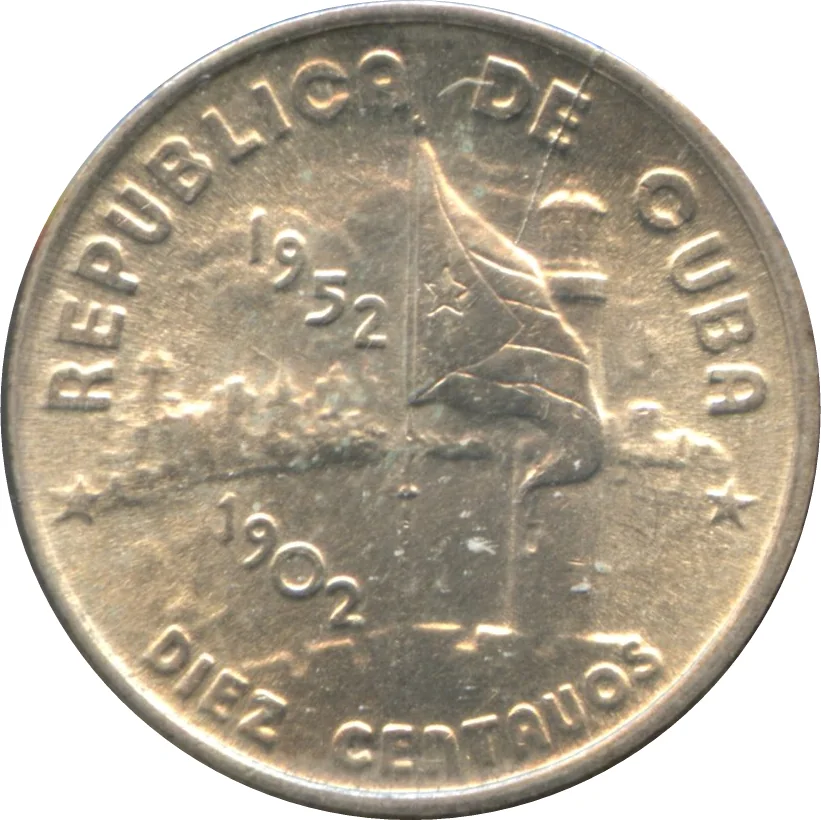
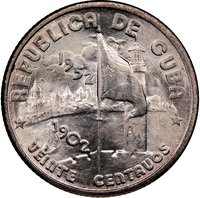
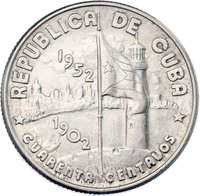
Cuban flag centered over Santiago de Cuba fortress, with an enlarged lighthouse on the right. Coin date above, commemorative date below. Country name arcs across the top, face value along the bottom.
Inscription:
REPUBLICA DE CUBA
1952
1902
DIEZ CENTAVOS
1952
1902
DIEZ CENTAVOS
Translation:
REPUBLIC OF CUBA
1952
1902
TEN CENTS
1952
1902
TEN CENTS
Script: Latin
Language: Spanish
Engraver: Juan J. Sicre
Reverse
Description:
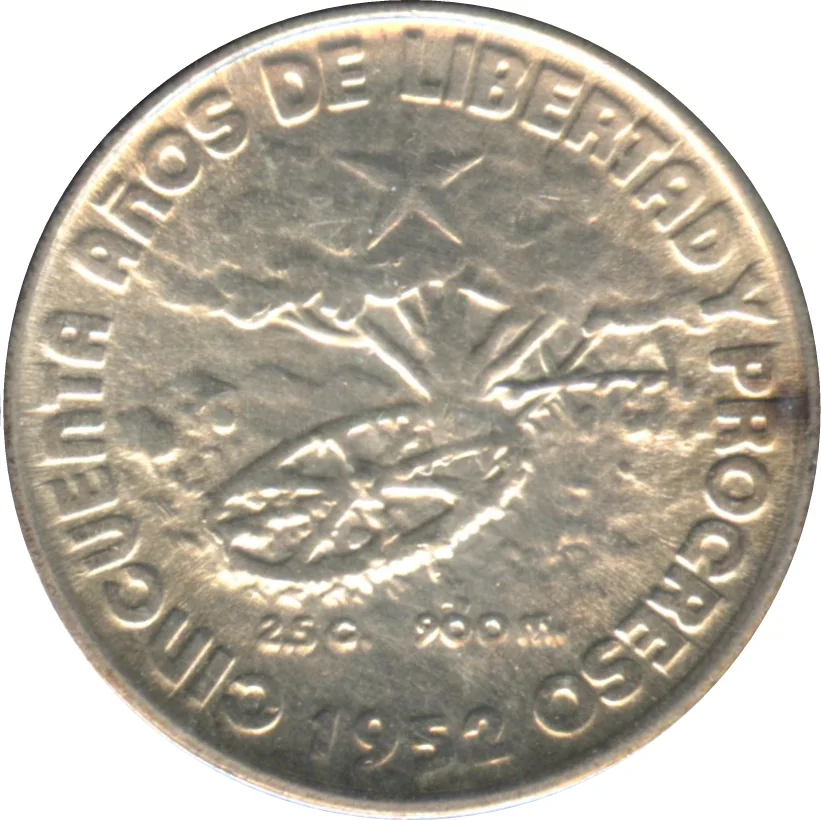
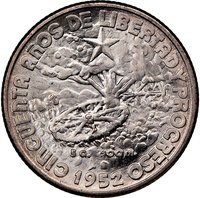
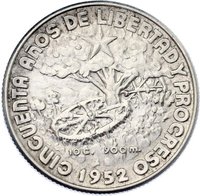
"La Demajagua," the birthplace of Cuban independence and a star.
Inscription:
CINCUENTA AÑOS DE LIBERTAD Y PROGRESO
1952
1952
Translation:
FIFTY YEARS OF LIBERTY AND PROGRESS
1952
1952
Script: Latin
Language: Spanish
Engraver: Juan J. Sicre
Edge
Reeded
Mints
| Name | Mark |
|---|---|
| United States Mint of Philadelphia | — |
Mintings
| Year | Mint Mark | Mintage | Quality | Collection |
|---|---|---|---|---|
| 1952 | — | 10,000,000 |
Historical background
In 1952, Cuba’s currency situation was characterized by relative stability and integration with the U.S. economy, but it existed within a context of deep political and economic inequality. The Cuban peso was pegged to the U.S. dollar at a 1:1 parity, a system established in the early 20th century. This fixed exchange rate facilitated seamless trade and investment, particularly with the United States, which dominated the Cuban economy through sugar exports, tourism, and banking. The currency was fully convertible, and U.S. dollars circulated widely alongside pesos, especially in Havana and the tourist sectors, creating a dual-monetary environment in practice.
This financial stability, however, masked profound structural problems. The economy was overwhelmingly dependent on sugar, whose price was volatile and subject to U.S. quotas. Wealth was concentrated in the hands of a small elite and foreign interests, while rural poverty was widespread. The currency peg, while beneficial for commerce and the affluent, also tied Cuba’s monetary policy to the U.S. Federal Reserve, limiting the government's ability to independently manage economic shocks. Furthermore, the administration of President Carlos Prío Socarrás was plagued by corruption and fiscal mismanagement, eroding public trust.
The currency’s apparent solidity was abruptly shaken on March 10, 1952, when former president Fulgencio Batista seized power in a military coup. While the peso’s formal parity remained unchanged, the coup introduced severe political instability, which would soon have economic repercussions. Batista’s regime initially sought to reassure foreign investors and maintain the dollar link, but his authoritarian rule, coupled with increased public spending financed by central bank loans, began to sow the seeds of future inflation and fiscal deficits. Thus, by the end of 1952, the stable currency facade was becoming increasingly fragile, presaging the economic turmoil that would accompany the coming Cuban Revolution.
This financial stability, however, masked profound structural problems. The economy was overwhelmingly dependent on sugar, whose price was volatile and subject to U.S. quotas. Wealth was concentrated in the hands of a small elite and foreign interests, while rural poverty was widespread. The currency peg, while beneficial for commerce and the affluent, also tied Cuba’s monetary policy to the U.S. Federal Reserve, limiting the government's ability to independently manage economic shocks. Furthermore, the administration of President Carlos Prío Socarrás was plagued by corruption and fiscal mismanagement, eroding public trust.
The currency’s apparent solidity was abruptly shaken on March 10, 1952, when former president Fulgencio Batista seized power in a military coup. While the peso’s formal parity remained unchanged, the coup introduced severe political instability, which would soon have economic repercussions. Batista’s regime initially sought to reassure foreign investors and maintain the dollar link, but his authoritarian rule, coupled with increased public spending financed by central bank loans, began to sow the seeds of future inflation and fiscal deficits. Thus, by the end of 1952, the stable currency facade was becoming increasingly fragile, presaging the economic turmoil that would accompany the coming Cuban Revolution.
🌱 Common