

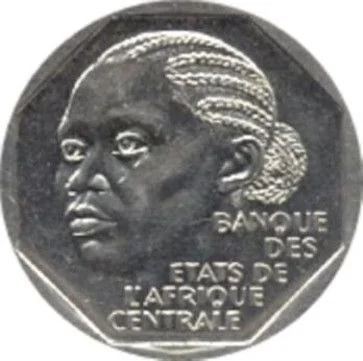
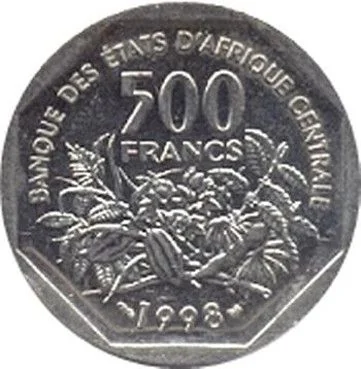
500 Francs CFA – Central African States
Context
Year: 1998
Issuer: Central African States
Issuing organization: Bank of Central African States
Currency:
(since 1973)
Total mintage: 4,500,000
Material
Diameter: 30 mm
Weight: 11 g
Thickness: 2 mm
Shape: Round
Composition: Copper-nickel
Technique: Milled
Alignment: Coin alignment
flip
References
KM: #Click to copy to clipboard14
Numista: #9312
Value
Exchange value: 500 XAF
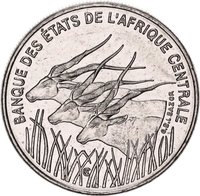
Obverse
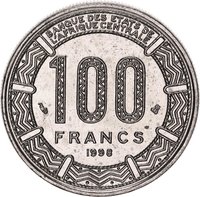
Reverse
Edge
Plain
Mints
| Name | Mark |
|---|---|
| Monnaie de Paris | — |
Mintings
| Year | Mint Mark | Mintage | Quality | Collection |
|---|---|---|---|---|
| 1998 | — | 4,500,000 |
Historical background
In 1998, the currency situation for the Central African States was defined by their shared membership in the Communauté Financière Africaine (CFA), specifically the Central African CFA franc (XAF). This currency, used by six nations forming the Economic and Monetary Community of Central Africa (CEMAC), was pegged at a fixed exchange rate to the French franc. The arrangement guaranteed unlimited convertibility by the French Treasury, which held the group's foreign reserves, in return for strict monetary policy rules and the maintenance of a common central bank, the Bank of Central African States (BEAC).
The year 1998 fell within a period of significant economic strain for the CEMAC region. The fixed peg, while providing monetary stability and low inflation, was increasingly criticized for overvaluing the CFA franc, making regional exports less competitive globally. This was exacerbated by a sharp decline in world prices for key commodities like oil and coffee, alongside internal governance issues. Consequently, several member states, including the Republic of the Congo and Cameroon, were grappling with severe public debt, arrears, and economic stagnation, which placed the credibility of the common currency under pressure.
Ultimately, the situation in 8 was a tense calm before a major monetary reform. Discussions about a necessary devaluation, which had last occurred in 1994, were ongoing but politically sensitive. The region's economies were caught between the immediate stability provided by the French-backed peg and the growing need for adjustment to stimulate growth. This culminated just a year later, in 1999, with the formal change of the peg from the French franc to the euro at a fixed rate of 655.957 CFA francs to one euro, a transition that preserved the monetary union but within a new European framework.
The year 1998 fell within a period of significant economic strain for the CEMAC region. The fixed peg, while providing monetary stability and low inflation, was increasingly criticized for overvaluing the CFA franc, making regional exports less competitive globally. This was exacerbated by a sharp decline in world prices for key commodities like oil and coffee, alongside internal governance issues. Consequently, several member states, including the Republic of the Congo and Cameroon, were grappling with severe public debt, arrears, and economic stagnation, which placed the credibility of the common currency under pressure.
Ultimately, the situation in 8 was a tense calm before a major monetary reform. Discussions about a necessary devaluation, which had last occurred in 1994, were ongoing but politically sensitive. The region's economies were caught between the immediate stability provided by the French-backed peg and the growing need for adjustment to stimulate growth. This culminated just a year later, in 1999, with the formal change of the peg from the French franc to the euro at a fixed rate of 655.957 CFA francs to one euro, a transition that preserved the monetary union but within a new European framework.
🌱 Fairly Common