

160 Reales Vellon – Spain
Spain
Context
Material
References
KM: #Click to copy to clipboard565
Numista: #93048
Value
Bullion value: $1894.40
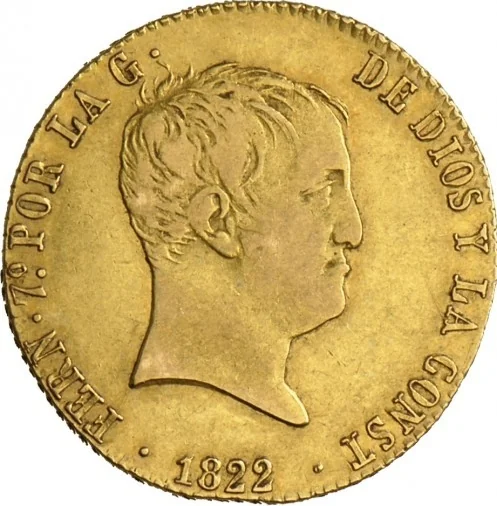
Obverse
Description:
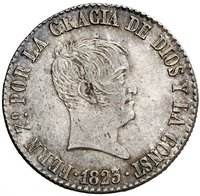
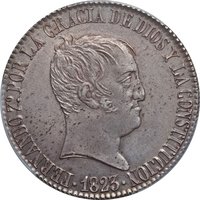
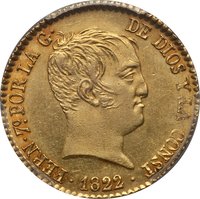
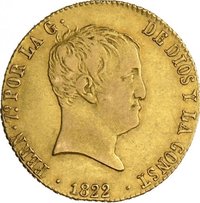
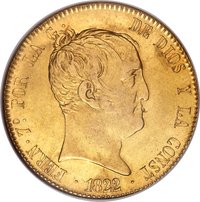
King Fernando VII facing right.
Inscription:
FERN · 7°. POR LA G · DE DIOS Y LA CONST
· 1822 ·
· 1822 ·
Translation:
FERDINAND VII. BY THE GRACE OF GOD AND THE CONSTITUTION
· 1822 ·
· 1822 ·
Script: Latin
Language: Spanish
Engraver: Félix Sagau y Dalmau de Galcerán
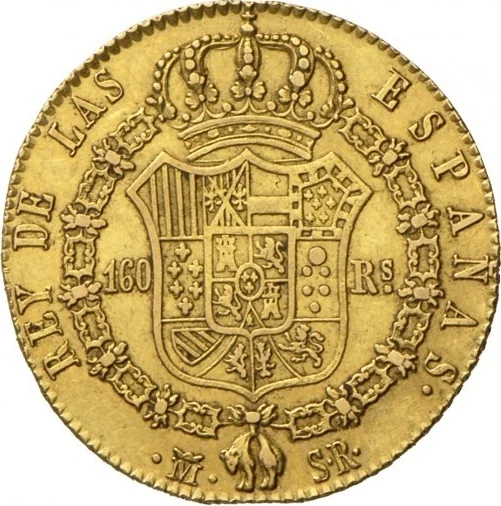
Reverse
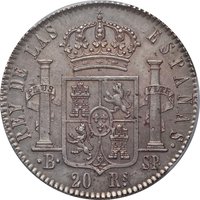
Description:
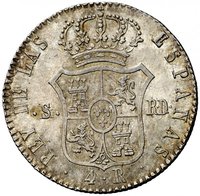
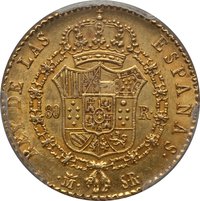
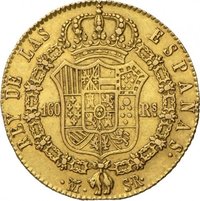
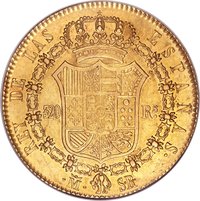
Crowned Spanish coat of arms with the Golden Fleece.
Inscription:
REY DE LAS ESPAÑAS ·
160 R ·
·M· S·R·
160 R ·
·M· S·R·
Translation:
King of the Spains ·
160 Reales ·
·M· S·R·
160 Reales ·
·M· S·R·
Script: Latin
Language: Spanish
Engraver: Félix Sagau y Dalmau de Galcerán
Edge
Categories
| Person> Monarch |
| Symbols> Coat of Arms |
Mints
| Name | Mark |
|---|---|
| Royal Mint of Madrid | (M) |
Mintings
| Year | Mint Mark | Mintage | Quality | Collection |
|---|---|---|---|---|
| 1822 | MSR | — |
Historical background
In 1822, Spain was embroiled in the political and military chaos of the Trienio Liberal (1820–1823), a period when liberal revolutionaries had forced King Ferdinand VII to accept a constitutional monarchy. The nation was deeply divided, with a civil war raging between the liberal government in Madrid and royalist absolutist rebels, while a French invasion force (the "Hundred Thousand Sons of Saint Louis") was preparing to cross the border to restore Ferdinand to absolute power. This profound instability shattered public finance and economic activity, creating a catastrophic environment for the currency.
The monetary system itself was in a state of severe disorder and devaluation. The primary circulating coin was the silver real, but years of war and deficit had led to the proliferation of low-quality copper coinage (calderilla) issued by both the government and even local authorities to pay expenses. This flood of debased coinage, combined with a critical shortage of precious metals due to the loss of American colonies, caused rampant inflation and a collapse in public trust. The paper money experiment of the Banco de San Carlos (precursor to the Bank of Spain) had ended in disaster earlier in the century, leaving a deep suspicion of fiduciary currency, so the circulating medium was an unreliable patchwork of physically degraded and adulterated coin.
Consequently, the currency situation in 1822 was characterized by a severe scarcity of sound money, a confusing multiplicity of devalued coins, and wildly fluctuating values that hampered commerce. The liberal government, fighting for survival, had little capacity to enact monetary reform. The instability was both a symptom and a cause of the broader collapse of state authority, and it would only be resolved—through forceful imposition of a restored absolute monarchy—after the fall of the liberal regime in 1823.
The monetary system itself was in a state of severe disorder and devaluation. The primary circulating coin was the silver real, but years of war and deficit had led to the proliferation of low-quality copper coinage (calderilla) issued by both the government and even local authorities to pay expenses. This flood of debased coinage, combined with a critical shortage of precious metals due to the loss of American colonies, caused rampant inflation and a collapse in public trust. The paper money experiment of the Banco de San Carlos (precursor to the Bank of Spain) had ended in disaster earlier in the century, leaving a deep suspicion of fiduciary currency, so the circulating medium was an unreliable patchwork of physically degraded and adulterated coin.
Consequently, the currency situation in 1822 was characterized by a severe scarcity of sound money, a confusing multiplicity of devalued coins, and wildly fluctuating values that hampered commerce. The liberal government, fighting for survival, had little capacity to enact monetary reform. The instability was both a symptom and a cause of the broader collapse of state authority, and it would only be resolved—through forceful imposition of a restored absolute monarchy—after the fall of the liberal regime in 1823.
Series: 1822 Spain circulation coins
✨ Legendary