

1 Baht (Rama IX) – Thailand
Circulating commemorative coins
Commemoration: 36th Anniversary of birth of Rama IX
Thailand
Context
Year: 1963
Issuer: Thailand 
Ruler: Bhumibol Adulyadej
Currency:
(since 1897)
Demonetized: Yes
Total mintage: 3,000,000
Material
Diameter: 26.9 mm
Weight: 7.5 g
Thickness: 1.8 mm
Shape: Round
Composition: Copper-nickel
Technique: Milled
Alignment: Coin alignment
flip
References
Y: #Click to copy to clipboard85
Numista: #9270
Value
Exchange value: 1 THB = $0.03
Obverse
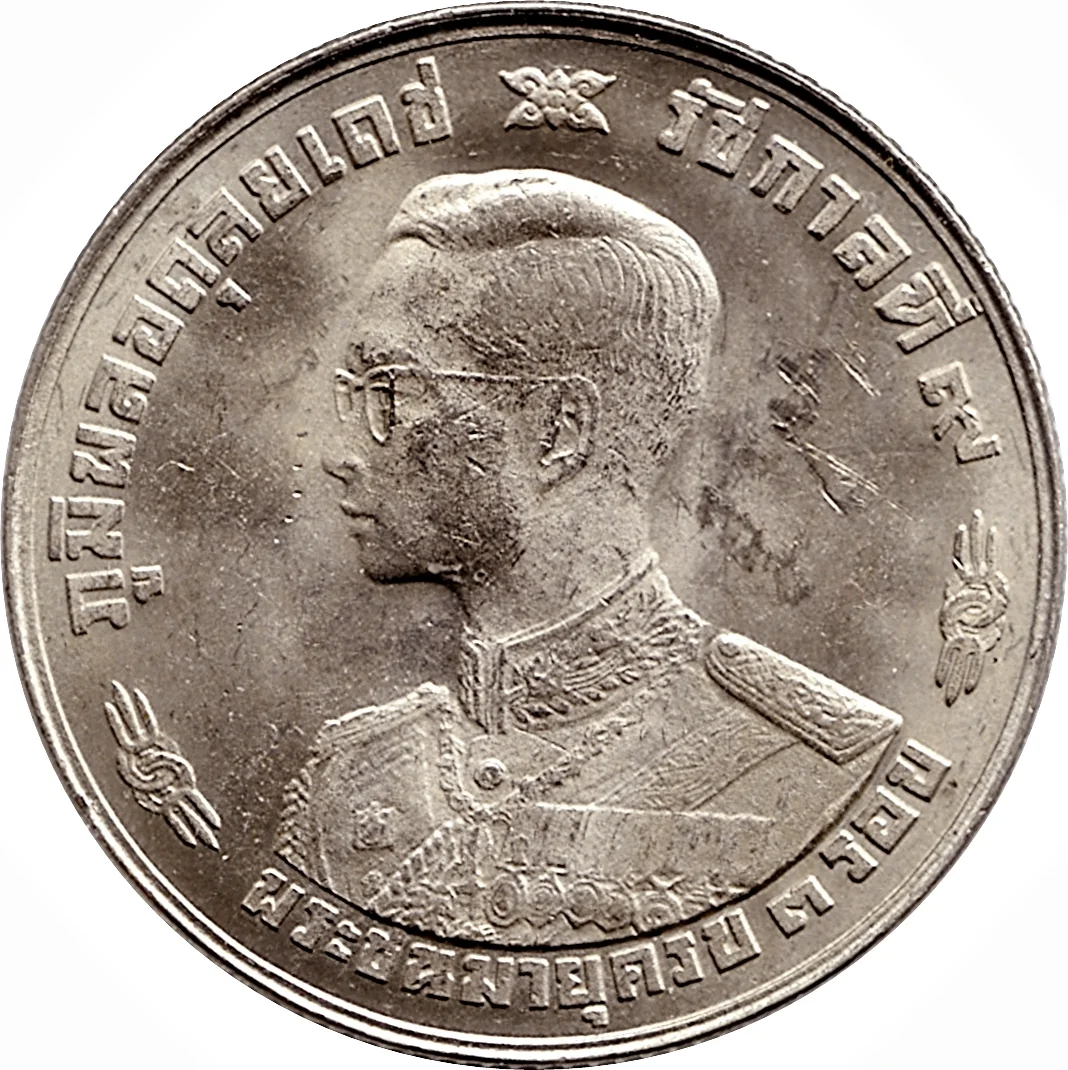
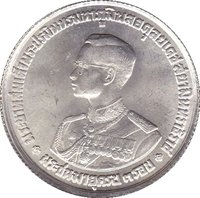
Description:
Uniformed bust facing left
Inscription:
ภูมิพลอดุลยเดช รัชกาลที่ ๙
พระชนมายุครบ ๓ รอบ
พระชนมายุครบ ๓ รอบ
Translation:
Bhumibol Adulyadej The 9th Reign
Aged 3 cycles
Aged 3 cycles
Language: Thai
Reverse
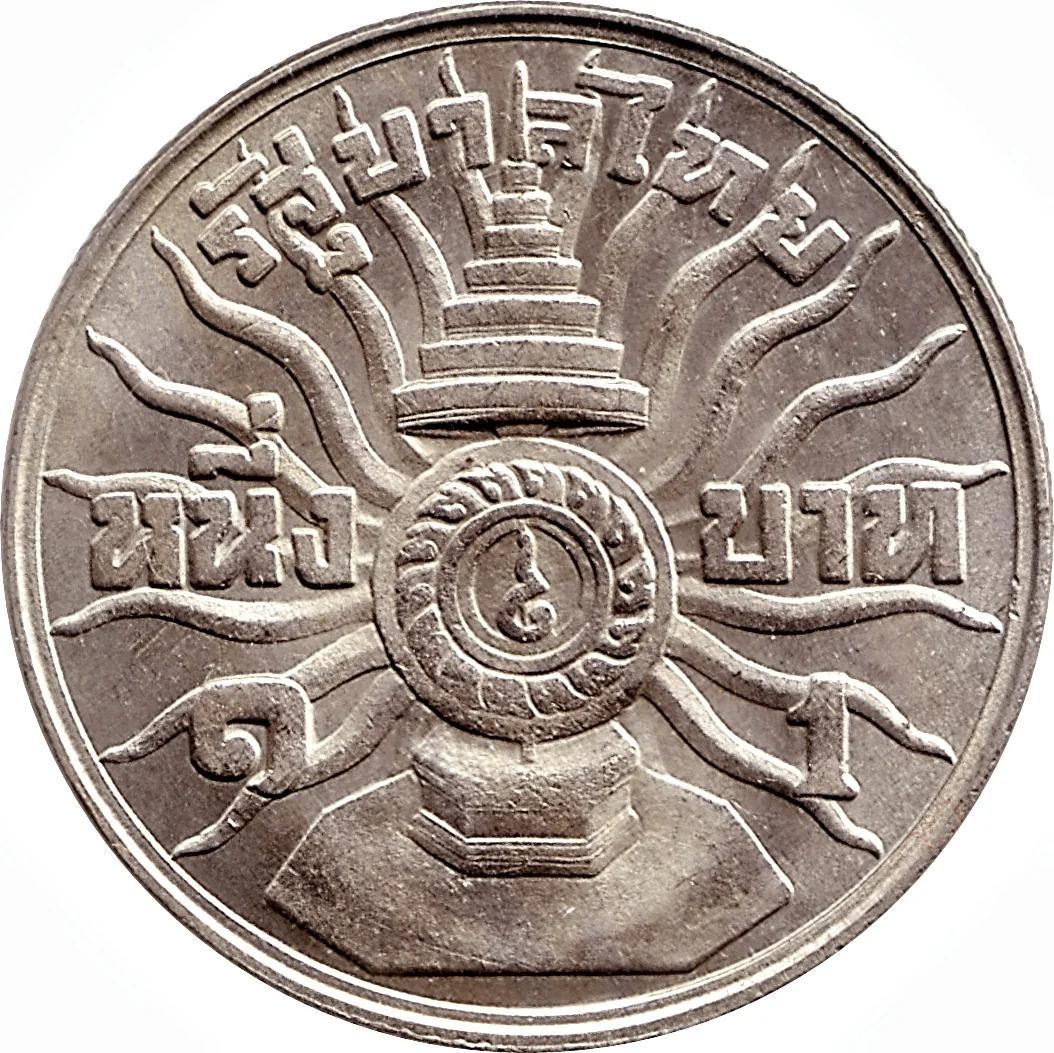
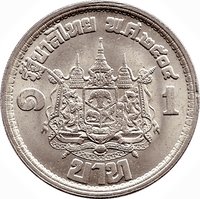
Description:
Center circle design.
Inscription:
รัฐบาลไทย
หนึ่ง บาท
๑ 1
หนึ่ง บาท
๑ 1
Translation:
Thai Government
One Baht
1 1
One Baht
1 1
Language: Thai
Edge
Reeded
Mintings
| Year | Mint Mark | Mintage | Quality | Collection |
|---|---|---|---|---|
| 1963 | — | 3,000,000 |
Historical background
In 1963, Thailand's currency system was firmly anchored to the gold standard and the US dollar, operating under the Gold Bullion Standard Act of 1908. The official currency was the Baht, which was pegged at a fixed rate of 20.80 Baht to 1 US dollar, a parity that had been established in 1963 and would remain remarkably stable for over a decade until 1978. This peg provided critical stability for international trade and investment, fostering a predictable economic environment during a period of national development under Field Marshal Sarit Thanarat's government and his successor, Field Marshal Thanom Kittikachachorn.
The management of the currency fell under the purview of the Bank of Thailand (BOT), established in 1942. In 1963, the BOT's primary role was to maintain the fixed exchange rate by holding sufficient foreign reserves, primarily in gold and US dollars, to back the Baht. This conservative monetary policy prioritized stability over aggressive growth, controlling inflation and building international confidence. The currency itself was issued in both paper notes and coins, with the economy still largely cash-based, especially in rural areas.
This period was one of monetary calm before significant future shifts. The stability of the Baht peg supported Thailand's early steps toward industrialization and its alignment with Western economic interests during the Cold War. However, the system's rigidity would later be challenged by global financial turbulence in the 1970s, leading to the eventual floatation of the Baht in 1978. Thus, 1963 represents a point of steadfast fixity in Thailand's monetary history, underpinning a decade of economic planning and growth.
The management of the currency fell under the purview of the Bank of Thailand (BOT), established in 1942. In 1963, the BOT's primary role was to maintain the fixed exchange rate by holding sufficient foreign reserves, primarily in gold and US dollars, to back the Baht. This conservative monetary policy prioritized stability over aggressive growth, controlling inflation and building international confidence. The currency itself was issued in both paper notes and coins, with the economy still largely cash-based, especially in rural areas.
This period was one of monetary calm before significant future shifts. The stability of the Baht peg supported Thailand's early steps toward industrialization and its alignment with Western economic interests during the Cold War. However, the system's rigidity would later be challenged by global financial turbulence in the 1970s, leading to the eventual floatation of the Baht in 1978. Thus, 1963 represents a point of steadfast fixity in Thailand's monetary history, underpinning a decade of economic planning and growth.
🌱 Common