

2000 pesetas (Francisco de Goya) – Spain
Add to wishlist
Circulating commemorative coins
Commemoration: 250th anniversary of the birth of Francisco de Goya
Series: Face Value Exchange Series
Spain
Context
Year: 1996
Issuer: Spain
Ruler: Juan Carlos I
Currency:
(1868—2001)
Demonetization: 28 February 2002
Total mintage: 3,781,150
Material
Diameter: 33 mm
Weight: 18 g
Silver Weight:: 16.65 g
Thickness: 2 mm
Shape: Round
Composition: 92.5% Silver
Magnetic: No
Techniques: Latent image, Milled
Alignment: Coin alignment
flip
References
KM: #
Numista: #9260
Value
Exchange value: 2000 ESP
Bullion value: $42.69
Inflation-adjusted value: 3987.48 ESP
Obverse
Description:
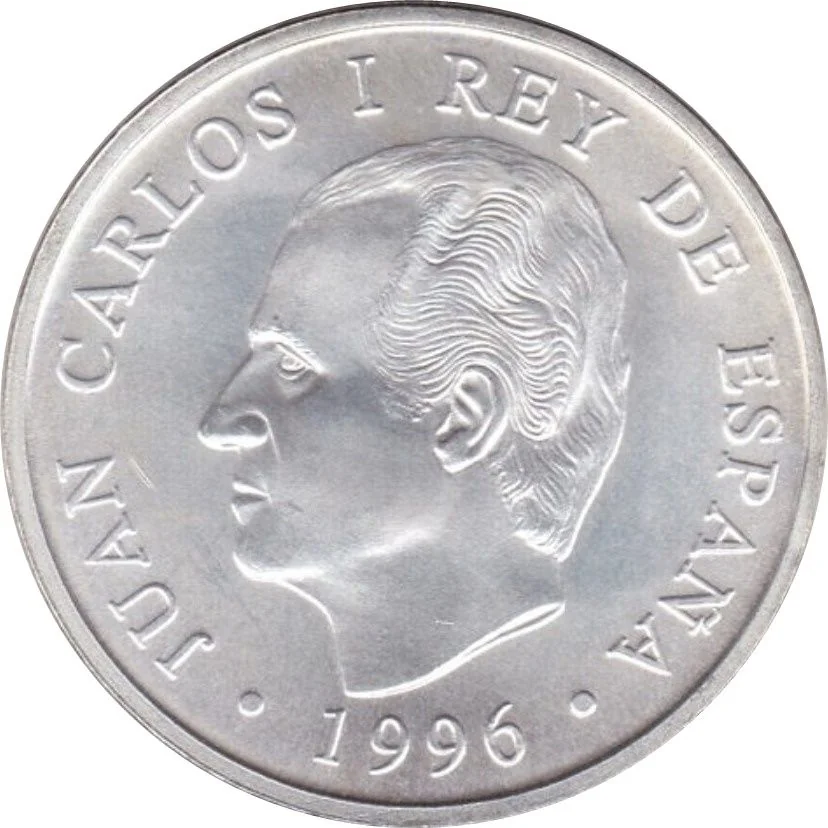
King Juan Carlos I facing left.
Inscription:
JUAN CARLOS I REY DE ESPAÑA
· 1996 ·
· 1996 ·
Translation:
Juan Carlos I King of Spain
· 1996 ·
· 1996 ·
Script: Latin
Language: Spanish
Engraver: Manuel Martinez Tornero
Reverse
Description:
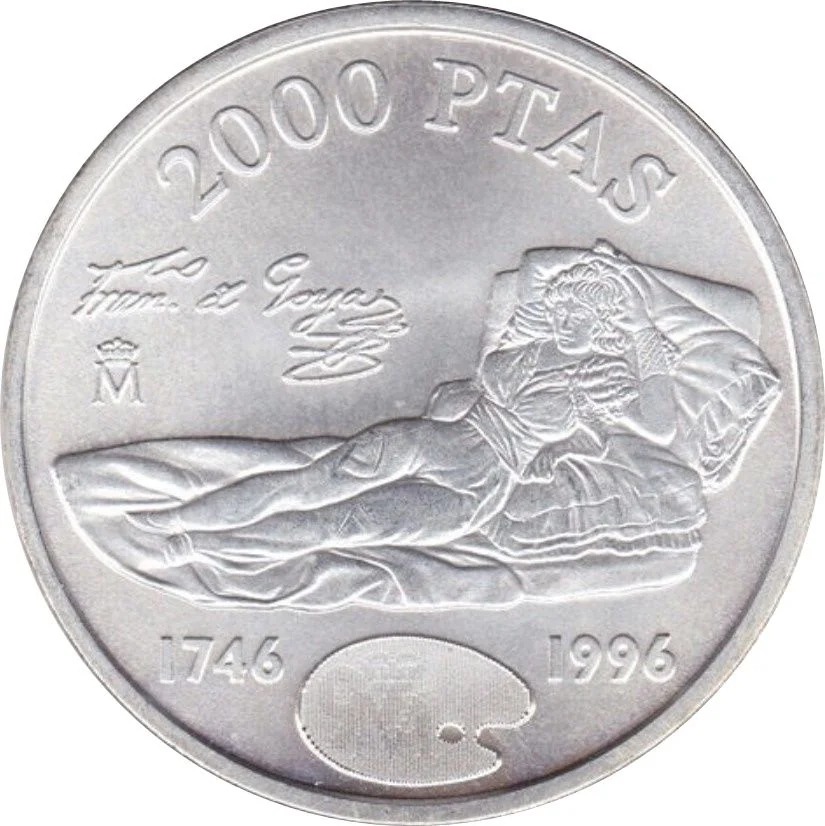
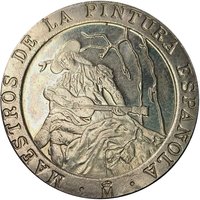
Goya's "La Maja Vestida" fragment. Palette reveals latent Madrid mintmark and "96."
Inscription:
2000 PTAS
Fran. & Goya
M
1746 1996
Fran. & Goya
M
1746 1996
Script: Latin
Engraver: Luis José Díaz Salas
Edge
Plain
Mints
| Name | Mark |
|---|---|
| Royal Mint of Madrid | (M) |
Mintings
| Year | Mint Mark | Mintage | Quality | Collection |
|---|---|---|---|---|
| 1996 | M | 3,781,150 |
Historical background
In 1996, Spain's currency situation was defined by its pivotal position within the European Monetary System (EMS) and the broader march toward Economic and Monetary Union (EMU). The peseta, after a turbulent first half of the decade, was relatively stable but under constant market scrutiny. A severe crisis in 1992-93 had forced a series of devaluations and the peseta's eventual exit from the EMS Exchange Rate Mechanism (ERM), only to re-enter at a significantly lower parity. By 1996, with the election of Prime Minister José María Aznar's center-right government, the primary economic objective was unequivocal: to meet the strict Maastricht Treaty convergence criteria—on inflation, interest rates, budget deficits, and public debt—to qualify for the first wave of the European single currency, the euro.
The year was thus characterized by a rigorous austerity drive and structural reforms aimed at fiscal consolidation. The government implemented deep spending cuts and pursued privatization programs to reduce a public deficit that exceeded 6% of GDP, while the Bank of Spain maintained a tight monetary policy to control inflation and ensure exchange rate stability within the ERM bands. This discipline was essential to convince both European partners and financial markets of Spain's commitment and economic credibility. Success was not guaranteed, as the country grappled with high unemployment, which remained above 20%, creating social tension alongside the technocratic push for convergence.
Ultimately, 1996 proved to be a decisive turning point. The successful stabilization of the peseta and demonstrable progress on the Maastricht criteria set the stage for Spain's formal inclusion in the eurozone in May 1998. The peseta's exchange rate was irrevocably fixed at 166.386 pesetas to one euro, marking the beginning of the end for the national currency. The year's policies cemented Spain's place in the core of the European project, transitioning the currency situation from one of vulnerability and crisis management to one of preparation for the historic adoption of the euro on 1 January 1999.
The year was thus characterized by a rigorous austerity drive and structural reforms aimed at fiscal consolidation. The government implemented deep spending cuts and pursued privatization programs to reduce a public deficit that exceeded 6% of GDP, while the Bank of Spain maintained a tight monetary policy to control inflation and ensure exchange rate stability within the ERM bands. This discipline was essential to convince both European partners and financial markets of Spain's commitment and economic credibility. Success was not guaranteed, as the country grappled with high unemployment, which remained above 20%, creating social tension alongside the technocratic push for convergence.
Ultimately, 1996 proved to be a decisive turning point. The successful stabilization of the peseta and demonstrable progress on the Maastricht criteria set the stage for Spain's formal inclusion in the eurozone in May 1998. The peseta's exchange rate was irrevocably fixed at 166.386 pesetas to one euro, marking the beginning of the end for the national currency. The year's policies cemented Spain's place in the core of the European project, transitioning the currency situation from one of vulnerability and crisis management to one of preparation for the historic adoption of the euro on 1 January 1999.
Series: Face Value Exchange Series
🌱 Common