

1 rupee – Pakistan
Add to wishlist
Pakistan
Context
Years: 1981–1992
Issuer: Pakistan
Period:
(since 1956)
Currency:
(since 1961)
Total mintage: 153,842,000
Material
Diameter: 25 mm
Weight: 6 g
Thickness: 1.6 mm
Shape: Round
Composition: Copper-nickel
Technique: Milled
Alignment: Medal alignment
flip
References
KM: #
Numista: #9251
Value
Exchange value: 1 PKR
Obverse
Description:
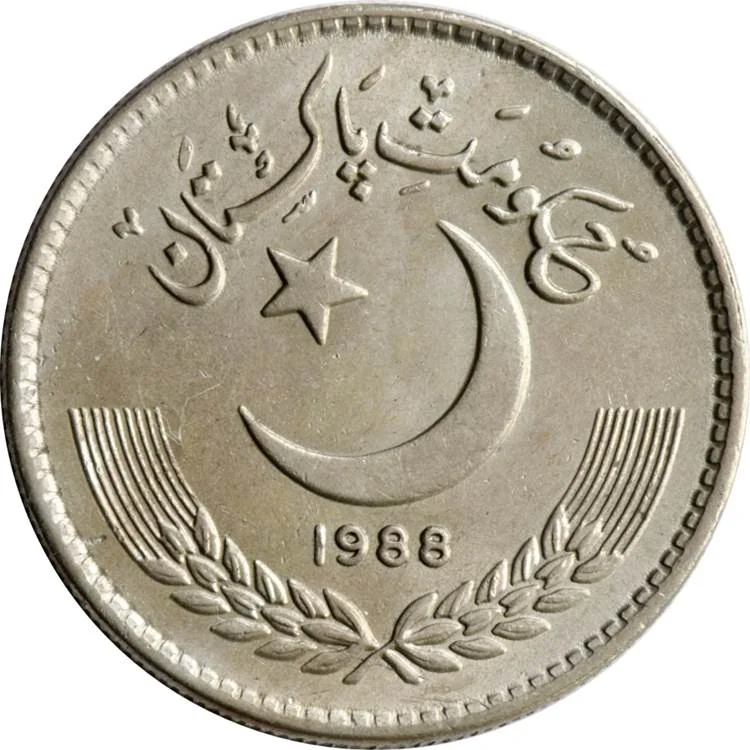
Crescent and star above date.
Inscription:
حكومت پاکستان
1988
1988
Translation:
Government of Pakistan
1988
1988
Language: Urdu
Reverse
Description:
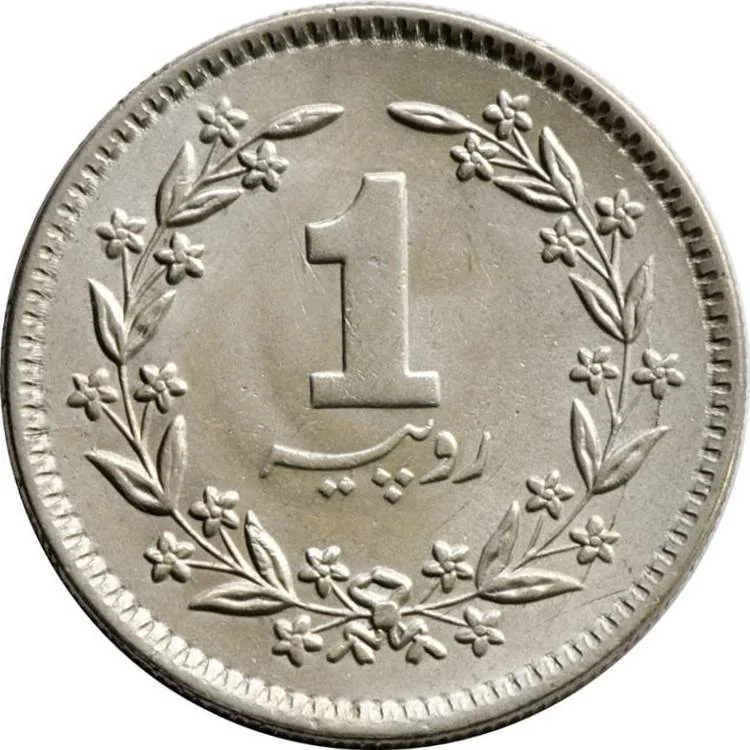
Denomination flanked by sprays
Inscription:
1
روپيه
روپيه
Translation:
One Rupee
Language: Urdu
Edge
Reeded
Mintings
| Year | Mint Mark | Mintage | Quality | Collection |
|---|---|---|---|---|
| 1981 | — | 4,084,000 | ||
| 1982 | — | 27,878,000 | ||
| 1983 | — | 18,746,000 | ||
| 1984 | — | 14,562,000 | ||
| 1985 | — | 4,934,000 | ||
| 1986 | — | 11,840,000 | ||
| 1987 | — | 50,416,000 | ||
| 1988 | — | 10,644,000 | ||
| 1990 | — | 9,344,000 | ||
| 1991 | — | 1,394,000 | ||
| 1992 | — | — |
Historical background
In 1981, Pakistan's currency situation was characterized by a tightly managed exchange rate regime under the rule of President General Zia-ul-Haq. The Pakistani rupee was pegged to a basket of currencies of its major trading partners, but in practice, it was closely aligned with the US dollar. The official exchange rate was fixed by the State Bank of Pakistan at approximately 9.9 rupees to the dollar, a rate maintained with strict capital controls to conserve foreign reserves. This overvalued official rate, however, failed to reflect market realities, leading to the proliferation of a vibrant black market where the rupee traded at a significant discount, often exceeding 11 or 12 rupees to the dollar.
The economy was navigating the aftermath of the 1970s nationalization policies and benefiting from a substantial influx of foreign aid and remittances. The Soviet invasion of Afghanistan in 1979 turned Pakistan into a frontline state, unlocking massive financial and military assistance from the United States and Gulf allies. Concurrently, the launch of the worker remittance program through the Bearer Certificate Scheme (introduced in the 1970s) incentivized overseas Pakistanis, particularly in the Middle East, to send money home through official channels. These dollar inflows were critical in supporting the fixed exchange rate, boosting foreign exchange reserves, and financing a growing trade deficit.
Despite these inflows, the system exhibited significant strains. The fixed and overvalued exchange rate, combined with import restrictions, discouraged exports and encouraged smuggling and under-invoicing. The disparity between the official and kerb (black market) rates created distortions and rent-seeking opportunities. While the regime provided superficial stability, it masked underlying competitiveness issues. The period thus represented a controlled but fragile equilibrium, heavily dependent on geopolitical-driven external flows rather than robust export-led growth, setting the stage for future balance of payments pressures.
The economy was navigating the aftermath of the 1970s nationalization policies and benefiting from a substantial influx of foreign aid and remittances. The Soviet invasion of Afghanistan in 1979 turned Pakistan into a frontline state, unlocking massive financial and military assistance from the United States and Gulf allies. Concurrently, the launch of the worker remittance program through the Bearer Certificate Scheme (introduced in the 1970s) incentivized overseas Pakistanis, particularly in the Middle East, to send money home through official channels. These dollar inflows were critical in supporting the fixed exchange rate, boosting foreign exchange reserves, and financing a growing trade deficit.
Despite these inflows, the system exhibited significant strains. The fixed and overvalued exchange rate, combined with import restrictions, discouraged exports and encouraged smuggling and under-invoicing. The disparity between the official and kerb (black market) rates created distortions and rent-seeking opportunities. While the regime provided superficial stability, it masked underlying competitiveness issues. The period thus represented a controlled but fragile equilibrium, heavily dependent on geopolitical-driven external flows rather than robust export-led growth, setting the stage for future balance of payments pressures.
Series: 1981 Pakistan circulation coins
🌱 Common