

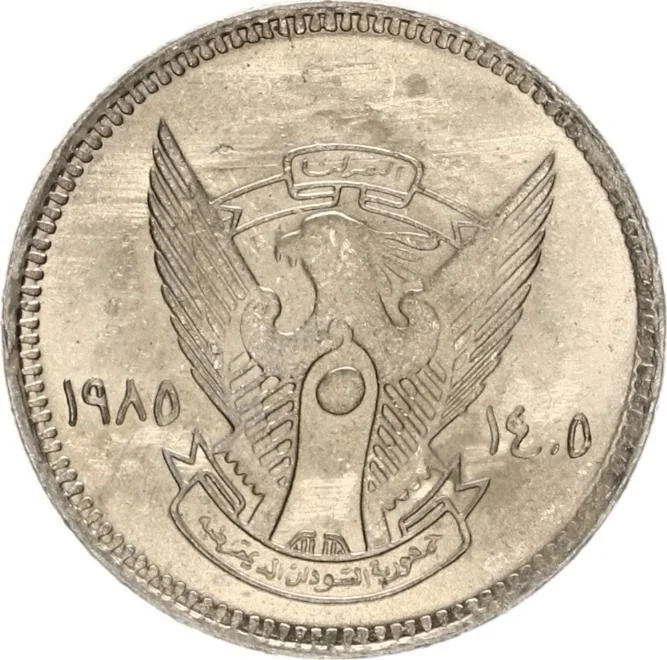
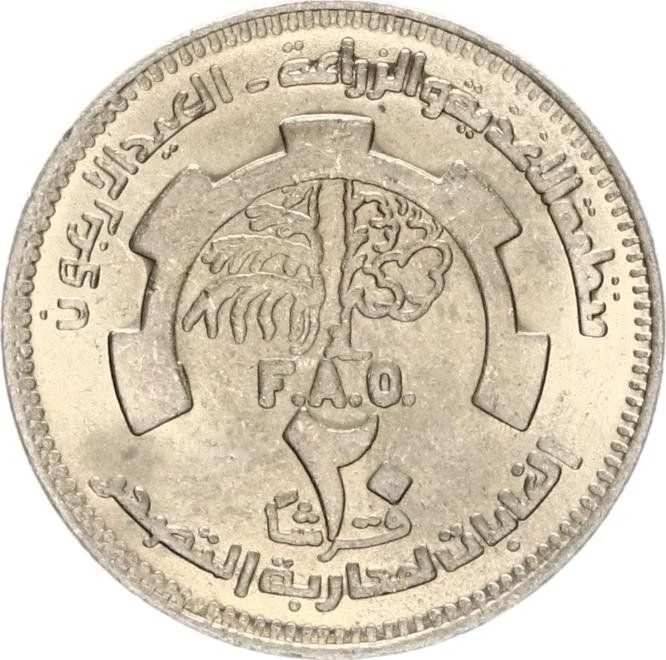
20 piastres (Food and Agriculture Organization) – Sudan
Add to wishlist
Circulating commemorative coins
Commemoration: 40th Anniversary of the Food and Agriculture Organization
Sudan
Context
Year: 1985
Islamic (Hijri) Year:: 1405
Issuer: Sudan
Period:
(1969—1985)
Currency:
(1956—1992)
Demonetization: 8 June 1992
Total mintage: 1,000,000
Material
References
KM: #
Numista: #9242
Value
Exchange value: 0.20 SDP
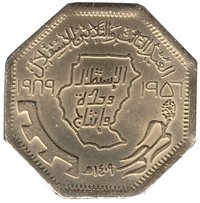
Obverse
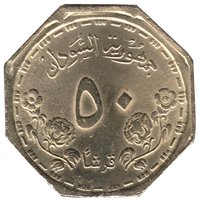
Reverse
Edge
Reeded
Categories
| Animal> Bird |
| Organization> FAO |
Mintings
| Year | Mint Mark | Mintage | Quality | Collection |
|---|---|---|---|---|
| 1985 | — | 1,000,000 |
Historical background
In 1985, Sudan's currency situation was characterized by severe instability and devaluation, deeply intertwined with the nation's political and economic crises. The year began with the Sudanese pound (SDG) under immense pressure due to President Gaafar Nimeiry's disastrous economic policies, including the abrupt implementation of Islamic sharia law in 1983 and the removal of vital subsidies on basic commodities like bread and fuel. This triggered widespread inflation, a collapse in investor confidence, and a crippling foreign debt burden, leading to a stark divergence between the official exchange rate and a rampant black market.
The crisis culminated in April 1985 with the popular uprising that overthrew Nimeiry. His government's final act, just days before its fall, was a desperate and chaotic currency reform. In early April, old banknotes were suddenly demonetized and replaced with new ones, a move ostensibly aimed at curbing black-market trading and hoarding. However, the poorly planned execution caused public panic, cash shortages, and economic paralysis, further eroding trust in the monetary system and fueling the protests that ended his 16-year rule.
The transitional military-civilian government that took power inherited a shattered economy. The black market for foreign currency, especially US dollars, flourished as the official rate became increasingly unrealistic. Inflation soared, driven by massive budget deficits monetized by the central bank. This period set the stage for the chronic hyperinflation and currency instability that would plague Sudan for decades, as the fundamental issues of debt, agricultural decline (particularly the failing Gezira Scheme), and political instability remained unresolved.
The crisis culminated in April 1985 with the popular uprising that overthrew Nimeiry. His government's final act, just days before its fall, was a desperate and chaotic currency reform. In early April, old banknotes were suddenly demonetized and replaced with new ones, a move ostensibly aimed at curbing black-market trading and hoarding. However, the poorly planned execution caused public panic, cash shortages, and economic paralysis, further eroding trust in the monetary system and fueling the protests that ended his 16-year rule.
The transitional military-civilian government that took power inherited a shattered economy. The black market for foreign currency, especially US dollars, flourished as the official rate became increasingly unrealistic. Inflation soared, driven by massive budget deficits monetized by the central bank. This period set the stage for the chronic hyperinflation and currency instability that would plague Sudan for decades, as the fundamental issues of debt, agricultural decline (particularly the failing Gezira Scheme), and political instability remained unresolved.
🌱 Fairly Common