

5 Afghanis – Afghanistan
Afghanistan
Context
Years: 2004–2005
Issuer: Afghanistan 
Issuing organization: Da Afghanistan Bank
Period:
(since 2004)
Currency:
(since 2003)
Material
References
KM: #Click to copy to clipboard1046
Numista: #9240
Value
Exchange value: 5 AFN
Obverse
Description:
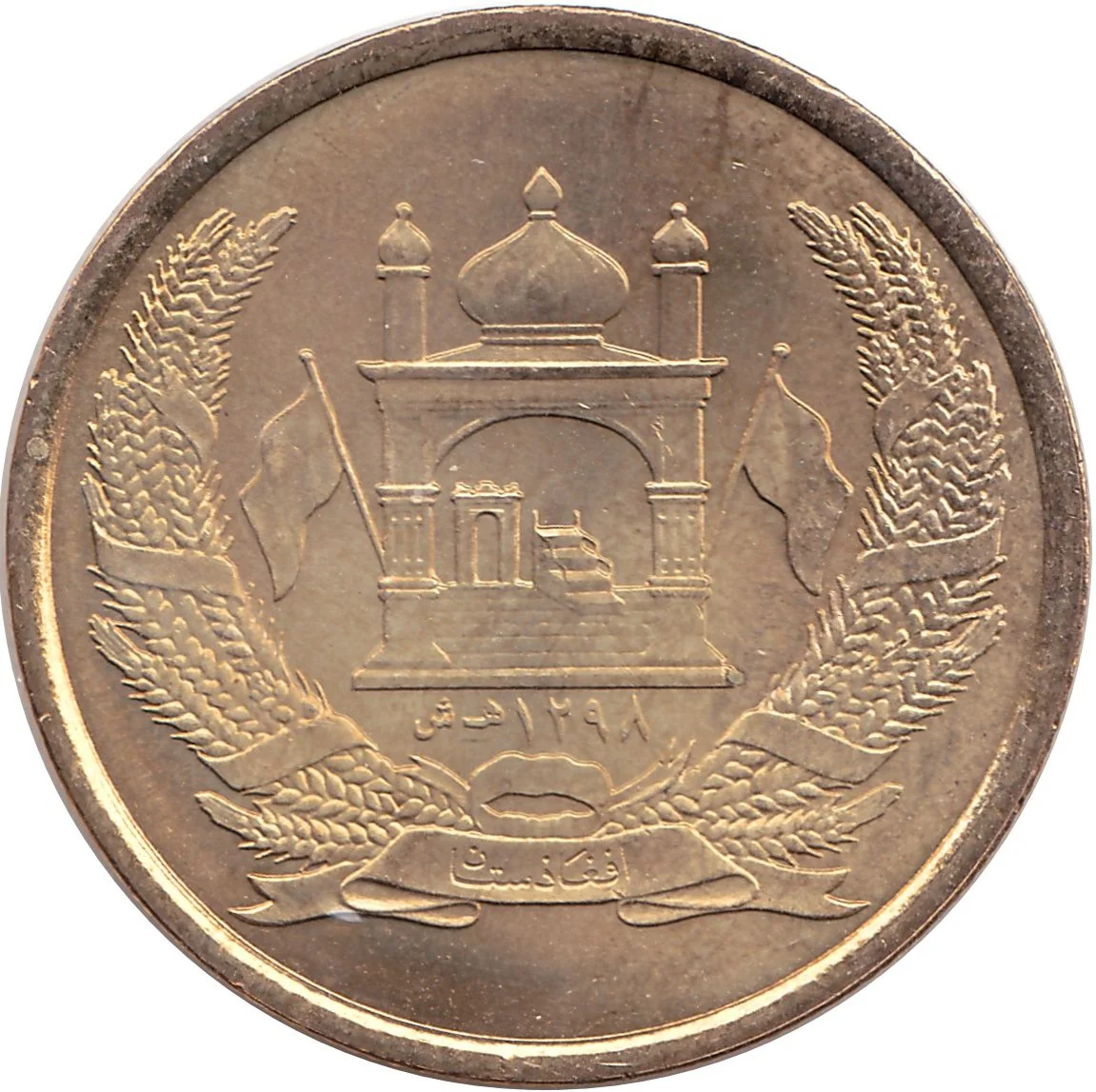
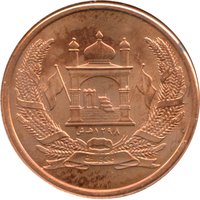
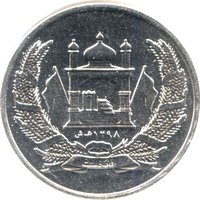
Afghanistan's coat of arms, adopted in 2002, features a mosque with two flags, a *mihrab*, and a prayer rug. It is encircled by wheat sheaves, a sunrise, and the independence year 1298. A ribbon at the bottom bears the country's Pashto name.
Inscription:
١٢٩٨ هـ ش
افغانستان
افغانستان
Translation:
1298 AH
Afghanistan
Afghanistan
Script: Arabic
Reverse
Description:
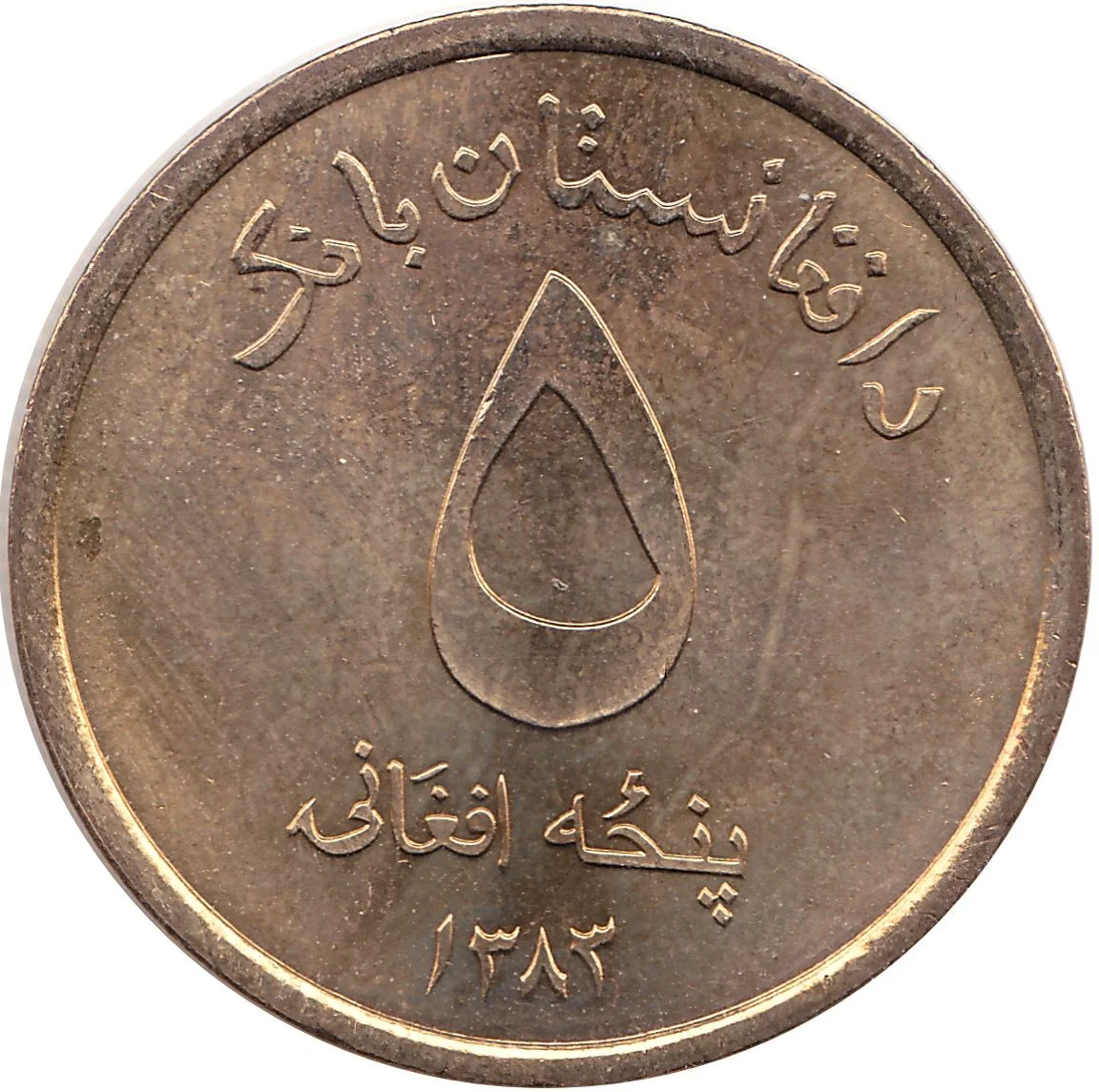
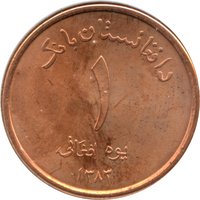
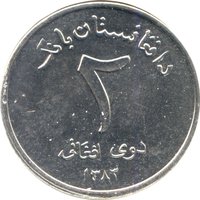
State Bank, denomination, year.
Inscription:
د افغانستان بانک
٥
پنحه افغانی
۱۳۸۳
٥
پنحه افغانی
۱۳۸۳
Translation:
5
Five Afghani
1383
Five Afghani
1383
Script: Arabic
Languages: Arabic numeral., Pashto
Edge
Reeded
Categories
| Building> Religious building |
| Symbols> Coat of Arms |
Mints
| Name | Mark |
|---|---|
| Monnaie de Paris | — |
Mintings
| Year | Mint Mark | Mintage | Quality | Collection |
|---|---|---|---|---|
| 2004 | — | — | ||
| 2005 | — | — |
Historical background
In 2004, Afghanistan's currency situation was defined by a fragile but crucial transition following the fall of the Taliban regime. The cornerstone of this period was the successful introduction of a new, unified currency—the Afghani (AFA)—in 2002-2003, which replaced a chaotic landscape of multiple competing notes issued by warlords and the previous central bank. This monetary reform, orchestrated by the interim government with international support, was a critical step in re-establishing state sovereignty and economic stability. By 2004, the new Afghani had gained public trust and was circulating nationwide, providing a single, reliable medium of exchange for the first time in decades.
Despite this foundational achievement, the economy in 2004 remained heavily dependent on foreign aid and the cash-driven influx of international military and NGO spending. The formal banking sector was extremely underdeveloped, with limited access for most citizens, while informal hawala networks continued to handle a significant portion of remittances and trade finance. Furthermore, the Afghan economy was highly dollarized, with the US Dollar widely used for large transactions, savings, and as a hedge against uncertainty. This dollarization, while providing some stability, also limited the central bank's control over monetary policy.
Overall, the currency situation in 2004 was one of successful institutional rebuilding from a state of collapse, yet it operated within an economy still in its early stages of post-conflict recovery. The new Afghani provided a symbol and tool of national unity, but its environment was characterized by informality, external dependencies, and the ongoing challenge of building a robust financial system to support lasting economic growth.
Despite this foundational achievement, the economy in 2004 remained heavily dependent on foreign aid and the cash-driven influx of international military and NGO spending. The formal banking sector was extremely underdeveloped, with limited access for most citizens, while informal hawala networks continued to handle a significant portion of remittances and trade finance. Furthermore, the Afghan economy was highly dollarized, with the US Dollar widely used for large transactions, savings, and as a hedge against uncertainty. This dollarization, while providing some stability, also limited the central bank's control over monetary policy.
Overall, the currency situation in 2004 was one of successful institutional rebuilding from a state of collapse, yet it operated within an economy still in its early stages of post-conflict recovery. The new Afghani provided a symbol and tool of national unity, but its environment was characterized by informality, external dependencies, and the ongoing challenge of building a robust financial system to support lasting economic growth.
🌱 Very Common