

5 euro – Latvia
Add to wishlist
Non-circulating coins
Commemoration: National Entrepreneur
Latvia
Context
Material

References
KM: #
Numista: #92397
Value
Exchange value: 5 EUR
Bullion value: $68.75
Inflation-adjusted value: 7.32 EUR
Obverse
Description:
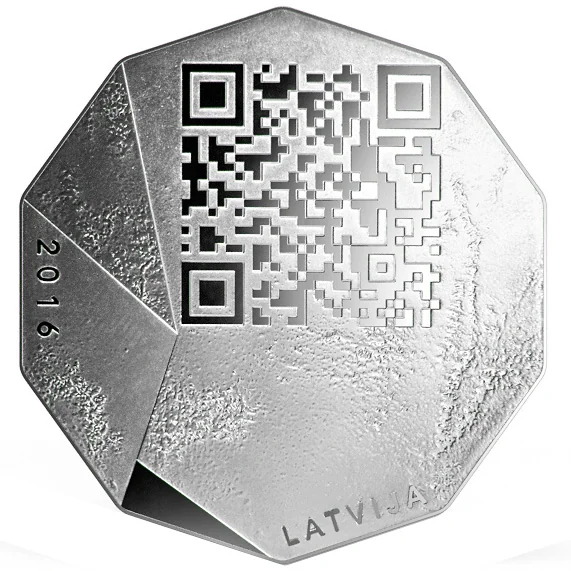
A QR code for the future is at the top, with 2016 on the left and LATVIJA at the bottom.
Inscription:
2016
LATVIJA
LATVIJA
Script: Latin
Engraver: Ivars Drulle
Designer: Paulis Liepa
Reverse
Description:
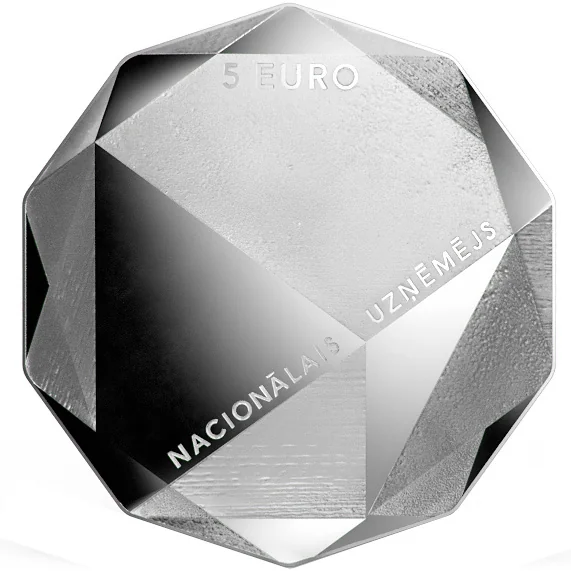
The reverse has 25 raised facets for the years of entrepreneurship, with "5 EURO" at the top and "NACIONĀLAIS UZŅĒMĒJS" inscribed slantwise below.
Inscription:
5 EURO
NACIONĀLAIS UZŅĒMĒJS
NACIONĀLAIS UZŅĒMĒJS
Translation:
5 EURO
NATIONAL ENTERPRISE
NATIONAL ENTERPRISE
Script: Latin
Language: Latvian
Engraver: Ivars Drulle
Designer: Paulis Liepa
Edge
Plain.
Mints
| Name | Mark |
|---|---|
| Lithuanian Mint | — |
Mintings
| Year | Mint Mark | Mintage | Quality | Collection |
|---|---|---|---|---|
| 2016 | — | 3,000 | Proof |
Historical background
In 2016, Latvia was in its third year as a member of the Eurozone, having adopted the euro on January 1, 2014. This transition from the lat (LVL) was a strategic political and economic milestone, solidifying the country's integration with core European institutions following its EU accession in 2004. The primary domestic motivation was to enhance economic stability, attract foreign investment, and eliminate currency exchange risks with its major trading partners, particularly other Eurozone members and the broader EU. By 2016, the euro was fully embedded in daily life, with public opinion, initially skeptical, having largely accepted the new currency as a symbol of Latvia's "return to Europe."
The macroeconomic context in 2016 was one of cautious stability but with underlying vulnerabilities. Latvia's economy was growing at a moderate pace, but it remained one of the poorer Eurozone members, with income levels below the EU average. A key ongoing concern was the risk of money laundering within the financial system, a legacy issue from the post-Soviet era that gained international scrutiny. While not a direct currency issue, this reputational risk had implications for financial stability and investor confidence within the single currency framework. Furthermore, Latvia continued to benefit from Eurozone membership through lower interest rates and enhanced trade, but it also had to adhere to the bloc's strict fiscal rules, limiting budgetary flexibility.
Internationally, Latvia's euro membership positioned it within the broader debates and challenges facing the Eurozone in 2016. The aftermath of the Greek debt crisis and the migration crisis were testing European solidarity. As a small, open economy on the EU's eastern frontier, Latvia's perspective within Eurozone discussions often emphasized fiscal discipline and geopolitical security, particularly in light of heightened tensions with Russia following the annexation of Crimea in 2014. Thus, in 2016, the currency situation was not one of transition or crisis for Latvia, but rather one of consolidated membership within a larger monetary union navigating significant political and economic headwinds.
The macroeconomic context in 2016 was one of cautious stability but with underlying vulnerabilities. Latvia's economy was growing at a moderate pace, but it remained one of the poorer Eurozone members, with income levels below the EU average. A key ongoing concern was the risk of money laundering within the financial system, a legacy issue from the post-Soviet era that gained international scrutiny. While not a direct currency issue, this reputational risk had implications for financial stability and investor confidence within the single currency framework. Furthermore, Latvia continued to benefit from Eurozone membership through lower interest rates and enhanced trade, but it also had to adhere to the bloc's strict fiscal rules, limiting budgetary flexibility.
Internationally, Latvia's euro membership positioned it within the broader debates and challenges facing the Eurozone in 2016. The aftermath of the Greek debt crisis and the migration crisis were testing European solidarity. As a small, open economy on the EU's eastern frontier, Latvia's perspective within Eurozone discussions often emphasized fiscal discipline and geopolitical security, particularly in light of heightened tensions with Russia following the annexation of Crimea in 2014. Thus, in 2016, the currency situation was not one of transition or crisis for Latvia, but rather one of consolidated membership within a larger monetary union navigating significant political and economic headwinds.

💎 Extremely Rare