

5 Euro (The First session of LPNC) – Latvia
Non-circulating coins
Commemoration: Dedicated to the 100th anniversary of The First session of LPNC
Latvia
Context
Material
Diameter: 38.61 mm
Weight: 31.47 g
Silver weight: 29.11 g
Shape: Round
Composition: 92.5% Silver
Standard: Silver ounce
Magnetic: No
Technique: Milled
Alignment: Medal alignment
flip
References
KM: #Click to copy to clipboard186
Numista: #130374
Value
Exchange value: 5 EUR = $5.91
Bullion value: $80.69
Inflation-adjusted value: 7.31 EUR
Obverse
Description:
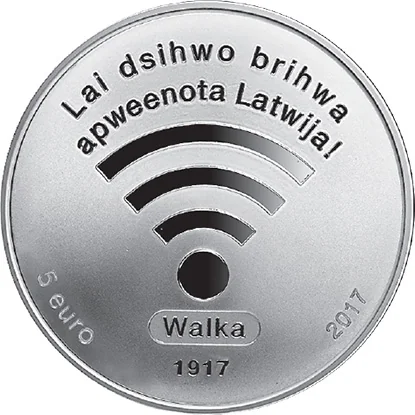
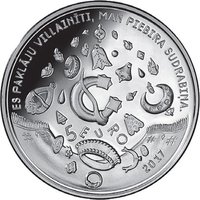
Centered Wi-Fi symbol, with "Long live the free and united Latvia!" arched above. "Walka" and the year 1917 are below. "5 euro" is arched at bottom left, with 2017 to its right.
Inscription:
Lai dsiwo brihwa
apweenota Latvija!
Walka
1917
5 euro
2017
apweenota Latvija!
Walka
1917
5 euro
2017
Translation:
For the independent Latvia!
Freedom
1917
5 euro
2017
Freedom
1917
5 euro
2017
Script: Latin
Designer: Ivars Drulle
Reverse
Description:
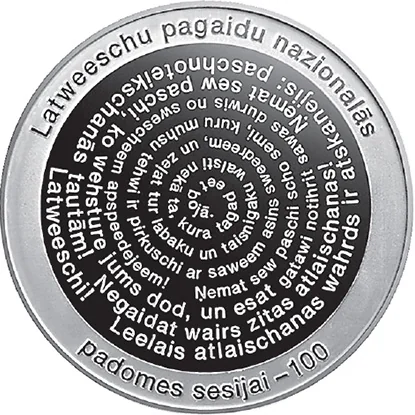
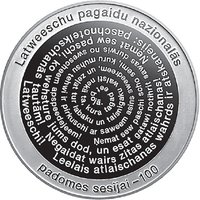
Centered in a spiral from the rim is a historically spelled extract from the Latvian Provisional National Council's appeal "To all Latvians!". It calls for self-determination, urging Latvians to seize the moment, liberate their land, and build a more just state. "Latveeschu pagaidu nazionalās" arches above, and "padomes sesijai – 100" arches below.
Inscription:
Latweeschu pagaidu nazionalās
Latweeschi! Leelais atlaischanas wahrds ir atskanejis: paschnoteikschanās tautām! Negaidat wairs zitas atlaischanas! Ņemat sew paschi, ko wehsture jums dod, un esat gatawi notihrit sawas durwis no swescheem apspeedeejeem! Ņemat sew paschi scho semi, kuru muhsu tehwi ir pirkuschi ar saweem asins sweedreem, un zeļat tur labaku un taisnigaku walsti nekā ta, kura tagad eet bojaa.
padomes sesijai – 100
Latweeschi! Leelais atlaischanas wahrds ir atskanejis: paschnoteikschanās tautām! Negaidat wairs zitas atlaischanas! Ņemat sew paschi, ko wehsture jums dod, un esat gatawi notihrit sawas durwis no swescheem apspeedeejeem! Ņemat sew paschi scho semi, kuru muhsu tehwi ir pirkuschi ar saweem asins sweedreem, un zeļat tur labaku un taisnigaku walsti nekā ta, kura tagad eet bojaa.
padomes sesijai – 100
Translation:
Latvian! The great word of liberation has resounded: self-determination for nations! Wait no longer for that liberation! Take for yourselves what history gives you, and be ready to defend your doors from foreign invaders! Take for yourselves that land, which our fathers have bought with their bloody sweat, and wish for it a better and more just state than the one that is now perishing.
to the council session – 100
to the council session – 100
Script: Latin
Language: Latvian
Designer: Ivars Drulle
Edge
Plain with inscription
Legend:
LATVIJAS BANKA ◊ LATVIJAS REPUBLIKA ◊
Translation:
LATVIJAS BANKA ◊ LATVIJAS REPUBLIKA ◊
Language: Latvian
Mints
| Name | Mark |
|---|---|
| Royal Dutch Mint | — |
Mintings
| Year | Mint Mark | Mintage | Quality | Collection |
|---|---|---|---|---|
| 2017 | — | 3,000 | Proof |
Historical background
In 2017, Latvia was in its fourth year as a member of the Eurozone, having adopted the euro on January 1, 2014. This transition from the national currency, the lats, was largely viewed as successful and had solidified the country's economic and political integration with core European institutions. By 2017, the euro was firmly established in daily use, with public support for the currency remaining relatively stable and the initial period of price-level adjustments largely complete. The macroeconomic environment was one of steady, moderate growth, with low inflation and a stable financial sector.
The primary currency-related discussions in Latvia during 2017 were not about the euro itself, but about broader financial governance and security within the monetary union. As a member of the Eurozone, Latvia's monetary policy was set by the European Central Bank (ECB), which continued its expansive quantitative easing program to stimulate the euro area economy. Domestically, attention focused on maintaining fiscal discipline to meet Eurozone stability criteria and on addressing longstanding issues within the banking sector. This was particularly salient following the 2016 liquidation of ABLV Bank, which underscored concerns about financial supervision and the sector's exposure to non-resident deposits, primarily from the former Soviet Union.
Furthermore, 2017 was a year of looking forward within the Eurozone framework. There was active Latvian participation in discussions on deepening the Economic and Monetary Union (EMU), including proposals for a European banking union and further fiscal integration. Domestically, the government's focus was on leveraging the stability of the single currency to attract investment and converge with average EU income levels, while ensuring that the national economy remained competitive within the euro area. Thus, the currency situation was characterized by operational normality, with policy debates centered on enhancing the architecture and security of the Eurozone system to which Latvia was now irrevocably tied.
The primary currency-related discussions in Latvia during 2017 were not about the euro itself, but about broader financial governance and security within the monetary union. As a member of the Eurozone, Latvia's monetary policy was set by the European Central Bank (ECB), which continued its expansive quantitative easing program to stimulate the euro area economy. Domestically, attention focused on maintaining fiscal discipline to meet Eurozone stability criteria and on addressing longstanding issues within the banking sector. This was particularly salient following the 2016 liquidation of ABLV Bank, which underscored concerns about financial supervision and the sector's exposure to non-resident deposits, primarily from the former Soviet Union.
Furthermore, 2017 was a year of looking forward within the Eurozone framework. There was active Latvian participation in discussions on deepening the Economic and Monetary Union (EMU), including proposals for a European banking union and further fiscal integration. Domestically, the government's focus was on leveraging the stability of the single currency to attract investment and converge with average EU income levels, while ensuring that the national economy remained competitive within the euro area. Thus, the currency situation was characterized by operational normality, with policy debates centered on enhancing the architecture and security of the Eurozone system to which Latvia was now irrevocably tied.
💎 Extremely Rare