

20 Decimos de Real – Buenos Aires
Argentina
Context
Year: 1830
Country: Argentina 
Issuer: Buenos Aires
Period:
(1810—1831)
Currency:
(1822—1861)
Demonetized: Yes
Material
References
KM: #Click to copy to clipboard5
Numista: #92298
Obverse
Description:
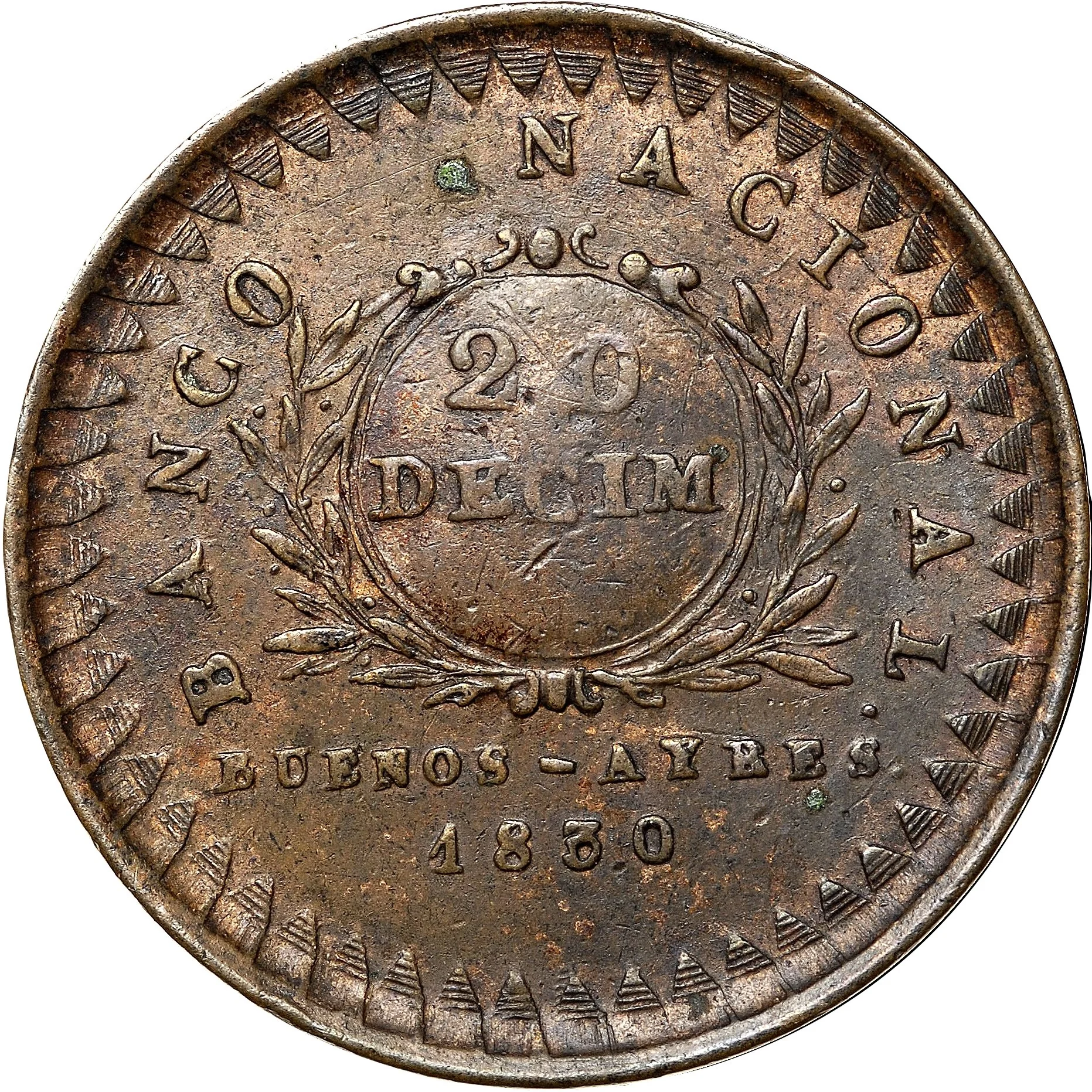
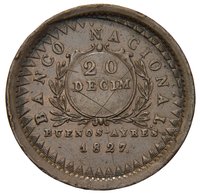
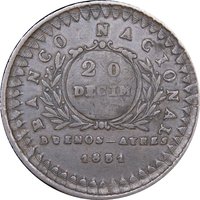
Center ornament with "20 / DECIM," framed by fruited laurel garlands. Above, "BANCO NACIONAL" arches; below, "BUENOS-AYRES / 1830" is inscribed. Border of small, striped triangles.
Inscription:
BUENOS - AYRES .
1830
BANCO NACIONAL.
20 DECIM
1830
BANCO NACIONAL.
20 DECIM
Translation:
BUENOS AIRES .
1830
NATIONAL BANK.
20 TENTHS
1830
NATIONAL BANK.
20 TENTHS
Script: Latin
Language: Spanish
Reverse
Description:
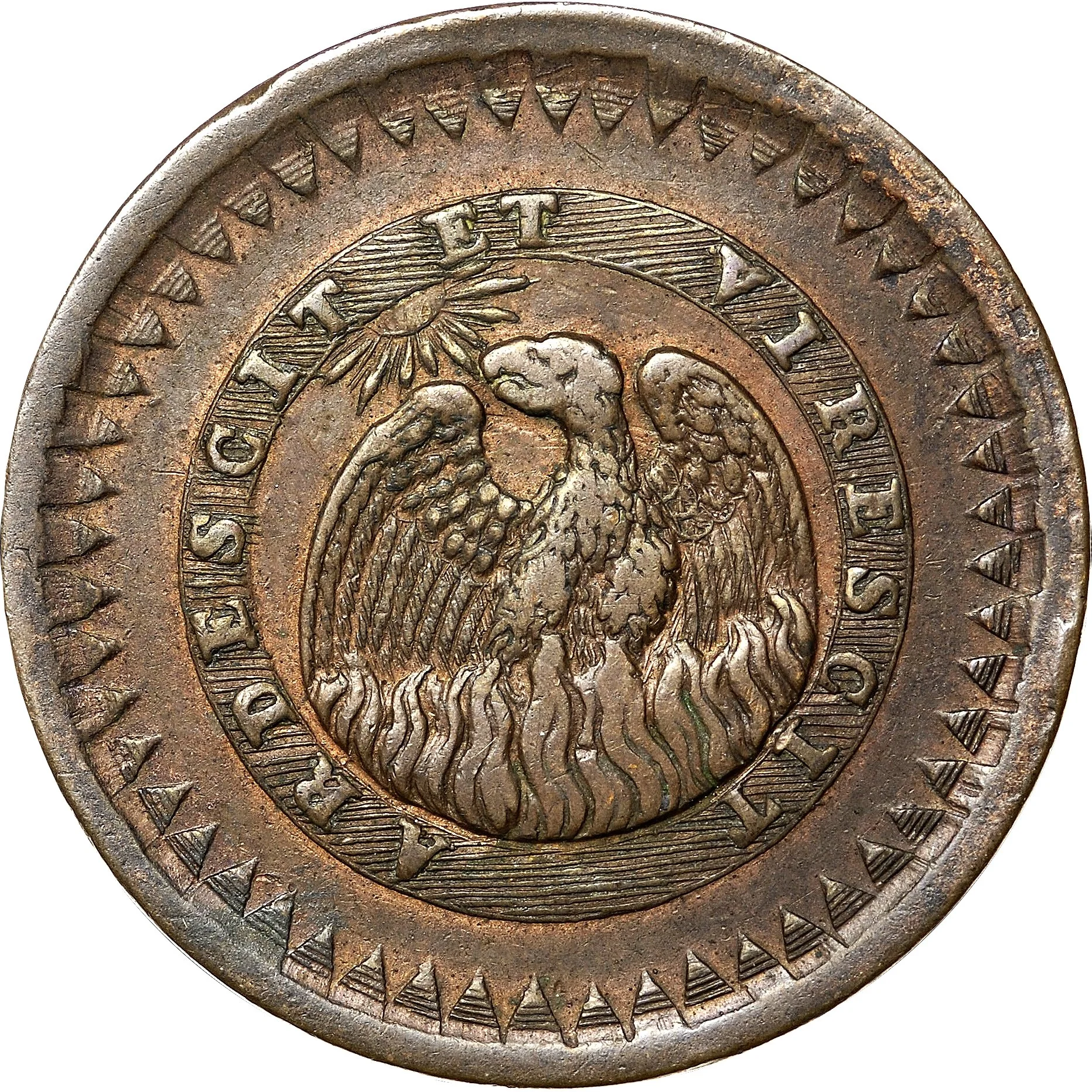
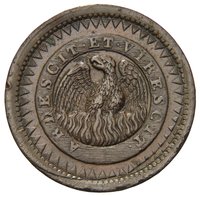
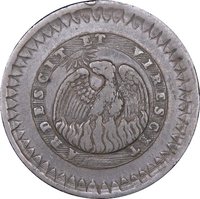
Inside a blue striped circle inscribed "ARDESCIT ET VIRESCIT," a phoenix faces right toward a partial radiant sun.
Inscription:
ARDESCIT ET VIRESCIT
Script: Latin
Edge
Plain
Mintings
| Year | Mint Mark | Mintage | Quality | Collection |
|---|---|---|---|---|
| 1830 | — | — |
Historical background
In 1830, Buenos Aires was the dominant political and economic force within the Argentine Confederation, but its currency situation was one of profound disorder and fragmentation. Following independence from Spain, the region inherited a chaotic monetary landscape characterized by a severe shortage of official coinage. This vacuum was filled by a bewildering array of currencies circulating simultaneously: worn Spanish colonial coins (like pesos fuertes and reales), coins from other nations (especially British sovereigns, Brazilian pesos, and Bolivian soles), and a flood of privately issued paper money from provincial banks and even mercantile houses. The lack of a unified national mint or a central banking authority meant there was no standardised currency, leading to constant confusion over values and widespread counterfeiting.
The most significant development was the introduction of paper money by the Banco de Buenos Aires (established in 1822). Initially convertible to precious metal, the bank's notes gained public trust. However, to finance the costly wars against Brazil and internal federalist conflicts, the government of Juan Manuel de Rosas, who rose to power in 1829, began to pressure the bank for large, non-convertible loans. This initiated a cycle of excessive note issuance, which steadily eroded the value of paper pesos against silver. By 1830, the gap between the face value of paper and its real value in metal (the "agio") was becoming a fixed and troubling feature of the economy, creating a dual monetary system where transactions were often specified as being in "paper" or "metal."
Consequently, the currency chaos of 1830 reflected the broader political struggles of the era. The monetary instability directly resulted from the constant fiscal demands of war and the absence of strong central institutions, as Rosas consolidated his autocratic rule. This environment discouraged long-term investment and complicated trade, both internally with other Argentine provinces and externally with foreign merchants. The persistent devaluation of paper money effectively acted as a hidden tax on the populace, setting a precedent for monetary policy that would plague Argentina for decades and cementing a deep public distrust of paper currency that endured long after the Rosas era.
The most significant development was the introduction of paper money by the Banco de Buenos Aires (established in 1822). Initially convertible to precious metal, the bank's notes gained public trust. However, to finance the costly wars against Brazil and internal federalist conflicts, the government of Juan Manuel de Rosas, who rose to power in 1829, began to pressure the bank for large, non-convertible loans. This initiated a cycle of excessive note issuance, which steadily eroded the value of paper pesos against silver. By 1830, the gap between the face value of paper and its real value in metal (the "agio") was becoming a fixed and troubling feature of the economy, creating a dual monetary system where transactions were often specified as being in "paper" or "metal."
Consequently, the currency chaos of 1830 reflected the broader political struggles of the era. The monetary instability directly resulted from the constant fiscal demands of war and the absence of strong central institutions, as Rosas consolidated his autocratic rule. This environment discouraged long-term investment and complicated trade, both internally with other Argentine provinces and externally with foreign merchants. The persistent devaluation of paper money effectively acted as a hidden tax on the populace, setting a precedent for monetary policy that would plague Argentina for decades and cementing a deep public distrust of paper currency that endured long after the Rosas era.
💎 Very Rare