

5 euro – Italy
Add to wishlist
Non-circulating coins
Commemoration: Historic villas and gardens: Villa Cicogna Mozzoni in Bisuschio, Lombardy.
Series: Historical Villas and Gardens
Italy
Context
Material

References
KM: #
Numista: #92193
Value
Exchange value: 5 EUR
Bullion value: $42.21
Inflation-adjusted value: 6.03 EUR
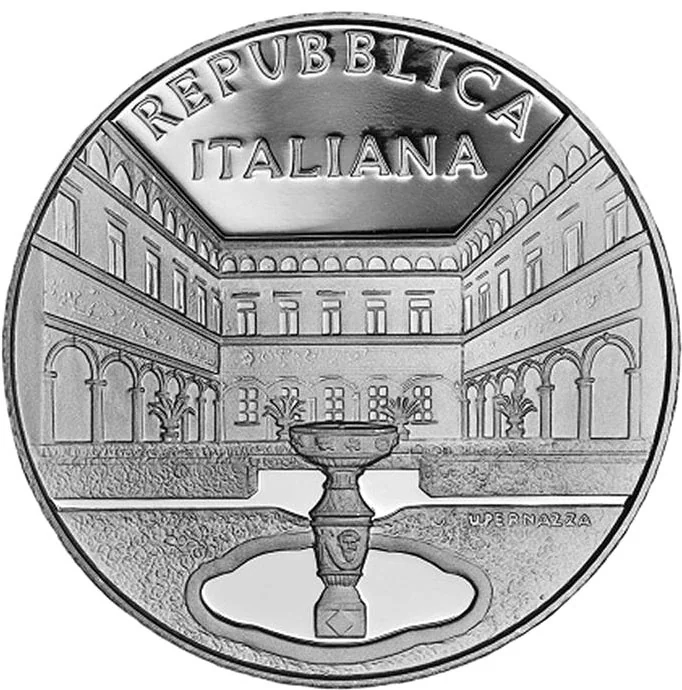
Obverse
Description:
The 16th-century Villa Cicogna Mozzoni's courtyard of honour opens onto its Italian garden.
Inscription:
REPUBBLICA
ITALIANA
U. PERNAZZA
ITALIANA
U. PERNAZZA
Translation:
Italian Republic
U. Pernazza
U. Pernazza
Script: Latin
Language: Italian
Engraver: Uliana Pernazza
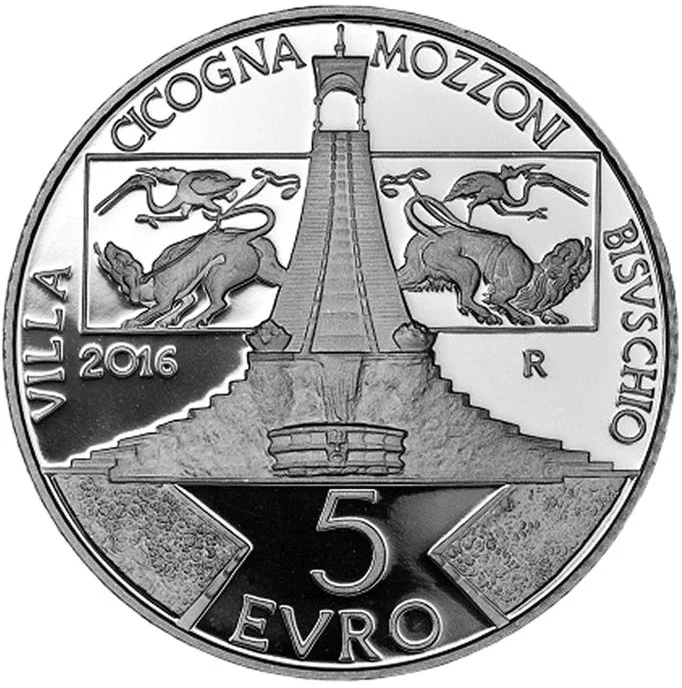
Reverse
Description:
A 156-step double water staircase ascends from a lion fountain to a hilltop nymphaeum, set in a park with frescoes of wild beasts.
Inscription:
VILLA CICOGNA MOZZONI BISVSCHIO
2016 R
5
EVRO
2016 R
5
EVRO
Script: Latin
Engraver: Uliana Pernazza
Edge
Coarsely reeded.
Mintings
| Year | Mint Mark | Mintage | Quality | Collection |
|---|---|---|---|---|
| 2016 | R | 4,000 | Proof |
Historical background
In 2016, Italy’s currency situation was defined by its continued use of the euro, a decade and a half after adopting it. The country remained a core member of the Eurozone, but this period was marked by profound economic strain and growing political skepticism toward the single currency. The Italian economy was still grappling with the legacy of the 2008 financial crisis and the subsequent Eurozone debt crisis, burdened by stagnant growth, a public debt exceeding 130% of GDP, and a fragile banking sector saddled with non-performing loans. These challenges fueled a domestic debate on whether the euro, with its strict fiscal constraints, was an impediment to Italy’s recovery and competitiveness.
The year saw significant pressure on the euro itself, driven in part by Italy's banking crisis and political instability. Concerns over the viability of major banks like Monte dei Paschi di Siena triggered fears of a broader financial contagion within the Eurozone. Furthermore, the rise of populist movements, most notably the Five Star Movement and the Northern League, amplified calls for a potential return to a national currency. They argued that leaving the euro (or "Italexit") would allow Italy to devalue its money and regain control over monetary policy to stimulate growth, though mainstream parties and the business establishment largely defended euro membership.
Ultimately, 2016 ended without a change in Italy's legal tender, but the underlying tensions were unmistakable. The constitutional referendum in December, which resulted in a defeat for Prime Minister Matteo Renzi and his resignation, was interpreted not just as a domestic political event but also as a rejection of the austerity-focused, pro-European establishment. While the immediate trigger for a euro exit did not materialize, the year solidified the currency as a central fault line in Italian politics, setting the stage for continued volatility and debate in the years that followed.
The year saw significant pressure on the euro itself, driven in part by Italy's banking crisis and political instability. Concerns over the viability of major banks like Monte dei Paschi di Siena triggered fears of a broader financial contagion within the Eurozone. Furthermore, the rise of populist movements, most notably the Five Star Movement and the Northern League, amplified calls for a potential return to a national currency. They argued that leaving the euro (or "Italexit") would allow Italy to devalue its money and regain control over monetary policy to stimulate growth, though mainstream parties and the business establishment largely defended euro membership.
Ultimately, 2016 ended without a change in Italy's legal tender, but the underlying tensions were unmistakable. The constitutional referendum in December, which resulted in a defeat for Prime Minister Matteo Renzi and his resignation, was interpreted not just as a domestic political event but also as a rejection of the austerity-focused, pro-European establishment. While the immediate trigger for a euro exit did not materialize, the year solidified the currency as a central fault line in Italian politics, setting the stage for continued volatility and debate in the years that followed.




💎 Extremely Rare