

Haiti
Context
Year: 1906
Issuer: Haiti 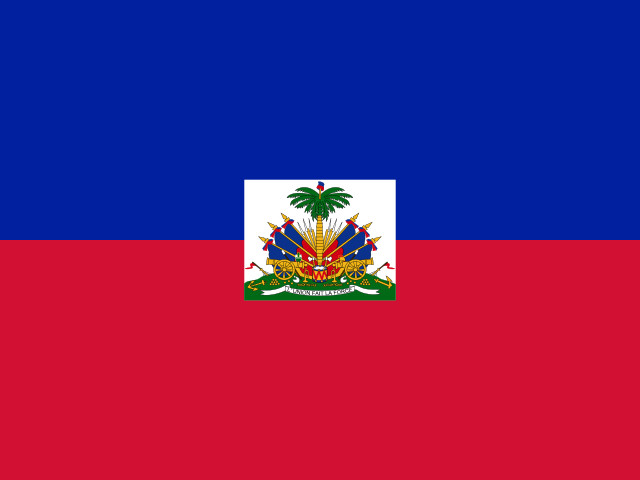
Period:
(1859—1957)
Currency:
(since 1872)
Demonetized: Yes
Total mintage: 10,000,000
Material
References
KM: #Click to copy to clipboard54
Numista: #9208
Value
Exchange value: 0.10 HTG
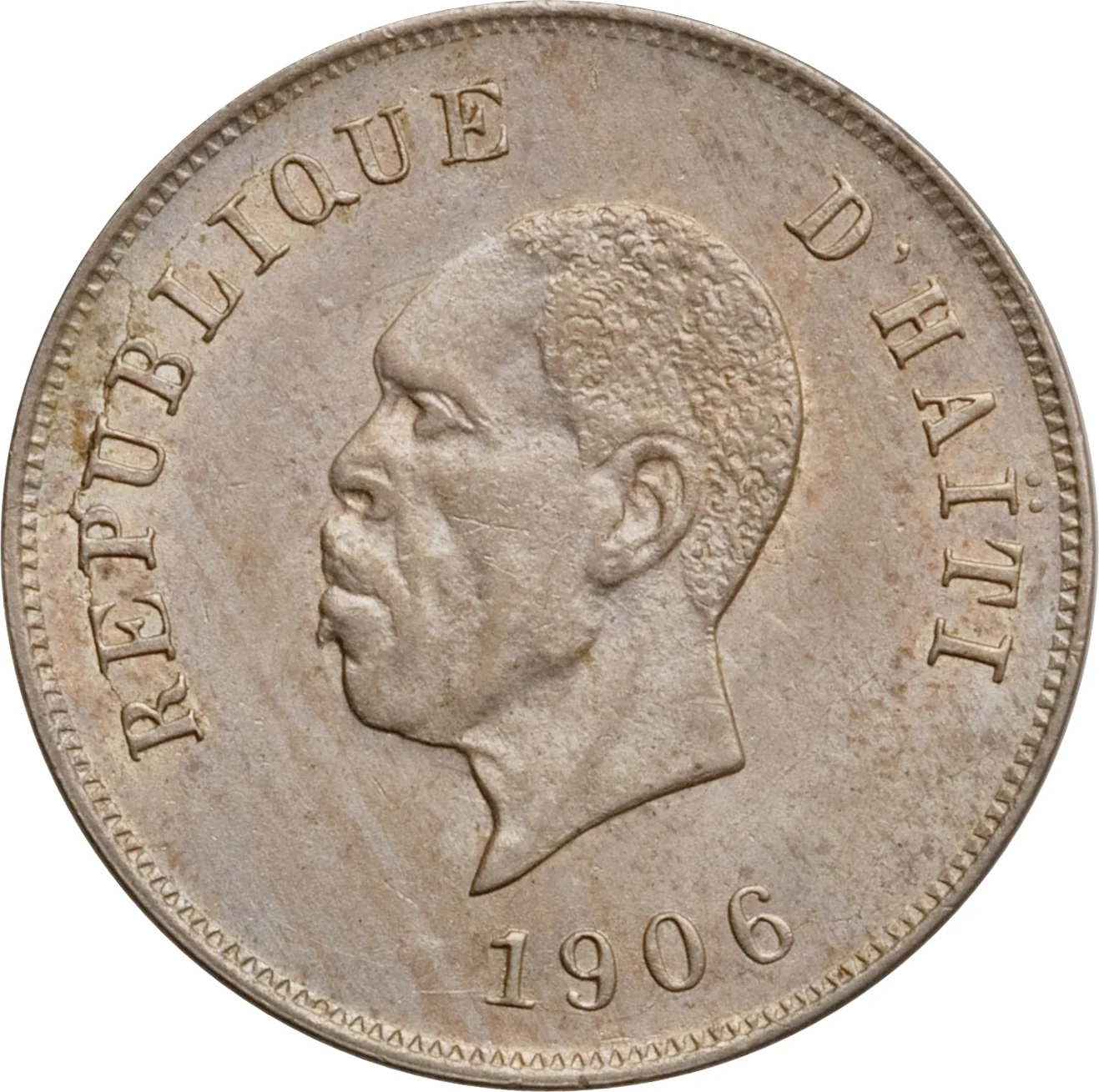
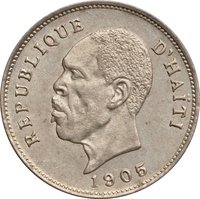
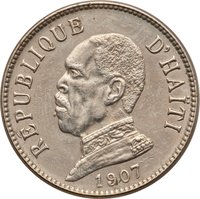
Obverse
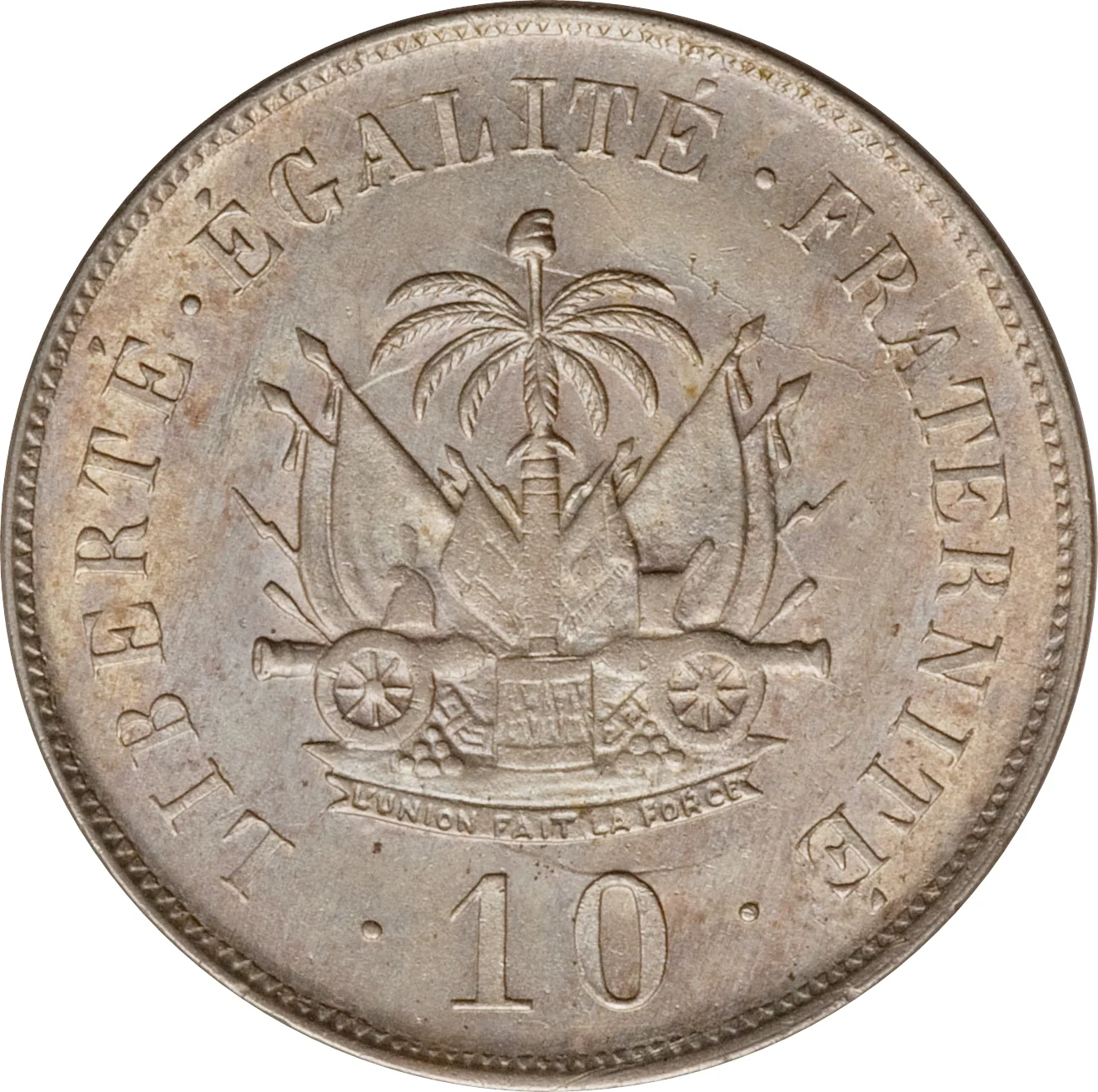
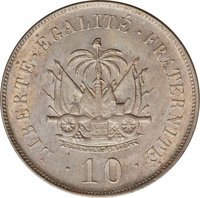
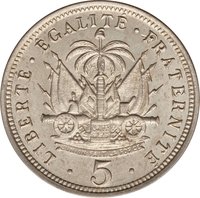
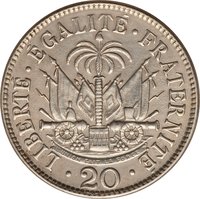
Reverse
Edge
Plain
Categories
| Person> Military leader |
| Person> Politician |
| Symbols> Coat of Arms |
Mints
| Name | Mark |
|---|---|
| Scovill Manufacturing Company | — |
Mintings
| Year | Mint Mark | Mintage | Quality | Collection |
|---|---|---|---|---|
| 1906 | — | 10,000,000 | ||
| 1906 | — | — | Proof |
Historical background
In 1906, Haiti’s currency situation was characterized by profound instability and a complex duality between the national currency, the Haitian gourde, and foreign coinage. The gourde, theoretically pegged to the French franc at a rate of 5 gourdes to 1 franc since 1881, was in practice severely depreciated and circulated alongside a multitude of foreign coins, particularly U.S. dollars, British pounds, and French francs. This monetary chaos stemmed from decades of political turmoil, chronic budget deficits financed by high-interest loans from foreign banks, and a lack of confidence in the government's ability to manage its finances. The result was a disordered system where daily transactions required cumbersome calculations of fluctuating exchange rates.
The instability was exacerbated by the heavy involvement of foreign powers, particularly France and Germany, whose merchants and banks extended credit to the Haitian government at onerous terms. These debts, often secured against future customs revenues, drained the treasury and contributed to inflation. Furthermore, the National Bank of Haiti, which held the exclusive right to issue currency, was a French-controlled institution (chartered in 1881) that often prioritized the interests of its foreign shareholders over Haitian economic stability. Its policies did little to unify the currency system or instill public confidence, leaving the gourde vulnerable to speculation and devaluation.
Consequently, by 1906, Haiti was caught in a cycle of economic weakness and foreign dependency. The unreliable gourde hampered internal trade and complicated international commerce, while the government's desperate need for revenue made it susceptible to further foreign financial intervention. This precarious monetary environment was a key symptom of the broader political and economic fragility that would culminate in the complete takeover of Haitian finances by the United States following its military occupation in 1915. The currency chaos of 1906 thus represented a critical point in Haiti's gradual loss of fiscal sovereignty.
The instability was exacerbated by the heavy involvement of foreign powers, particularly France and Germany, whose merchants and banks extended credit to the Haitian government at onerous terms. These debts, often secured against future customs revenues, drained the treasury and contributed to inflation. Furthermore, the National Bank of Haiti, which held the exclusive right to issue currency, was a French-controlled institution (chartered in 1881) that often prioritized the interests of its foreign shareholders over Haitian economic stability. Its policies did little to unify the currency system or instill public confidence, leaving the gourde vulnerable to speculation and devaluation.
Consequently, by 1906, Haiti was caught in a cycle of economic weakness and foreign dependency. The unreliable gourde hampered internal trade and complicated international commerce, while the government's desperate need for revenue made it susceptible to further foreign financial intervention. This precarious monetary environment was a key symptom of the broader political and economic fragility that would culminate in the complete takeover of Haitian finances by the United States following its military occupation in 1915. The currency chaos of 1906 thus represented a critical point in Haiti's gradual loss of fiscal sovereignty.
🌱 Common