

100 dirhams – United Arab Emirates
Add to wishlist
Non-circulating coins
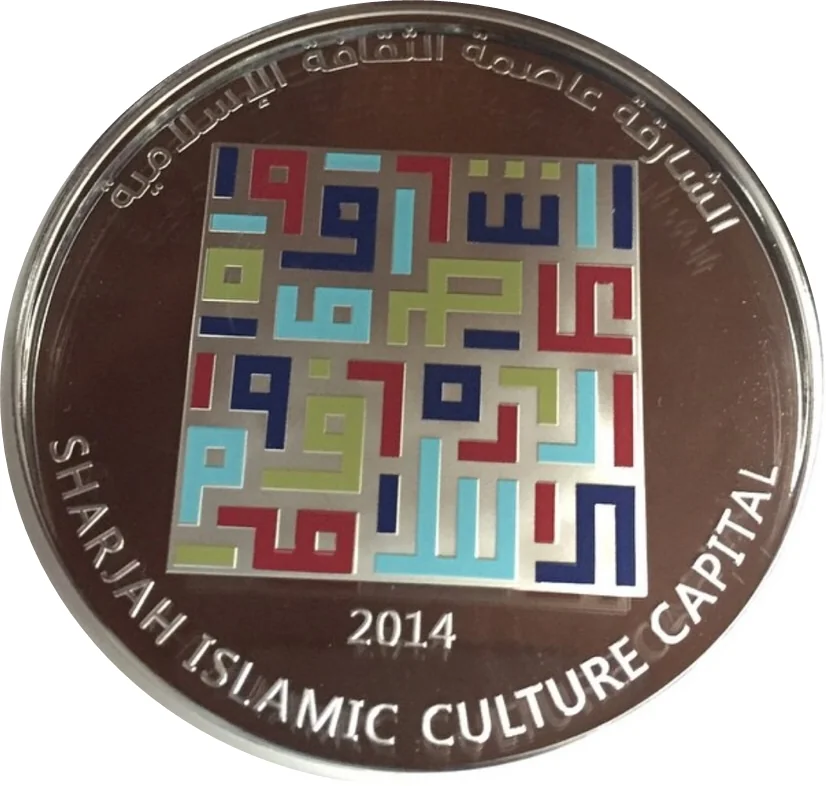
Commemoration: Selection of Sharjah as Capital of Islamic Culture 2014
United Arab Emirates
Context
Year: 2014
Issuer: United Arab Emirates
Ruler: Khalifa bin Zayed Al Nahyan
Currency:
(since 1973)
Total mintage: 900
Material
References
KM: #
Numista: #91983
Value
Exchange value: 100 AED
Bullion value: $139.07
Obverse
Description:
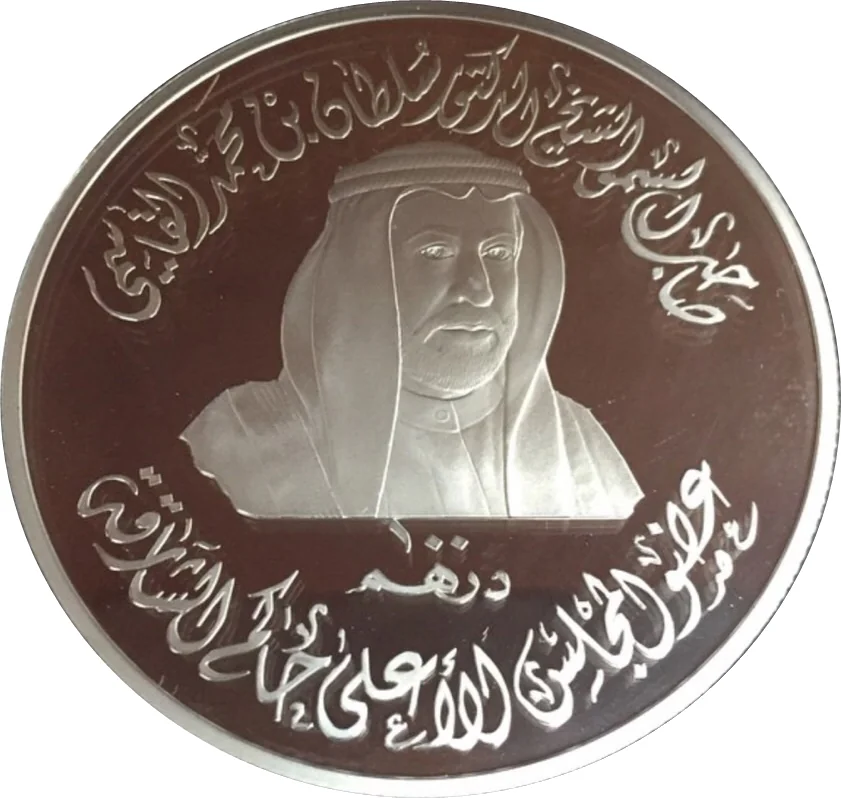
Bust of Dr. Sultan Al Qasimi, facing right.
Inscription:
صاحب السمو الشيخ الدكتور سُلطان بن محمّد القاسِمي
١٠٠
درهمـ
عضو المجلِس الأعلى حاكم الشَارقة
١٠٠
درهمـ
عضو المجلِس الأعلى حاكم الشَارقة
Translation:
His Highness Sheikh Dr. Sultan bin Muhammad Al Qasimi
100
Dirhams
Member of the Supreme Council, Ruler of Sharjah
100
Dirhams
Member of the Supreme Council, Ruler of Sharjah
Script: Arabic
Language: Arabic
Reverse
Edge
Reeded
Mintings
| Year | Mint Mark | Mintage | Quality | Collection |
|---|---|---|---|---|
| 2014 | — | 900 | Proof |
Historical background
In 2014, the currency situation in the United Arab Emirates was characterized by exceptional stability and confidence, anchored by the UAE Dirham's (AED) long-standing peg to the US Dollar. This peg, established in 1997 at a fixed rate of approximately AED 3.6725 per USD, provided a crucial foundation for the economy. It ensured low inflation, eliminated exchange rate risk for foreign investors, and supported the UAE's role as a global trade and tourism hub, particularly as Dubai prepared for Expo 2020. The policy mirrored that of other Gulf Cooperation Council (GCC) states, aligning monetary policy with the US Federal Reserve, which was particularly significant as the Fed began tapering its quantitative easing program in late 2013.
The year saw the dirham's peg quietly reaffirmed as a cornerstone of economic policy, despite occasional market speculation. Discussions about potential GCC monetary union had largely faded by this time, leaving the individual pegs as the definitive framework. Economically, 2014 was a period of robust growth and high oil prices in the first half, which bolstered foreign currency reserves and further cemented the sustainability of the peg. The currency stability was a key factor in facilitating massive infrastructure spending and sustaining the UAE's booming real estate and construction sectors.
However, the latter part of 2014 introduced a new dynamic as global oil prices began a sharp, unexpected collapse, falling by nearly 50% in the second half of the year. This immediately raised questions about the fiscal sustainability of oil-exporting nations and led to mild, short-lived pressures on forward currency markets. Despite this shock, the UAE's substantial sovereign wealth buffers, diversified economy (especially in Dubai), and unwavering commitment from the Central Bank of the UAE ensured that the dirham peg remained unquestioned and operationally unchallenged throughout the year, demonstrating its resilience as a core pillar of the nation's financial system.
The year saw the dirham's peg quietly reaffirmed as a cornerstone of economic policy, despite occasional market speculation. Discussions about potential GCC monetary union had largely faded by this time, leaving the individual pegs as the definitive framework. Economically, 2014 was a period of robust growth and high oil prices in the first half, which bolstered foreign currency reserves and further cemented the sustainability of the peg. The currency stability was a key factor in facilitating massive infrastructure spending and sustaining the UAE's booming real estate and construction sectors.
However, the latter part of 2014 introduced a new dynamic as global oil prices began a sharp, unexpected collapse, falling by nearly 50% in the second half of the year. This immediately raised questions about the fiscal sustainability of oil-exporting nations and led to mild, short-lived pressures on forward currency markets. Despite this shock, the UAE's substantial sovereign wealth buffers, diversified economy (especially in Dubai), and unwavering commitment from the Central Bank of the UAE ensured that the dirham peg remained unquestioned and operationally unchallenged throughout the year, demonstrating its resilience as a core pillar of the nation's financial system.
✨ Legendary