

5 Fils – Jordan
Jordan
Context
Year: 1949
Islamic (Hijri) Year: 1368
Issuer: Jordan 
Ruler: Abdullah I bin Al-Hussein
Currency:
(since 1949)
Demonetized: Yes
Total mintage: 3,300,025
Material
References
KM: #Click to copy to clipboard3
Numista: #11510
Value
Exchange value: 0.005 JOD
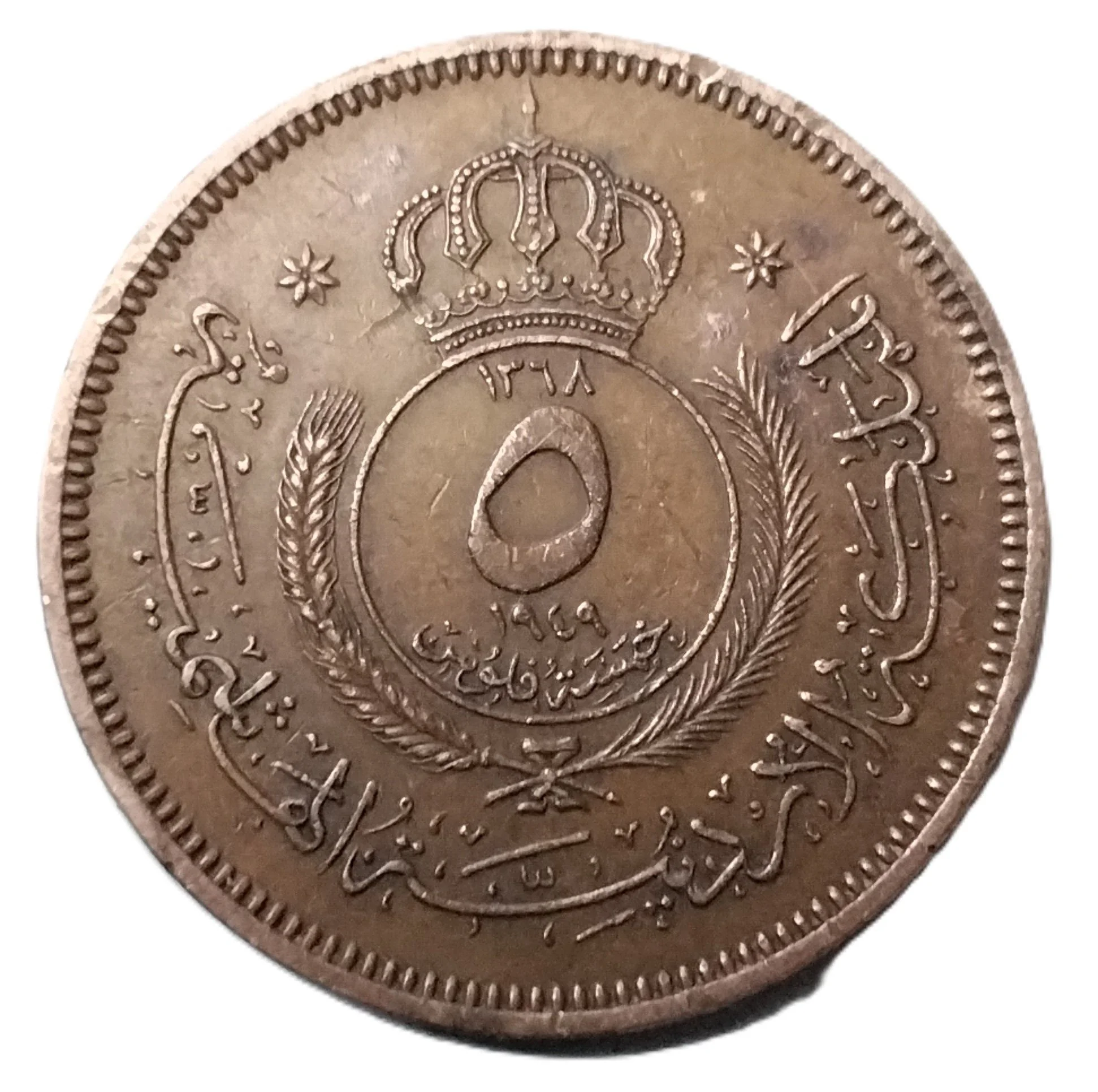
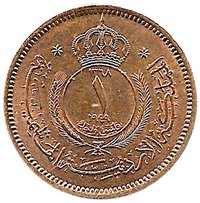
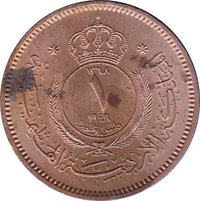
Obverse
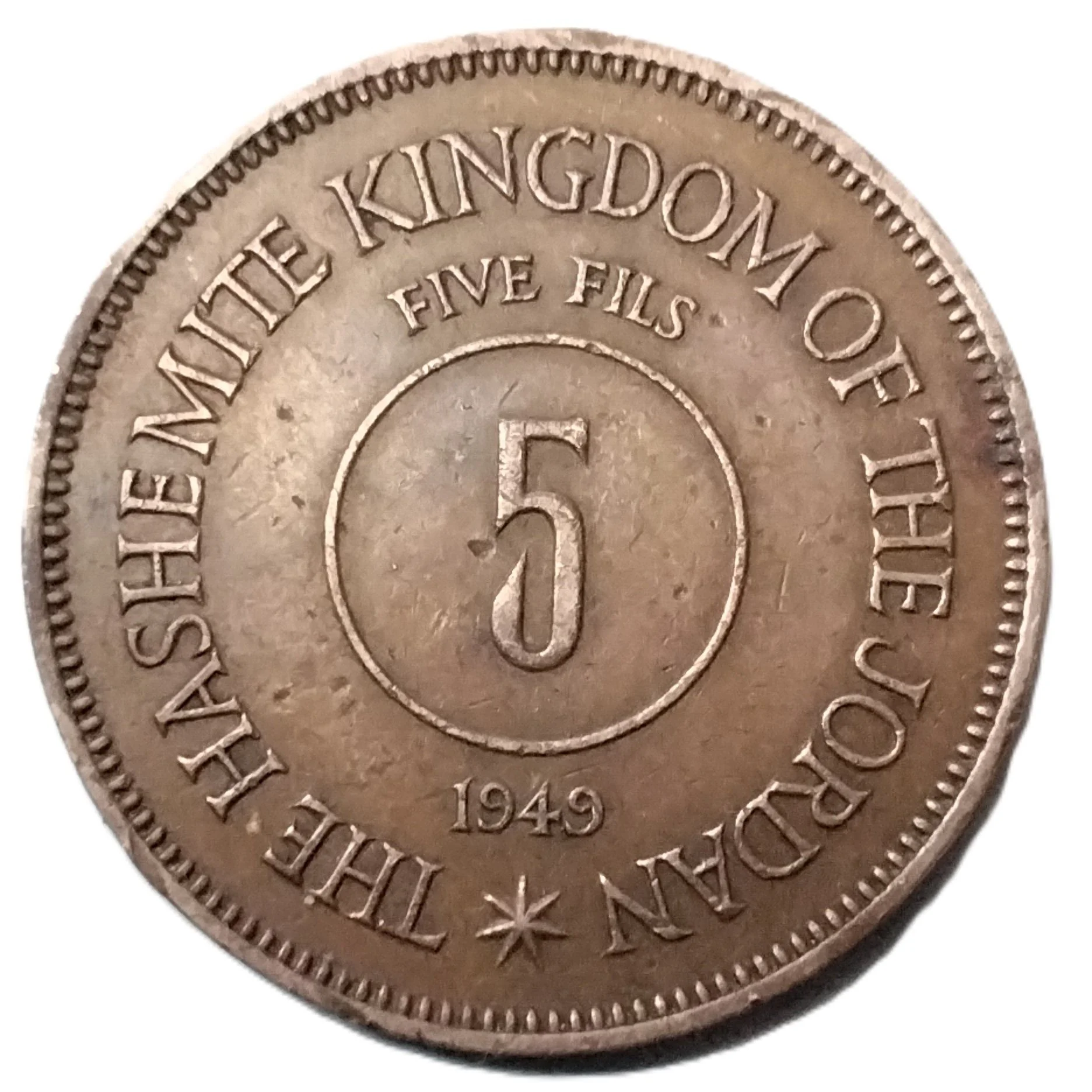
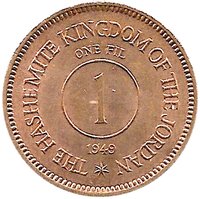
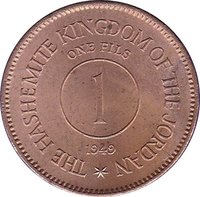
Reverse
Description:
Circle value over date.
Inscription:
THE HASHEMITE KINGDOM OF THE JORDAN
FIVE FILS
5
1949
FIVE FILS
5
1949
Script: Latin
Edge
Plain
Mints
| Name | Mark |
|---|---|
| Royal Mint (Tower Hill) | — |
Mintings
| Year | Mint Mark | Mintage | Quality | Collection |
|---|---|---|---|---|
| 1949 | — | 3,300,000 | ||
| 1949 | — | 25 | Proof |
Historical background
In 1949, the Hashemite Kingdom of Jordan was navigating its early economic independence following the 1948 Arab-Israeli War. The conflict had profound consequences, doubling the country's population with an influx of Palestinian refugees and placing immense strain on its limited resources and infrastructure. The national currency, the Jordanian Dinar (JOD), had not yet been introduced; instead, the region primarily used the Palestinian Pound. This currency was issued by the Palestine Currency Board, a British colonial institution, and remained pegged to the British Pound Sterling.
The currency situation was inherently unstable and symbolic of a transitional political state. Jordan had gained full independence from the British Mandate in 1946, but its monetary system remained tied to a colonial board based in London. The Palestinian Pound circulated alongside other currencies in the region, but the geopolitical landscape had been irrevocably altered by the war and the annexation of the West Bank in 1950. This created an urgent need for a distinct national currency to assert sovereignty and manage the expanded kingdom's unified economic policy.
Consequently, 1949 was a pivotal year of preparation for monetary reform. The government, under King Abdullah I, laid the groundwork to replace the Palestinian Pound. This culminated in the establishment of the Jordan Currency Board in 1950, which introduced the Jordanian Dinar as the official currency. The 1949 period, therefore, represents the final chapter of a colonial monetary system, with Jordan poised on the brink of establishing a central monetary authority and a national currency to support its modern statehood and post-war economic challenges.
The currency situation was inherently unstable and symbolic of a transitional political state. Jordan had gained full independence from the British Mandate in 1946, but its monetary system remained tied to a colonial board based in London. The Palestinian Pound circulated alongside other currencies in the region, but the geopolitical landscape had been irrevocably altered by the war and the annexation of the West Bank in 1950. This created an urgent need for a distinct national currency to assert sovereignty and manage the expanded kingdom's unified economic policy.
Consequently, 1949 was a pivotal year of preparation for monetary reform. The government, under King Abdullah I, laid the groundwork to replace the Palestinian Pound. This culminated in the establishment of the Jordan Currency Board in 1950, which introduced the Jordanian Dinar as the official currency. The 1949 period, therefore, represents the final chapter of a colonial monetary system, with Jordan poised on the brink of establishing a central monetary authority and a national currency to support its modern statehood and post-war economic challenges.
Series: 1949 Jordan circulation coins
🌱 Common