

50 dirhams (First Archaeological Excavation in the Emirate of Abu Dhabi) – United Arab Emirates
Add to wishlist
Non-circulating coins
Commemoration: The 50th Anniversary of the First Archaeological Excavation in the Emirate of Abu Dhabi
United Arab Emirates
Context
Year: 2009
Issuer: United Arab Emirates
Ruler: Khalifa bin Zayed Al Nahyan
Currency:
(since 1973)
Total mintage: 2,000
Material
References
Numista: #91970
Value
Exchange value: 50 AED
Bullion value: $92.71
Obverse
Description:
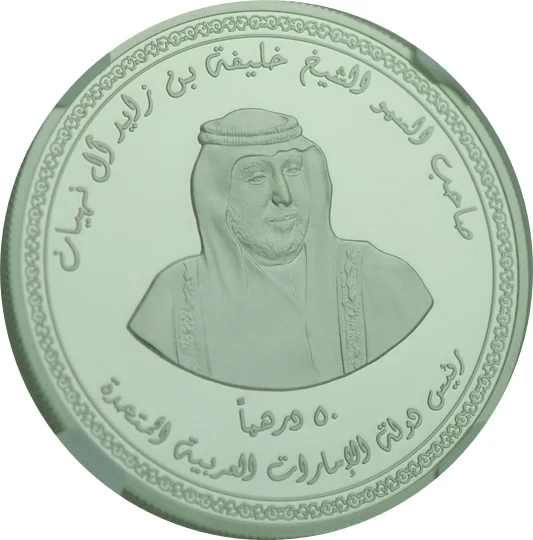
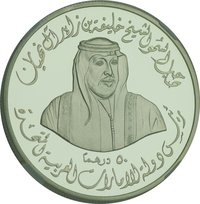
Bust of Sheikh Khalifa bin Zayed Al Nahyan, turned slightly right.
Inscription:
صاحب السُمو الشيخ خليفة بن زايد آل نهيان
٥٠ درهماً
رئيس دولة الامارات العربية المتحدة
٥٠ درهماً
رئيس دولة الامارات العربية المتحدة
Translation:
His Highness Sheikh Khalifa bin Zayed Al Nahyan
50 Dirhams
President of the United Arab Emirates
50 Dirhams
President of the United Arab Emirates
Language: Arabic
Reverse
Description:
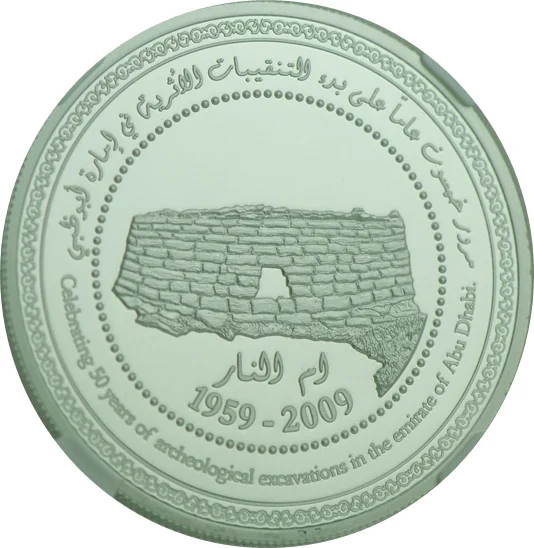
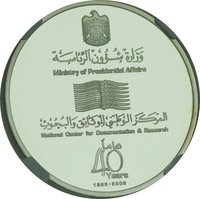
Umm Al Nar, site of Abu Dhabi's first excavations.
Inscription:
مرور خمسون عاماً على بدء التنقيبات الأثرية في إمارة أبوظبي
ام النار
1959 - 2009
Celebrating 50 years of archaeological excavation in the emirate of Abu Dhabi.
ام النار
1959 - 2009
Celebrating 50 years of archaeological excavation in the emirate of Abu Dhabi.
Translation:
Fifty years since the beginning of archaeological excavations in the Emirate of Abu Dhabi
Umm an-Nar
1959 - 2009
Umm an-Nar
1959 - 2009
Language: Arabic
Edge
Reeded
Mintings
| Year | Mint Mark | Mintage | Quality | Collection |
|---|---|---|---|---|
| 2009 | — | 2,000 | Proof |
Historical background
In 2009, the United Arab Emirates faced a significant currency dilemma centered on its long-standing peg to the US dollar. The dirham had been fixed at approximately 3.67 to the dollar since 1997, a policy that provided stability and supported the UAE's economic transformation. However, the global financial crisis of 2008-2009 placed this peg under intense strain. As the US Federal Reserve slashed interest rates to near zero to stimulate its own economy, the UAE was forced to follow suit to maintain the peg, despite facing soaring domestic inflation and a overheating property market in the preceding years. This created a conflict between US monetary policy and the UAE's local economic needs, leading to widespread speculation about a possible revaluation or de-pegging of the dirham.
The situation was further complicated by the Dubai debt crisis that erupted in November 2009, when Dubai World requested a standstill on $26 billion of debt. This triggered a collapse in confidence and raised concerns about capital flight, making the stability offered by the dollar peg more crucial than ever. While neighboring Qatar and Kuwait had allowed their currencies to appreciate or float to combat inflation, the UAE's central bank, backed by the substantial hydrocarbon wealth of Abu Dhabi, publicly and repeatedly reaffirmed its commitment to the peg. This was seen as essential to restoring financial market confidence and ensuring liquidity during a period of extreme stress.
Ultimately, the UAE authorities prioritized stability over flexibility. The central bank maintained the peg as an anchor during the turbulent crisis, accepting the imported loose monetary policy as the cost of preserving investor confidence and banking sector stability. This decision underscored the peg's role as a cornerstone of the UAE's financial system. The events of 2009 solidified the policy stance, and the dirham's peg to the dollar remains firmly in place today, having successfully weathered the immediate storm despite the earlier pressures for change.
The situation was further complicated by the Dubai debt crisis that erupted in November 2009, when Dubai World requested a standstill on $26 billion of debt. This triggered a collapse in confidence and raised concerns about capital flight, making the stability offered by the dollar peg more crucial than ever. While neighboring Qatar and Kuwait had allowed their currencies to appreciate or float to combat inflation, the UAE's central bank, backed by the substantial hydrocarbon wealth of Abu Dhabi, publicly and repeatedly reaffirmed its commitment to the peg. This was seen as essential to restoring financial market confidence and ensuring liquidity during a period of extreme stress.
Ultimately, the UAE authorities prioritized stability over flexibility. The central bank maintained the peg as an anchor during the turbulent crisis, accepting the imported loose monetary policy as the cost of preserving investor confidence and banking sector stability. This decision underscored the peg's role as a cornerstone of the UAE's financial system. The events of 2009 solidified the policy stance, and the dirham's peg to the dollar remains firmly in place today, having successfully weathered the immediate storm despite the earlier pressures for change.
✨ Legendary