

50 Dirhams (National Center for Documentation and Research) – United Arab Emirates
Non-circulating coins
Commemoration: The 40th Anniversary of the National Center for Documentation and Research (NCDR)
United Arab Emirates
Context
Year: 2008
Issuer: United Arab Emirates 
Ruler: Khalifa bin Zayed Al Nahyan
Currency:
(since 1973)
Total mintage: 2,000
Material
References
Numista: #91969
Value
Exchange value: 50 AED
Bullion value: $106.93
Obverse
Description:
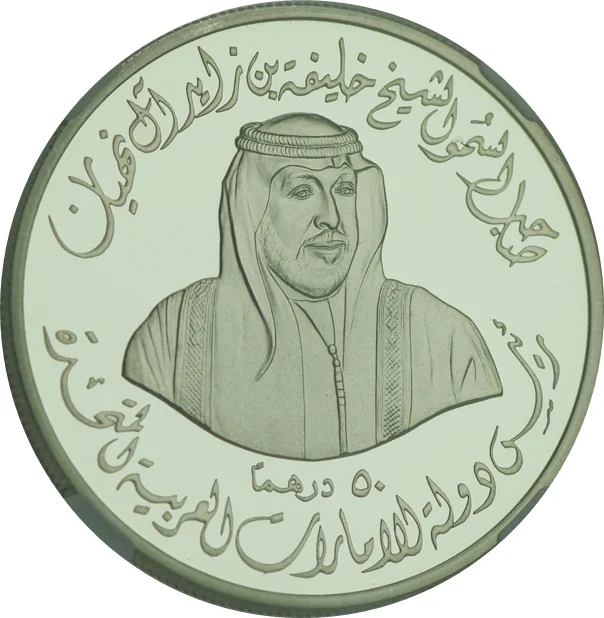
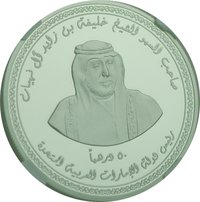
Bust of Sheikh Khalifa bin Zayed Al Nahyan, turned slightly right.
Inscription:
صاحب السُمو الشيخ خليفة بن زايد آل نهيان
٥٠ درهماً
رئيس دولة الامارات العربية المتحدة
٥٠ درهماً
رئيس دولة الامارات العربية المتحدة
Translation:
His Highness Sheikh Khalifa bin Zayed Al Nahyan
50 Dirhams
President of the United Arab Emirates
50 Dirhams
President of the United Arab Emirates
Script: Arabic
Language: Arabic
Reverse
Description:
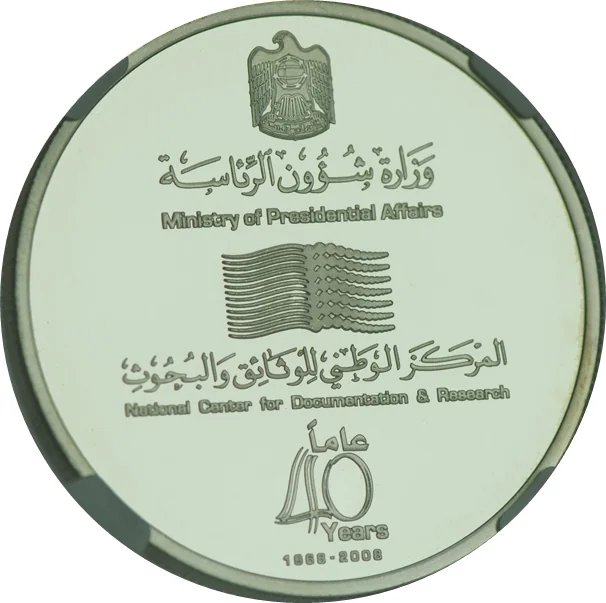
The logo of the National Center for Documentation and Research (NCDR) and the UAE emblem, which features a golden falcon (the Hawk of Quraish). The falcon holds a parchment with the country's name in Kufic script and has a central disk displaying the UAE flag, with seven stars and seven tail feathers each symbolizing the seven Emirates.
Inscription:
وَزَارة شُؤُون الرّئاسَة
Ministry of Presidential Affairs
ِالمَركَز الوَطني لِلوَثائِق وَالبُحُوث
National Center for Documentation and Research
عاماً
40
Years
1968 - 2008
Ministry of Presidential Affairs
ِالمَركَز الوَطني لِلوَثائِق وَالبُحُوث
National Center for Documentation and Research
عاماً
40
Years
1968 - 2008
Translation:
Ministry of Presidential Affairs
National Center for Documentation and Research
40
Years
1968 - 2008
National Center for Documentation and Research
40
Years
1968 - 2008
Language: Arabic
Edge
Reeded
Mintings
| Year | Mint Mark | Mintage | Quality | Collection |
|---|---|---|---|---|
| 2008 | — | 2,000 | Proof |
Historical background
In 2008, the United Arab Emirates faced a significant monetary policy challenge centered on its currency peg. Since 1997, the UAE dirham had been formally pegged to the US dollar at a fixed rate of approximately AED 3.67 per dollar. This policy provided stability and was a cornerstone for the UAE's rapid economic growth, particularly in Dubai and Abu Dhabi, by anchoring inflation expectations and facilitating trade and investment inflows. However, the peg also meant importing the monetary policy of the United States Federal Reserve.
The core issue in 2008 was a stark policy divergence: while the US Federal Reserve was aggressively cutting interest rates to combat the unfolding global financial crisis and domestic recession, the UAE's economy was overheating. Inflation in the Emirates soared to a record high of 11.1% in 2008, driven by a booming real estate sector, high oil prices in the first half of the year, and rising food and rental costs. The Fed's rate cuts forced the UAE Central Bank to lower its own rates in step to maintain the peg, thereby exacerbating domestic inflation by making borrowing cheaper and fueling further speculative investment, even as local economic conditions demanded tighter monetary policy.
Consequently, 2008 was a year of intense speculation and debate about whether the UAE would abandon or revalue its dollar peg. Market pressure and analyst commentary were frequent, with many arguing a revaluation would help curb inflation. However, the UAE authorities remained steadfast in their commitment to the peg, emphasizing long-term stability over a short-term fix. The government chose to address inflation through fiscal measures—such as increasing public sector wages and implementing subsidies—and by allowing greater appreciation pressure to be absorbed within the narrow band of the peg. The global financial crisis that intensified in late 2008 ultimately dampened inflationary pressures, ending the immediate revaluation debate but leaving a lasting discussion on the long-term suitability of the dollar peg for the UAE's economy.
The core issue in 2008 was a stark policy divergence: while the US Federal Reserve was aggressively cutting interest rates to combat the unfolding global financial crisis and domestic recession, the UAE's economy was overheating. Inflation in the Emirates soared to a record high of 11.1% in 2008, driven by a booming real estate sector, high oil prices in the first half of the year, and rising food and rental costs. The Fed's rate cuts forced the UAE Central Bank to lower its own rates in step to maintain the peg, thereby exacerbating domestic inflation by making borrowing cheaper and fueling further speculative investment, even as local economic conditions demanded tighter monetary policy.
Consequently, 2008 was a year of intense speculation and debate about whether the UAE would abandon or revalue its dollar peg. Market pressure and analyst commentary were frequent, with many arguing a revaluation would help curb inflation. However, the UAE authorities remained steadfast in their commitment to the peg, emphasizing long-term stability over a short-term fix. The government chose to address inflation through fiscal measures—such as increasing public sector wages and implementing subsidies—and by allowing greater appreciation pressure to be absorbed within the narrow band of the peg. The global financial crisis that intensified in late 2008 ultimately dampened inflationary pressures, ending the immediate revaluation debate but leaving a lasting discussion on the long-term suitability of the dollar peg for the UAE's economy.
✨ Legendary