

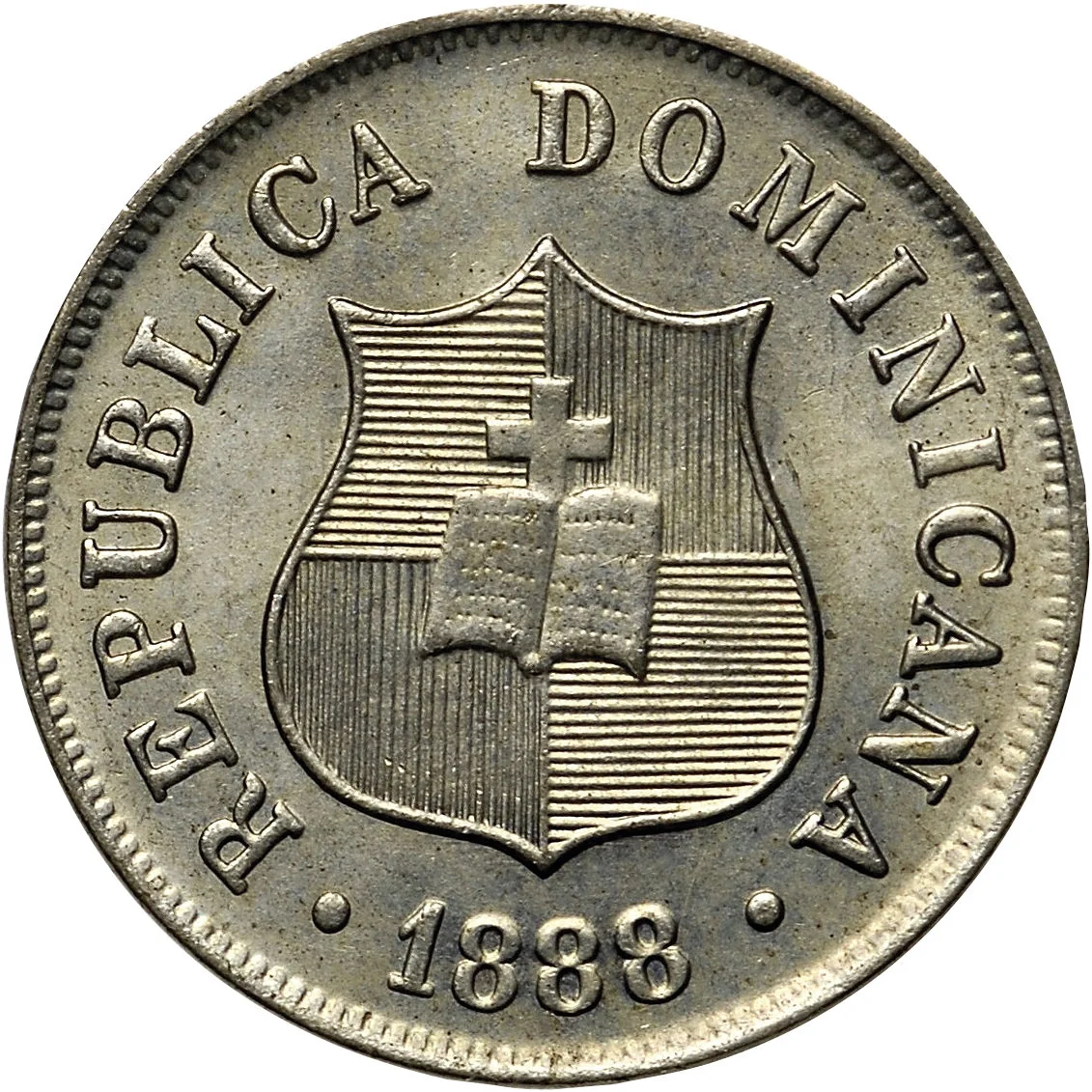
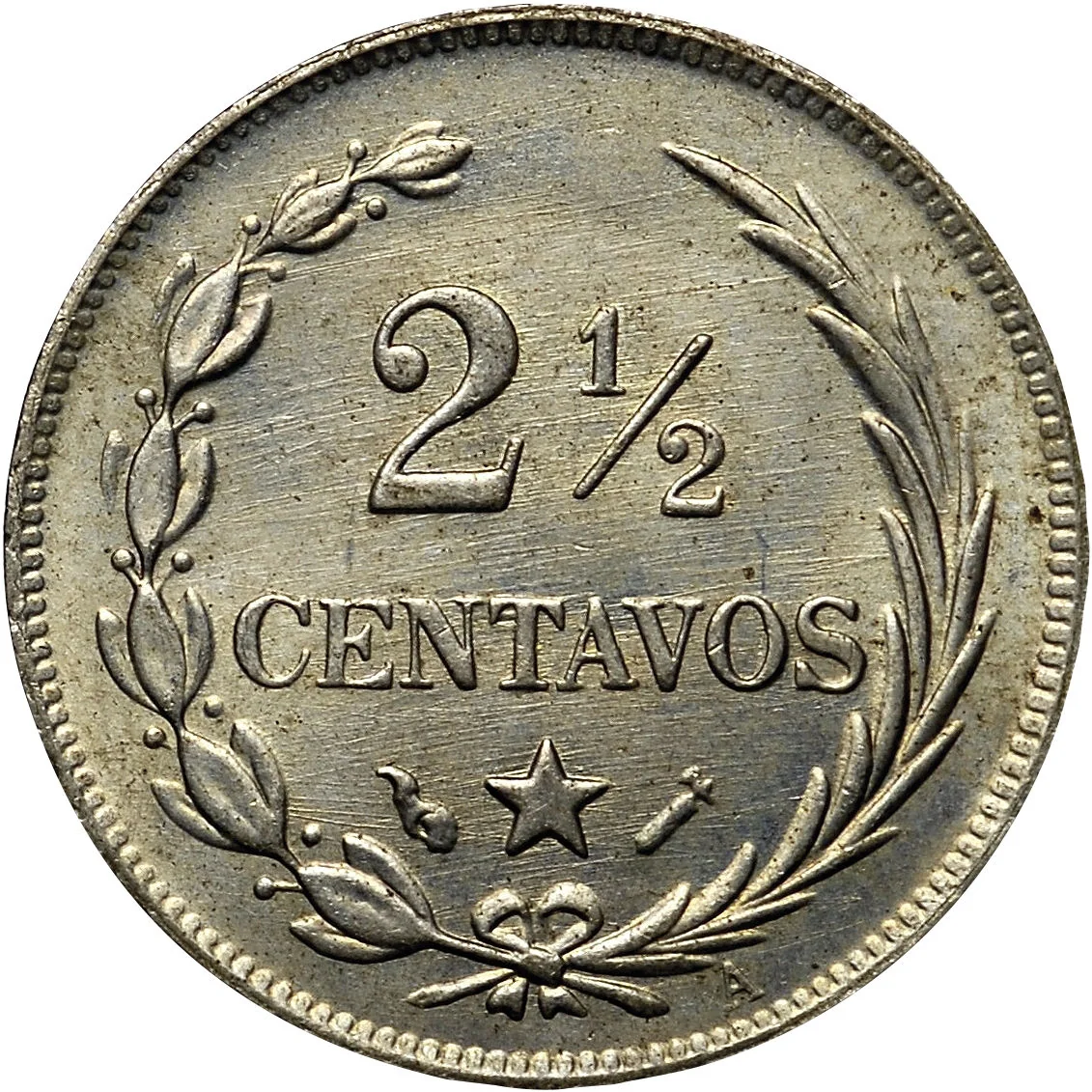
2½ centavos – Dominican Republic
Add to wishlist
Dominican Republic
Context
Years: 1882–1888
Issuer: Dominican Republic
Period:
(1863—1916)
Currency:
(1844—1905)
Demonetized: Yes
Total mintage: 4,971,000
Material
Diameter: 18 mm
Weight: 2 g
Thickness: 0.9 mm
Shape: Round
Composition: Copper-nickel
Technique: Milled
Alignment: Coin alignment
flip
References
KM: #
Numista: #9195
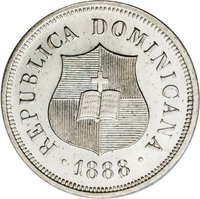
Obverse
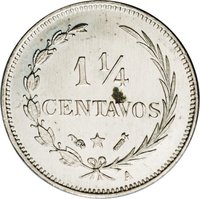
Reverse
Edge
Plain
Categories
| Symbols> Coat of Arms |
| Symbol> Wreath |
Mints
| Name | Mark |
|---|---|
| Monnaie de Paris | (A) |
| Heaton and Sons / The Mint Birmingham | H H |
Mintings
| Year | Mint Mark | Mintage | Quality | Collection |
|---|---|---|---|---|
| 1882 | — | 21,000 | ||
| 1888 | A | 950,000 | ||
| 1888 | A | — | Proof | |
| 1888 | H | 4,000,000 | ||
| 1888 | H | — | Proof |
Historical background
In 1882, the Dominican Republic was navigating a complex and unstable currency situation, a legacy of its turbulent 19th-century history. Following decades of political instability, war, and a brief return to Spanish rule, the nation's monetary system was characterized by a chaotic circulation of diverse coins. Spanish colonial pesos fuertes, French francs, British sovereigns, and various Latin American coins all circulated simultaneously, with their values fluctuating based on metallic content and local trust. This lack of a unified, state-controlled currency hindered commerce and state finances, as the government struggled to collect taxes in a reliable standard of value.
The situation was further complicated by the absence of a national mint. While the government attempted to assert monetary sovereignty by decreeing the Dominican peso as the official unit of account, the physical money in people's hands remained a heterogeneous mix of foreign silver and gold. This often led to a preference for sound foreign coinage over any debased or paper money the government might issue, a common problem in the region. The instability discouraged foreign investment and complicated the repayment of the country's substantial external debt, which was a constant source of diplomatic pressure.
Consequently, the year 1882 fell within a prolonged period of seeking monetary order. Efforts to standardize the system were incremental and faced significant challenges. It was not until the late 1880s and the 1890s, under the more stable political order of Ulises Heureaux, that more decisive steps were taken, including the issuance of the first official Dominican coins and the establishment of a national monetary law. Thus, the currency situation in 1882 was one of fragmentation, representing a key economic problem that the Dominican state was still in the process of confronting.
The situation was further complicated by the absence of a national mint. While the government attempted to assert monetary sovereignty by decreeing the Dominican peso as the official unit of account, the physical money in people's hands remained a heterogeneous mix of foreign silver and gold. This often led to a preference for sound foreign coinage over any debased or paper money the government might issue, a common problem in the region. The instability discouraged foreign investment and complicated the repayment of the country's substantial external debt, which was a constant source of diplomatic pressure.
Consequently, the year 1882 fell within a prolonged period of seeking monetary order. Efforts to standardize the system were incremental and faced significant challenges. It was not until the late 1880s and the 1890s, under the more stable political order of Ulises Heureaux, that more decisive steps were taken, including the issuance of the first official Dominican coins and the establishment of a national monetary law. Thus, the currency situation in 1882 was one of fragmentation, representing a key economic problem that the Dominican state was still in the process of confronting.
🌱 Common