

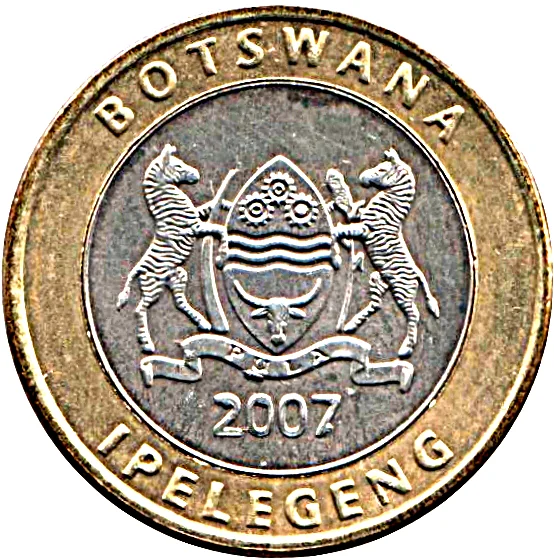
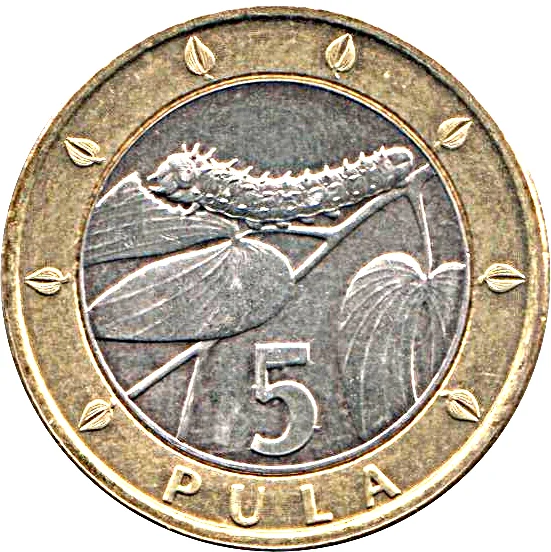
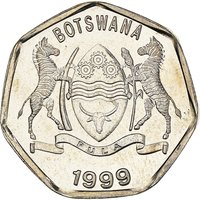
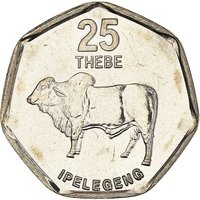
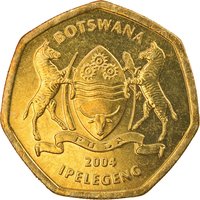
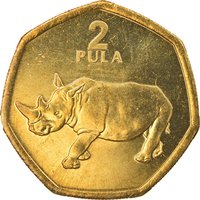
Obverse
Reverse
Edge
Reeded
Mints
| Name | Mark |
|---|---|
| Royal Mint | — |
Mintings
| Year | Mint Mark | Mintage | Quality | Collection |
|---|---|---|---|---|
| 2000 | — | — | ||
| 2007 | — | — |
Historical background
In the year 2000, Botswana's currency, the Pula (BWP), was a notable symbol of economic stability and prudent management in a region often marked by volatility. The country had maintained a tightly managed floating exchange rate system since 1976, with the Pula's value pegged to a basket of currencies, heavily weighted toward the South African Rand (ZAR) and the International Monetary Fund's Special Drawing Rights (SDR). This structure was crucial as Botswana's economy was deeply integrated with South Africa's, its largest trading partner. The deliberate linkage provided stability for trade and investment, but also meant that the Pula was indirectly influenced by the Rand's performance, which had experienced significant depreciation in the late 1990s.
The macroeconomic backdrop in 2000 was strong, underpinned by decades of sustained growth from diamond revenues, which were carefully managed through sovereign wealth funds. High foreign exchange reserves, consistently exceeding 24 months of import cover, provided the Bank of Botswana with substantial firepower to defend the Pula's value and manage liquidity. Inflation, a historical concern, had been brought under control, falling to around 8% from double-digit figures in the early 1990s, allowing for relatively stable monetary policy. This discipline stood in stark contrast to many neighboring economies, solidifying the Pula's reputation as one of Africa's strongest and most reliable currencies.
Looking forward from the year 2000, the key policy discussions centered on the appropriate level of the Pula's peg and the weightings within the basket. There was an ongoing debate about balancing the benefits of Rand-zone stability against the risks of imported inflation and the desire to diversify the economy away from diamonds and dependence on South Africa. The authorities were cautiously considering a gradual adjustment to allow for a more flexible and potentially stronger Pula, a move that would eventually lead to a revaluation of the currency basket in 2005. Thus, 2000 represented a period of confident stability, but also a pivot point for evaluating future exchange rate policy to secure long-term economic diversification.
The macroeconomic backdrop in 2000 was strong, underpinned by decades of sustained growth from diamond revenues, which were carefully managed through sovereign wealth funds. High foreign exchange reserves, consistently exceeding 24 months of import cover, provided the Bank of Botswana with substantial firepower to defend the Pula's value and manage liquidity. Inflation, a historical concern, had been brought under control, falling to around 8% from double-digit figures in the early 1990s, allowing for relatively stable monetary policy. This discipline stood in stark contrast to many neighboring economies, solidifying the Pula's reputation as one of Africa's strongest and most reliable currencies.
Looking forward from the year 2000, the key policy discussions centered on the appropriate level of the Pula's peg and the weightings within the basket. There was an ongoing debate about balancing the benefits of Rand-zone stability against the risks of imported inflation and the desire to diversify the economy away from diamonds and dependence on South Africa. The authorities were cautiously considering a gradual adjustment to allow for a more flexible and potentially stronger Pula, a move that would eventually lead to a revaluation of the currency basket in 2005. Thus, 2000 represented a period of confident stability, but also a pivot point for evaluating future exchange rate policy to secure long-term economic diversification.
🌱 Very Common