

30 para – United States of the Ionian Islands
Add to wishlist
Greece
Context
Material
References
KM: #
Numista: #91809
Value
Bullion value: $7.53
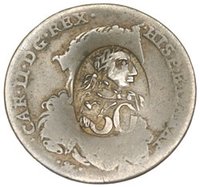
Obverse
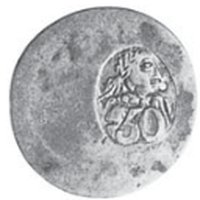
Description:
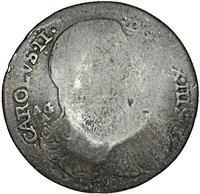
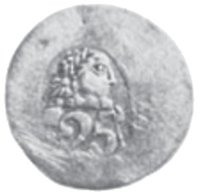
Spanish colonial real countermark: bust right.
Inscription:
CAROLUS·III·DEI·GRATIA
·1773·
30
·1773·
30
Translation:
Charles III by the Grace of God
1773
30
1773
30
Language: Latin
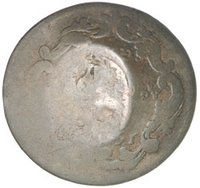
Reverse
Description:
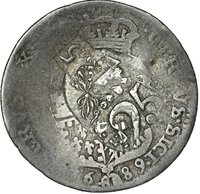
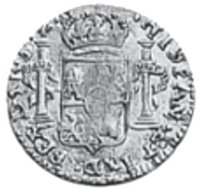
Heraldic emblem
Inscription:
•HISPAN•ET IND•REX•Mo•1R•F•M•
Translation:
King of Spain and the Indies, Madrid Mint, 1 Real, Philip IV, Madrid.
Language: Latin
Edge
Plain
Mintings
| Year | Mint Mark | Mintage | Quality | Collection |
|---|---|---|---|---|
| 1814 | — | — |
Historical background
The United States of the Ionian Islands, established as a British protectorate in 1815 following the Treaty of Paris, inherited a complex and fragmented monetary landscape in 1814. During the preceding years of French rule (1807-1814), the official currency was the French franc, but this period was marked by economic strain and the issuance of debased local coinage. More significantly, the historical circulation of a multitude of foreign coins—including Turkish piastres, Venetian sequins, Spanish dollars, and various British coins—remained deeply embedded in daily commerce, creating a chaotic system of multiple concurrent standards.
This monetary plurality posed a significant challenge to trade and administration. The lack of a unified, stable currency hindered economic transactions and facilitated confusion and fraud. As the British prepared to assume formal control, they recognized that establishing monetary order was a prerequisite for effective governance and economic integration of the seven islands. The situation demanded a clear policy to standardize the currency, stabilize the economy, and symbolically reinforce the new protectorate's authority.
Consequently, in 1814, the currency situation was in a state of transitional flux. The old French system was defunct, the historic heterogeneous coinage was still in widespread but inefficient use, and the British authorities were formulating plans for reform. This set the stage for the decisive monetary reforms that would follow in 1819, with the introduction of a new Ionian coinage pegged explicitly to the British pound sterling, aiming to replace the chaotic mix with a single, stable system aligned with British economic interests.
This monetary plurality posed a significant challenge to trade and administration. The lack of a unified, stable currency hindered economic transactions and facilitated confusion and fraud. As the British prepared to assume formal control, they recognized that establishing monetary order was a prerequisite for effective governance and economic integration of the seven islands. The situation demanded a clear policy to standardize the currency, stabilize the economy, and symbolically reinforce the new protectorate's authority.
Consequently, in 1814, the currency situation was in a state of transitional flux. The old French system was defunct, the historic heterogeneous coinage was still in widespread but inefficient use, and the British authorities were formulating plans for reform. This set the stage for the decisive monetary reforms that would follow in 1819, with the introduction of a new Ionian coinage pegged explicitly to the British pound sterling, aiming to replace the chaotic mix with a single, stable system aligned with British economic interests.


✨ Legendary