

1 penny – British West Africa
Add to wishlist
Context
Years: 1907–1910
Country: Western African States
Issuer: British West Africa
Ruler: Edward VII
Currency:
(1907—1968)
Demonetized: Yes
Total mintage: 7,560,152
Material
Diameter: 30.5 mm
Weight: 9.45 g
Thickness: 1.7 mm
Shape: Round with a round hole
Composition: Copper-nickel
Technique: Milled
Alignment: Medal alignment
flip
References
KM: #
Numista: #9180
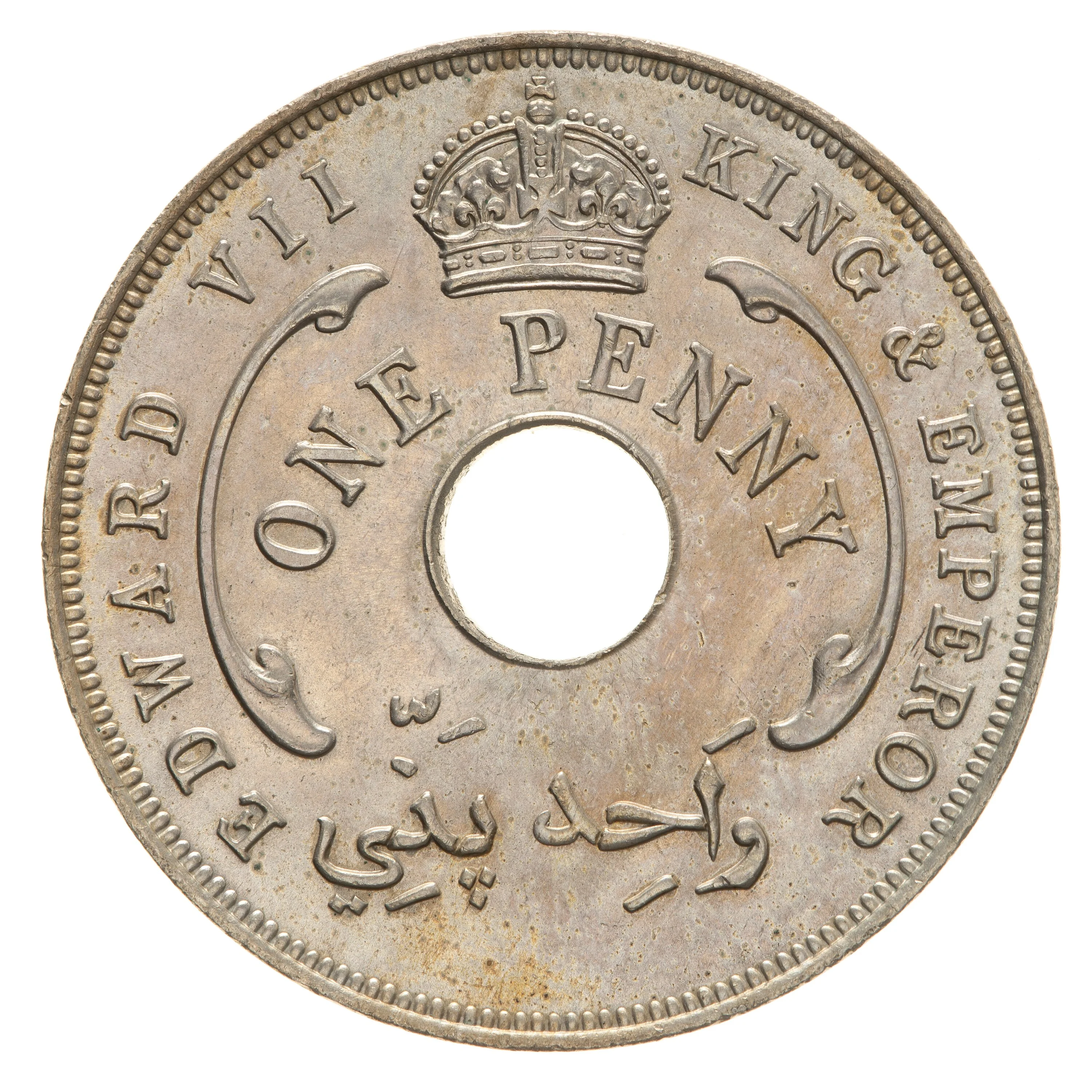
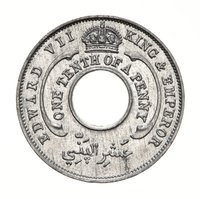
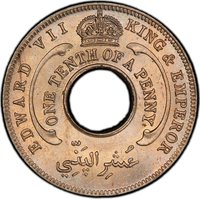
Obverse
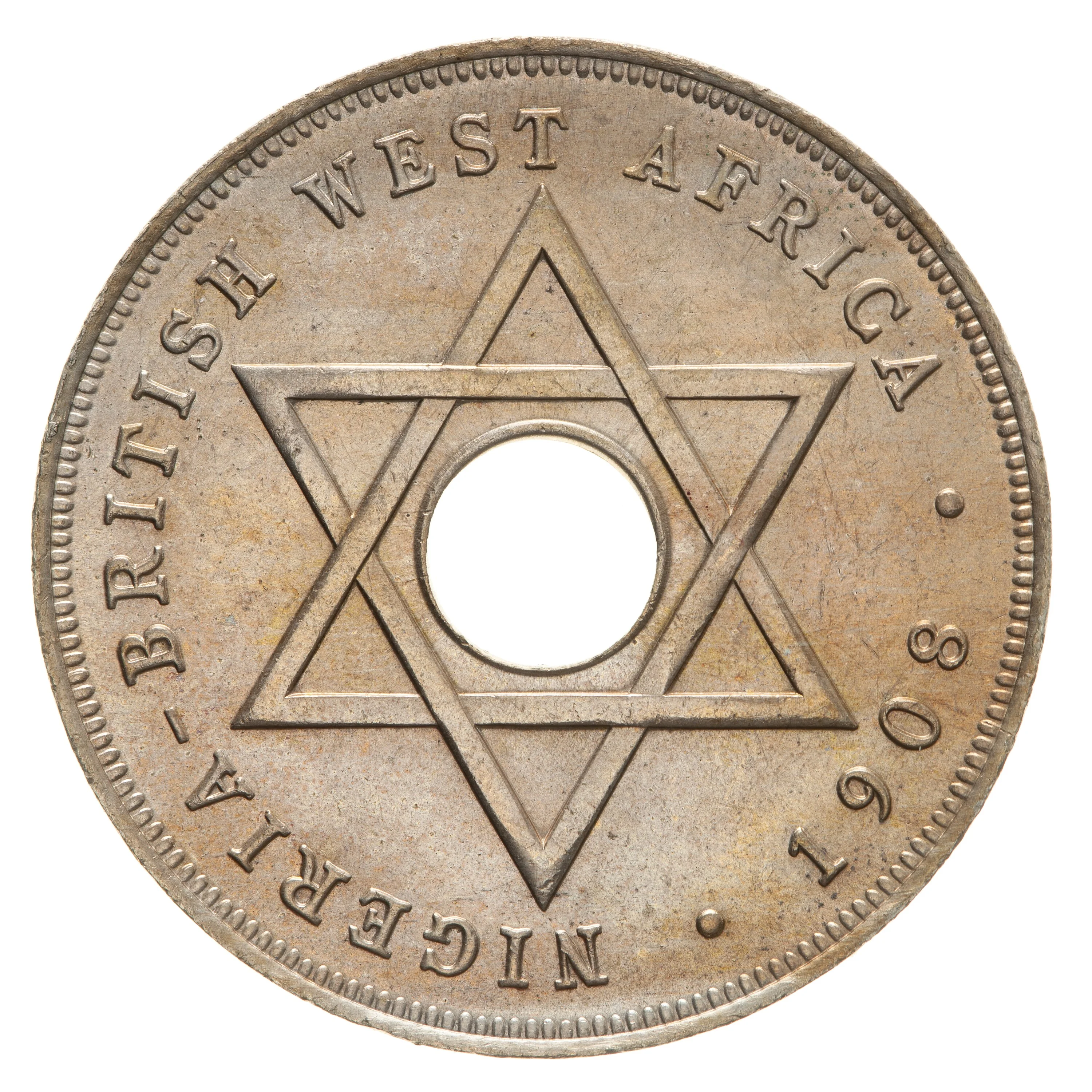
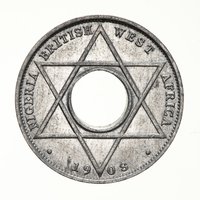
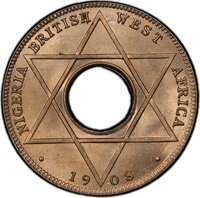
Reverse
Description:
Hexagram with date below.
Inscription:
NIGERIA-BRITISH WEST AFRICA
· 1910 ·
· 1910 ·
Script: Latin
Edge
Plain
Mints
| Name | Mark |
|---|---|
| Royal Mint (Tower Hill) | — |
Mintings
| Year | Mint Mark | Mintage | Quality | Collection |
|---|---|---|---|---|
| 1907 | — | 863,000 | ||
| 1908 | — | 3,217,152 | ||
| 1909 | — | 960,000 | ||
| 1910 | — | 2,520,000 |
Historical background
In 1907, the currency situation in British West Africa was defined by a state of transition and colonial monetary consolidation. The region, comprising the colonies of Nigeria, the Gold Coast (Ghana), Sierra Leone, and the Gambia, was moving away from a chaotic mix of traditional commodity money (like cowries), gold dust, and various foreign silver coins. The British authorities sought to replace this with a uniform, sterling-linked currency to facilitate colonial administration, boost export trade (primarily in palm oil, cocoa, and groundnuts), and ensure British commercial dominance. The cornerstone of this system was the West African Currency Board (WACC), established in 1912, meaning that in 1907, the final push for its creation was underway, driven by the inadequacies of the existing arrangements.
The immediate pre-WACC period saw the circulation of British silver coins, which were often in short supply and prone to being exported as bullion, causing local shortages. To address this, the imperial authorities had introduced special silver coins—the West African shillings and florins—struck with a distinctive central hole from 1907 onwards. These coins, valued at par with British sterling, were intended to be a "special purpose" currency that would remain within the region. The year 1907 is therefore significant as the first year of issue for these holed coins, a tangible symbol of the colonial monetary project designed to be distinct from UK coinage and less attractive for melting.
Thus, the currency background in 1907 was one of deliberate intervention, marking the final phase of planning before the full implementation of a formal currency board system. The introduction of the holed silver coinage was a direct response to the practical failures of previous monetary experiments and aimed to create a stable, fiduciary currency under strict British control. This move laid the technical and administrative groundwork for the West African Currency Board, which would ultimately issue a full set of notes and coins, firmly embedding the region within the sterling area and streamlining economic extraction for the colonial economy.
The immediate pre-WACC period saw the circulation of British silver coins, which were often in short supply and prone to being exported as bullion, causing local shortages. To address this, the imperial authorities had introduced special silver coins—the West African shillings and florins—struck with a distinctive central hole from 1907 onwards. These coins, valued at par with British sterling, were intended to be a "special purpose" currency that would remain within the region. The year 1907 is therefore significant as the first year of issue for these holed coins, a tangible symbol of the colonial monetary project designed to be distinct from UK coinage and less attractive for melting.
Thus, the currency background in 1907 was one of deliberate intervention, marking the final phase of planning before the full implementation of a formal currency board system. The introduction of the holed silver coinage was a direct response to the practical failures of previous monetary experiments and aimed to create a stable, fiduciary currency under strict British control. This move laid the technical and administrative groundwork for the West African Currency Board, which would ultimately issue a full set of notes and coins, firmly embedding the region within the sterling area and streamlining economic extraction for the colonial economy.
🌱 Fairly Common