

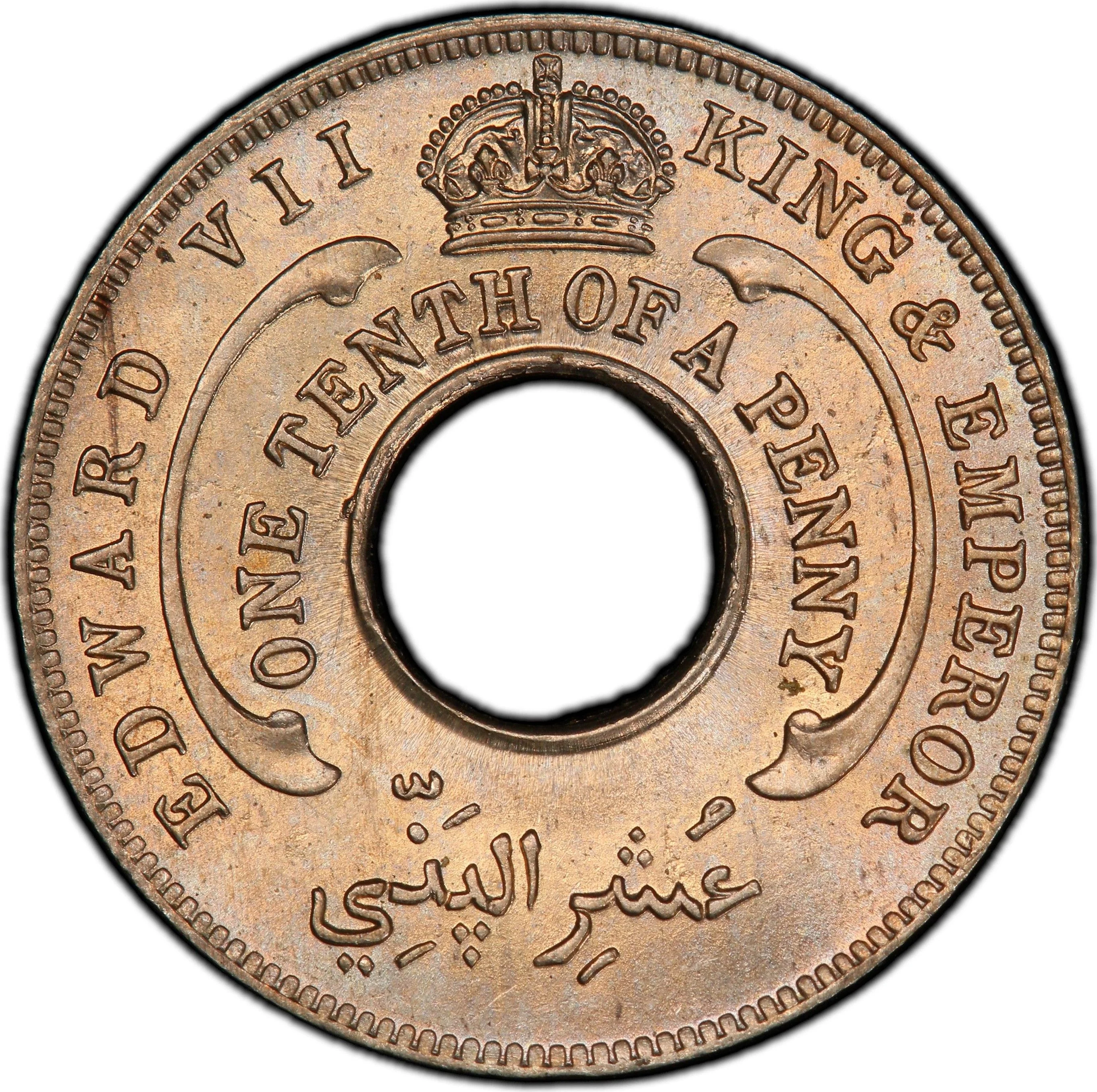
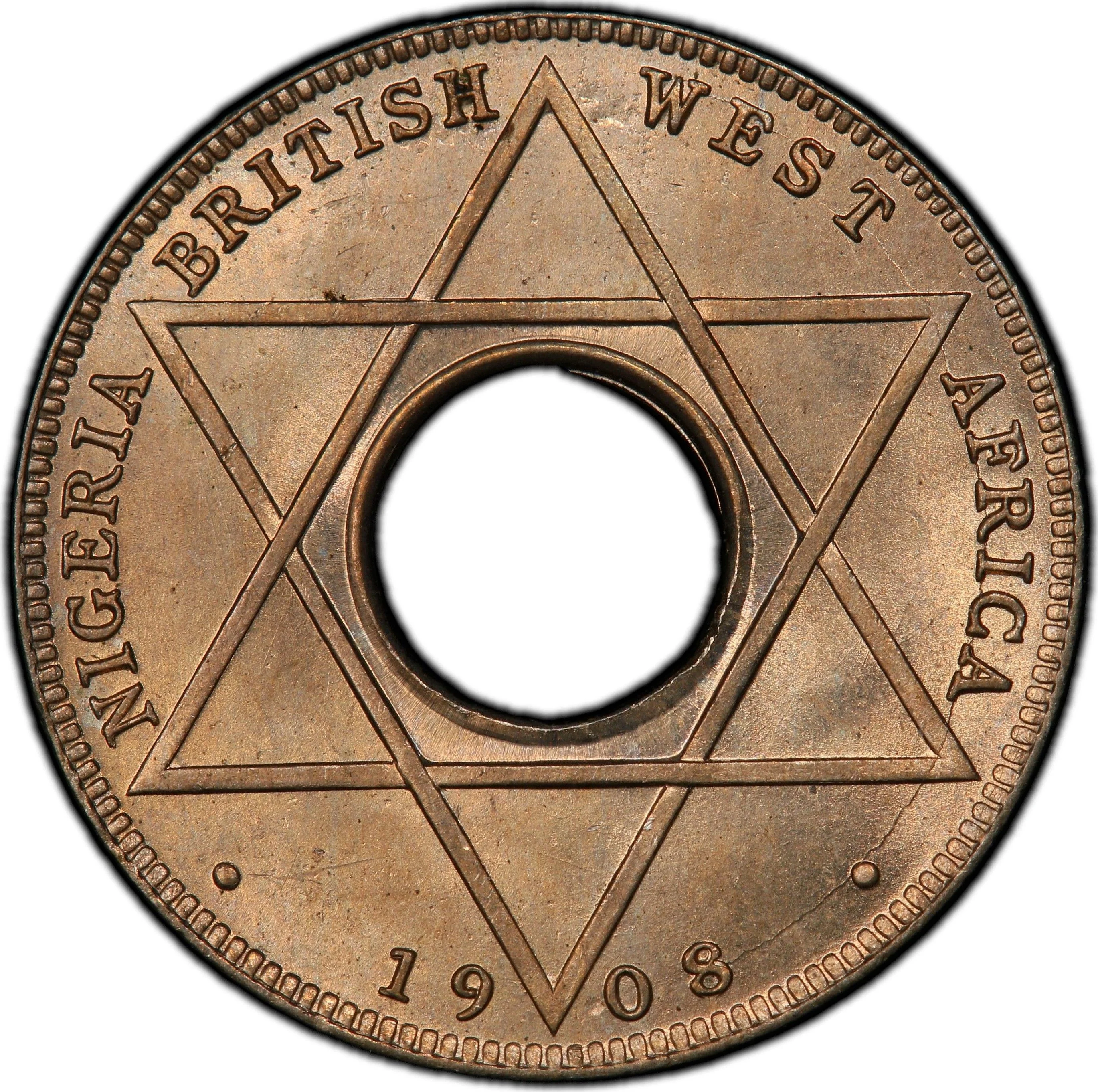
⅒ penny – British West Africa
Add to wishlist
Context
Years: 1908–1910
Country: Western African States
Issuer: British West Africa
Ruler: Edward VII
Currency:
(1907—1968)
Demonetized: Yes
Total mintage: 21,600,000
Material
Diameter: 20.3 mm
Weight: 1.94 g
Thickness: 1 mm
Shape: Round with a round hole
Composition: Copper-nickel
Technique: Milled
Alignment: Medal alignment
flip
References
KM: #
Numista: #11902
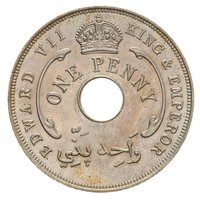
Obverse
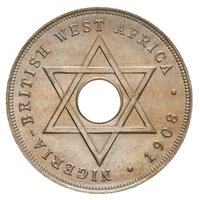
Reverse
Description:
Hexagram splits date below.
Inscription:
NIGERIA BRITISH WEST AFRICA
· 1908 ·
· 1908 ·
Script: Latin
Edge
Plain
Mints
| Name | Mark |
|---|---|
| Royal Mint (Tower Hill) | — |
Mintings
| Year | Mint Mark | Mintage | Quality | Collection |
|---|---|---|---|---|
| 1908 | — | 9,600,000 | ||
| 1909 | — | 4,800,000 | ||
| 1910 | — | 7,200,000 |
Historical background
By 1908, the currency situation in British West Africa was a complex and contentious issue, defined by the colonial administration's struggle to impose a unified sterling-based monetary system on a region with deeply embedded indigenous currencies. The official currency was the British West African shilling, introduced in 1907, which was tied to sterling and issued by the West African Currency Board. However, its circulation was largely confined to government transactions, European merchants, and coastal trade centres. The vast majority of internal trade continued to be conducted using traditional forms of money, most notably cowrie shells and manillas (brass or copper bracelets), alongside gold dust and silver coins in various localities.
This duality created significant economic friction. The British authorities viewed the indigenous currencies as primitive, inflationary, and a barrier to full economic integration with the Empire. In particular, the importation of massive quantities of cowries from German and French sources was seen as destabilising. Conversely, for the local population, these traditional currencies were not merely money but integral to social and ritual life, holding cultural value that the new coinage lacked. Furthermore, the limited supply and distribution of the British shilling created a practical barrier to its adoption, leaving a monetary vacuum filled by the very systems the colonial government sought to eradicate.
The year 1908 fell within a period of active but frustrated intervention. The colonial government had already enacted ordinances to demonetise manillas and cowries in certain jurisdictions, but these efforts were largely ineffective without providing a sufficient alternative. The situation was a microcosm of colonial economic policy: an attempt to streamline and control the regional economy for the benefit of export-import trade, which clashed with the resilient, decentralised, and culturally significant monetary practices of West African societies. The resulting instability would persist until more aggressive demonetisation policies and the wider circulation of official coinage were achieved in the subsequent decades.
This duality created significant economic friction. The British authorities viewed the indigenous currencies as primitive, inflationary, and a barrier to full economic integration with the Empire. In particular, the importation of massive quantities of cowries from German and French sources was seen as destabilising. Conversely, for the local population, these traditional currencies were not merely money but integral to social and ritual life, holding cultural value that the new coinage lacked. Furthermore, the limited supply and distribution of the British shilling created a practical barrier to its adoption, leaving a monetary vacuum filled by the very systems the colonial government sought to eradicate.
The year 1908 fell within a period of active but frustrated intervention. The colonial government had already enacted ordinances to demonetise manillas and cowries in certain jurisdictions, but these efforts were largely ineffective without providing a sufficient alternative. The situation was a microcosm of colonial economic policy: an attempt to streamline and control the regional economy for the benefit of export-import trade, which clashed with the resilient, decentralised, and culturally significant monetary practices of West African societies. The resulting instability would persist until more aggressive demonetisation policies and the wider circulation of official coinage were achieved in the subsequent decades.
🌱 Common