

3 rubles – Russian Federation
Add to wishlist
Russia
Context
Year: 2016
Country: Russia
Issuer: Russian Federation
Period:
(since 1991)
Currency:
(since 1998)
Total mintage: 3,000
Material
References
Value
Exchange value: 3 RUB
Bullion value: $78.27
Inflation-adjusted value: 6.29 RUB
Obverse
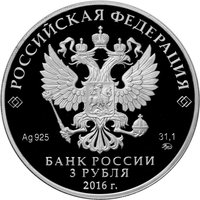
Description:
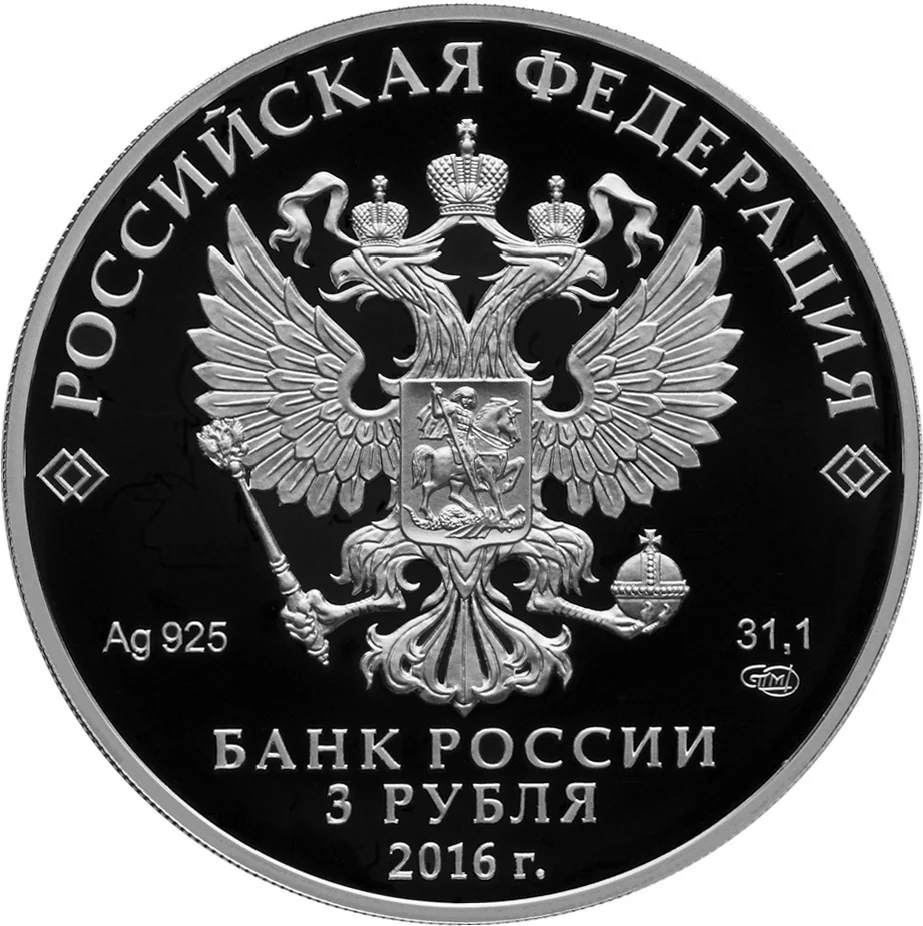
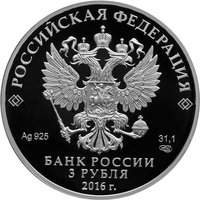
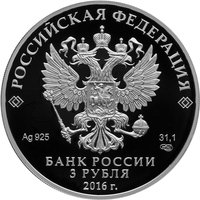
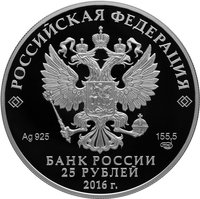
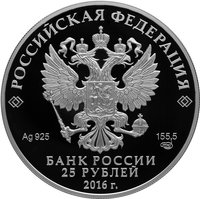
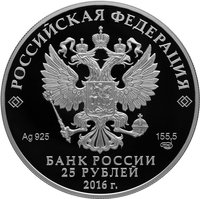
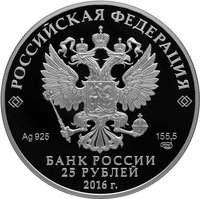
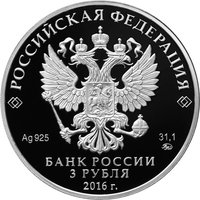
State Coat of Arms of the Russian Federation. Inscriptions: "РОССИЙСКАЯ ФЕДЕРАЦИЯ", "БАНК РОССИИ", "3 РУБЛЯ", "2016", metal designation, purity, mint mark, and fine metal content.
Inscription:
РОССИЙСКАЯ ФЕДЕРАЦИЯ
Ag 925 31,1
СПМД
БАНК РОССИИ
3 РУБЛЯ
2016 г.
Ag 925 31,1
СПМД
БАНК РОССИИ
3 РУБЛЯ
2016 г.
Translation:
RUSSIAN FEDERATION
Ag 925 31.1
SPMD
BANK OF RUSSIA
3 ROUBLES
2016
Ag 925 31.1
SPMD
BANK OF RUSSIA
3 ROUBLES
2016
Language: Russian
Engraver: Alexandra Arsenyevna Dolgopolova
Designer: Elena Viktorovna Kramskaya
Reverse
Description:
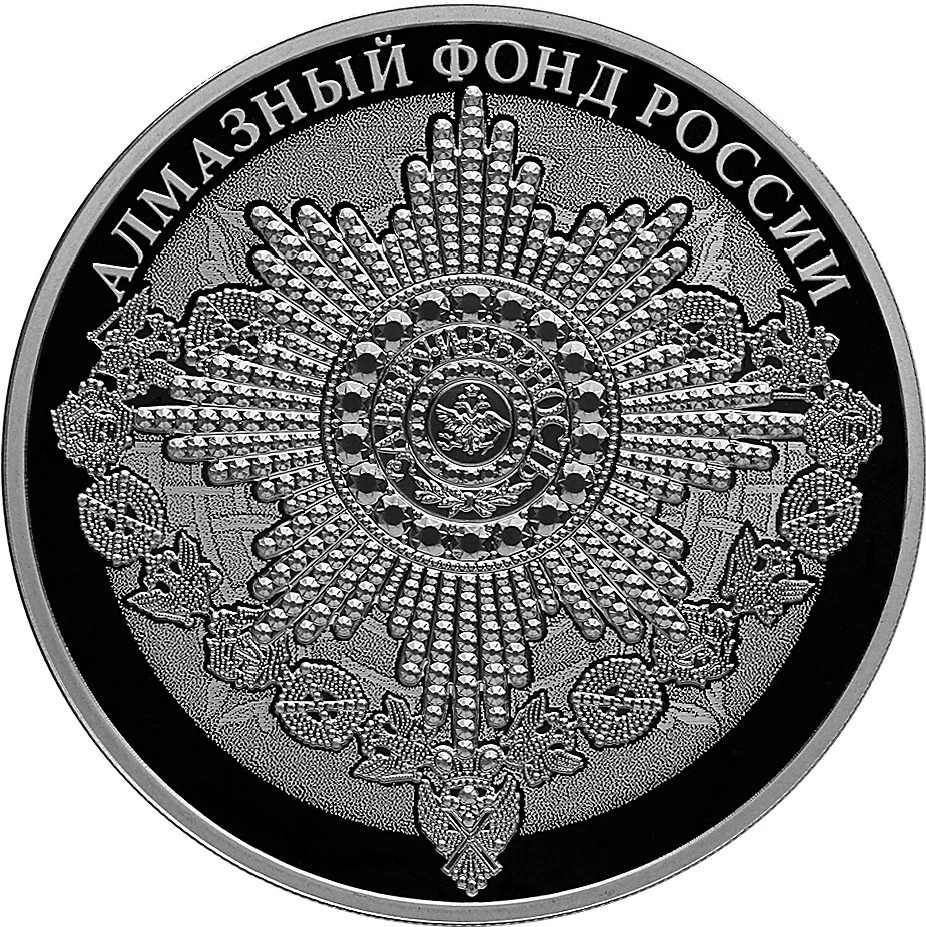
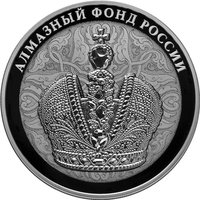
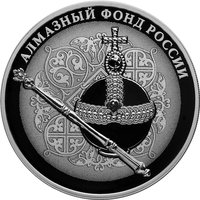
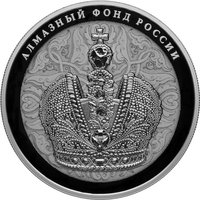
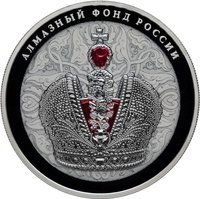
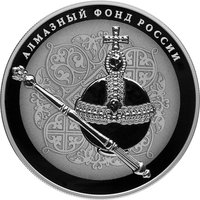
The Star, Badge, and Great Imperial Collar of the Order of St. Andrew. Above, the circumferential inscription reads: “АЛМАЗНЫЙ ФОНД РОССИИ” (DIAMOND FUND OF RUSSIA).
Inscription:
АЛМАЗНЫЙ ФОНД РОССИИ
Translation:
THE DIAMOND FUND OF RUSSIA
Script: Cyrillic
Language: Russian
Engraver: Fedor Sergeevich Andronov
Designer: Anton Dmitrievich Schablykin
Edge
252 corrugations
Mints
| Name | Mark |
|---|---|
| Saint Petersburg | (СПМД) |
Mintings
| Year | Mint Mark | Mintage | Quality | Collection |
|---|---|---|---|---|
| 2016 | СПМД | 3,000 | Proof |
Historical background
In 2016, the Russian economy and its currency, the ruble, were navigating a fragile recovery following the severe shocks of 2014-2015. The primary pressures stemmed from the dual impact of persistently low global oil prices—a critical determinant for Russia's hydrocarbon-dependent economy—and the ongoing economic sanctions imposed by Western nations following the annexation of Crimea. While the ruble had experienced a dramatic collapse in late 2014, by 2016 it had stabilized at a new, significantly weaker norm of roughly 60-70 rubles per US dollar, compared to the 30-35 range seen prior to the crises. This devaluation, though painful for living standards, had a protective effect by shielding federal budget revenues (denominated in rubles from dollar-priced oil exports) and supporting domestic industry through import substitution.
The Central Bank of Russia (CBR) played a pivotal role in this stabilization by shifting to a floating exchange rate regime in late 2014 and maintaining a tight monetary policy. Throughout 2016, the CBR focused on controlling inflation, which had spiked into double digits, by gradually lowering its key interest rate from 11% at the start of the year to 10% by year's end as price growth showed signs of easing. This cautious approach aimed to rebuild confidence and encourage ruble savings without triggering renewed volatility. Furthermore, the government implemented a conservative fiscal policy, drawing on its Reserve Fund to cover the budget deficit while avoiding drastic spending cuts that could provoke social unrest.
Overall, 2016 was a year of cautious consolidation for the Russian currency. The ruble's value became more directly tied to oil price fluctuations, demonstrating a clear correlation throughout the year. While the acute phase of the financial crisis had passed, the structural vulnerabilities remained. The economy officially emerged from recession by the end of 2016, but real incomes continued to fall, highlighting the lasting socio-economic toll of the currency crisis and the "new normal" of a weaker ruble within a constrained, sanction-affected economy.
The Central Bank of Russia (CBR) played a pivotal role in this stabilization by shifting to a floating exchange rate regime in late 2014 and maintaining a tight monetary policy. Throughout 2016, the CBR focused on controlling inflation, which had spiked into double digits, by gradually lowering its key interest rate from 11% at the start of the year to 10% by year's end as price growth showed signs of easing. This cautious approach aimed to rebuild confidence and encourage ruble savings without triggering renewed volatility. Furthermore, the government implemented a conservative fiscal policy, drawing on its Reserve Fund to cover the budget deficit while avoiding drastic spending cuts that could provoke social unrest.
Overall, 2016 was a year of cautious consolidation for the Russian currency. The ruble's value became more directly tied to oil price fluctuations, demonstrating a clear correlation throughout the year. While the acute phase of the financial crisis had passed, the structural vulnerabilities remained. The economy officially emerged from recession by the end of 2016, but real incomes continued to fall, highlighting the lasting socio-economic toll of the currency crisis and the "new normal" of a weaker ruble within a constrained, sanction-affected economy.
Series: Diamond Fund of Russia

✨ Legendary