

10 centimes – Belgium
Add to wishlist
Belgium
Context
Material
Diameter: 22 mm
Weight: 4 g
Shape: Round with a round hole
Composition: 10% Nickel brass
Magnetic: No
Technique: Milled
Alignment: Coin alignment
flip
References
KM: #
Numista: #9138
Value
Exchange value: 0.10 BEF
Obverse
Description:
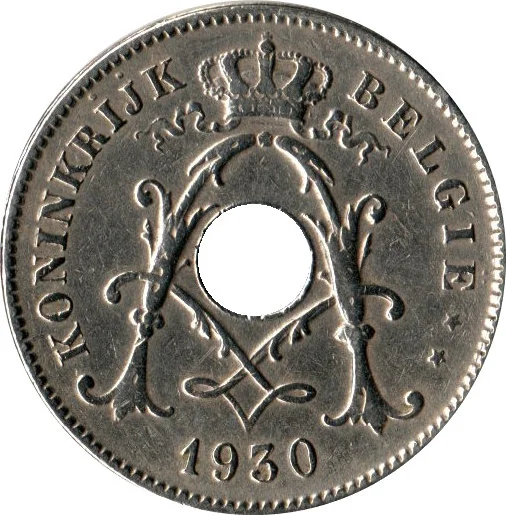
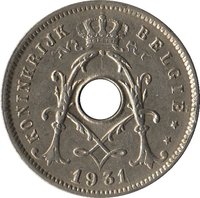
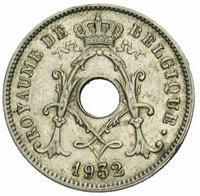
King Albert I's monogram, encircled by Dutch text. Date beneath.
Inscription:
KONINKRIJK BELGIE ★★
1930
1930
Translation:
KINGDOM OF BELGIUM ★★
1930
1930
Script: Latin
Language: Dutch
Engraver: Alphonse Michaux
Reverse
Description:
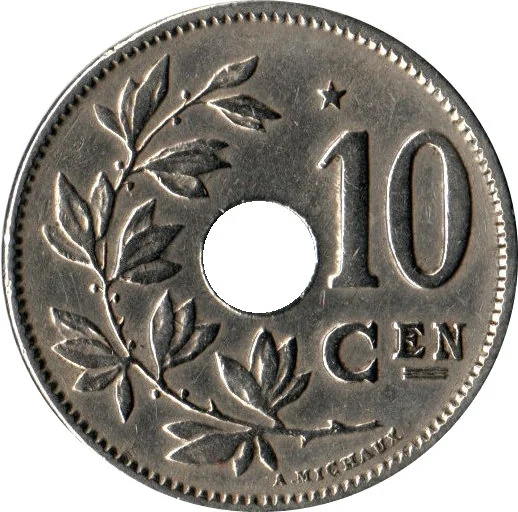
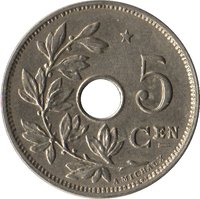
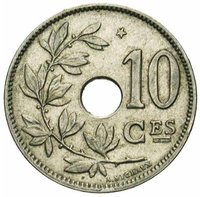
Center hole flanked by olive sprig and value. Star above, designer below.
Inscription:
★
10
CEN
A.MICHAUX
10
CEN
A.MICHAUX
Script: Latin
Engraver: Alphonse Michaux
Edge
Plain
Mints
| Name | Mark |
|---|---|
| Royal Mint of Belgium | — |
Mintings
| Year | Mint Mark | Mintage | Quality | Collection |
|---|---|---|---|---|
| 1930 | — | 1,581,250 | ||
| 1931 | — | 5,000,000 |
Historical background
In 1930, Belgium's currency situation was defined by its adherence to the gold standard and the stability of the Belgian franc, which had been successfully reformed and re-pegged to gold in 1926 following a period of severe postwar inflation and devaluation. The "Stabilisation Law" of October 1926, masterminded by Prime Minister Henri Jaspar and financier Emile Francqui, had restored confidence by defining the franc at one-fifth of its pre-war gold value (the so-called "franc germinal"). This created a stable and credible currency, known as the "Belga" (equivalent to 5 francs), which facilitated international trade and investment.
However, this stability existed within a fragile global context. The onset of the Great Depression, triggered by the 1929 Wall Street Crash, was beginning to exert severe deflationary pressures worldwide. As a major exporting nation with a heavily industrialized economy, Belgium faced plummeting demand for its steel, textiles, and other goods. Maintaining the gold standard required strict monetary discipline, limiting the National Bank of Belgium's ability to stimulate the economy through lower interest rates or currency devaluation, which left the country vulnerable to the deepening economic crisis.
Consequently, while the Belgian franc itself was technically strong and fully convertible in 1930, the underlying economic foundations were weakening. The government, led by a broad coalition, prioritized defending the gold parity above all else, a policy that would soon lead to painful deflation, falling wages, and rising unemployment. The tension between this rigid monetary orthodoxy and the worsening depression set the stage for the social and political turmoil that would force Belgium to reluctantly abandon the gold standard in March 1935, several years after key trading partners like the United Kingdom had done so.
However, this stability existed within a fragile global context. The onset of the Great Depression, triggered by the 1929 Wall Street Crash, was beginning to exert severe deflationary pressures worldwide. As a major exporting nation with a heavily industrialized economy, Belgium faced plummeting demand for its steel, textiles, and other goods. Maintaining the gold standard required strict monetary discipline, limiting the National Bank of Belgium's ability to stimulate the economy through lower interest rates or currency devaluation, which left the country vulnerable to the deepening economic crisis.
Consequently, while the Belgian franc itself was technically strong and fully convertible in 1930, the underlying economic foundations were weakening. The government, led by a broad coalition, prioritized defending the gold parity above all else, a policy that would soon lead to painful deflation, falling wages, and rising unemployment. The tension between this rigid monetary orthodoxy and the worsening depression set the stage for the social and political turmoil that would force Belgium to reluctantly abandon the gold standard in March 1935, several years after key trading partners like the United Kingdom had done so.
Series: 1930 Belgium circulation coins

🌱 Common