

2½ euro – Portugal
Add to wishlist
Portugal
Context
Material
Diameter: 28 mm
Weight: 10 g
Shape: Round
Composition: Copper-nickel
Technique: Milled
Alignment: Medal alignment
flip
References
KM: #
Numista: #9133
Value
Exchange value: 2.5 EUR
Inflation-adjusted value: 3.23 EUR
Obverse
Description:
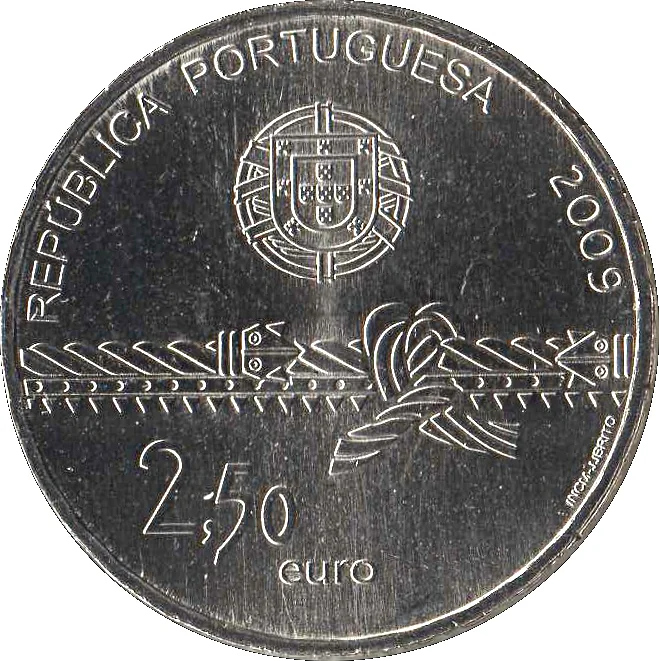
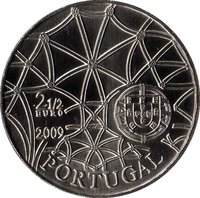
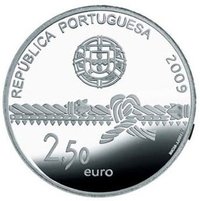
Portugal's coat of arms with "REPÚBLICA PORTUGUESA," "2009," "2,50 euro," engraver "JJBRITO," and mint mark "INCM."
Inscription:
REPÚBLICA PORTUGUESA 2009
2,50 euro INCM-JJBRITO
2,50 euro INCM-JJBRITO
Translation:
Portuguese Republic 2009
2.50 euro INCM-JJBRITO
2.50 euro INCM-JJBRITO
Script: Latin
Language: Portuguese
Engraver: J.J. Brito
Reverse
Description:
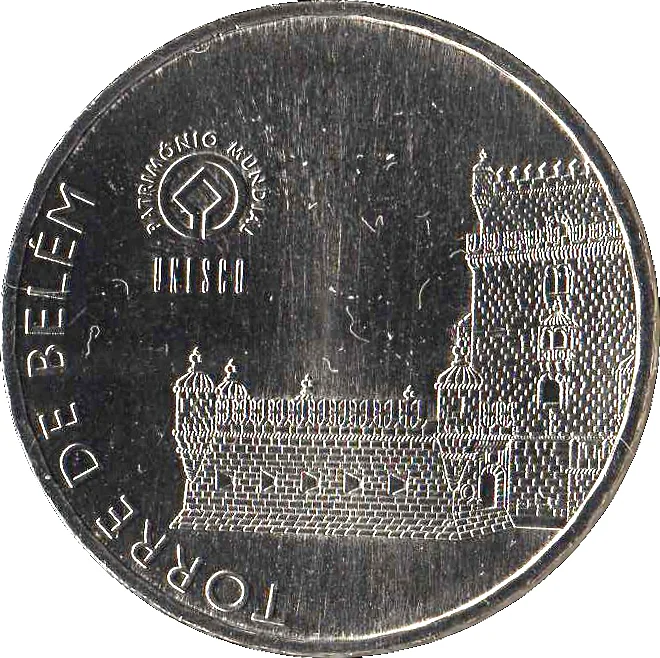
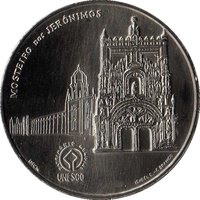
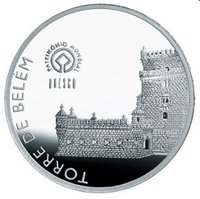
The Belém Tower, a UNESCO World Heritage Site, was built between 1515 and 1521 by King Manuel I. It guarded Lisbon's port at the Tagus River entrance, serving as a ceremonial gateway and a defense for the city and the nearby monastery.
Inscription:
TORRE DE BELÉM
PATRIMÓNIO MUNDIAL
UNESCO
PATRIMÓNIO MUNDIAL
UNESCO
Translation:
Torre de Belém
World Heritage
UNESCO
World Heritage
UNESCO
Script: Latin
Language: Portuguese
Engraver: J.J. Brito
Edge
Coarse reeded.
Categories
| Organization> UNESCO |
Mintings
| Year | Mint Mark | Mintage | Quality | Collection |
|---|---|---|---|---|
| 2009 | INCM | 79,319 |
Historical background
In 2009, Portugal's currency situation was defined by its membership in the Eurozone, having adopted the euro in 1999 (with notes and coins introduced in 2002). This meant the country had relinquished control over its monetary policy to the European Central Bank (ECB), which set interest rates for the entire bloc. While this provided stability and eliminated exchange rate risk within Europe, it also removed crucial tools—like currency devaluation and independent interest rate adjustments—that could have helped address Portugal's growing economic weaknesses. The fixed exchange rate of the euro locked Portugal into a high-value currency, making its exports less competitive compared to countries with flexible currencies.
The global financial crisis of 2008-2009 exposed and exacerbated Portugal's underlying structural problems: low productivity, stagnant growth, and a large public and private debt burden. Unlike some Eurozone peers, Portugal had not experienced a major housing bubble, but its economy was hit hard by the collapse in global trade and tightening credit. The recession led to a sharp rise in unemployment and a dramatic worsening of the budget deficit, which ballooned to 9.8% of GDP in 2009. Without the ability to devalue its currency to boost competitiveness or stimulate growth through independent monetary policy, Portugal was forced to rely solely on painful fiscal austerity measures, which further contracted the economy.
Consequently, 2009 marked the beginning of a severe sovereign debt crisis for Portugal within the wider Eurozone crisis. Investor confidence plummeted due to the soaring deficit and fears over debt sustainability, leading to sharply rising borrowing costs on government bonds. This vicious cycle—where high deficits led to higher risk premiums, which in turn increased debt servicing costs—trapped the Portuguese economy. The situation deteriorated over the next two years, culminating in Portugal's request for a €78 billion international bailout from the EU, ECB, and IMF in April 2011, making it the third Eurozone country after Greece and Ireland to require a financial rescue.
The global financial crisis of 2008-2009 exposed and exacerbated Portugal's underlying structural problems: low productivity, stagnant growth, and a large public and private debt burden. Unlike some Eurozone peers, Portugal had not experienced a major housing bubble, but its economy was hit hard by the collapse in global trade and tightening credit. The recession led to a sharp rise in unemployment and a dramatic worsening of the budget deficit, which ballooned to 9.8% of GDP in 2009. Without the ability to devalue its currency to boost competitiveness or stimulate growth through independent monetary policy, Portugal was forced to rely solely on painful fiscal austerity measures, which further contracted the economy.
Consequently, 2009 marked the beginning of a severe sovereign debt crisis for Portugal within the wider Eurozone crisis. Investor confidence plummeted due to the soaring deficit and fears over debt sustainability, leading to sharply rising borrowing costs on government bonds. This vicious cycle—where high deficits led to higher risk premiums, which in turn increased debt servicing costs—trapped the Portuguese economy. The situation deteriorated over the next two years, culminating in Portugal's request for a €78 billion international bailout from the EU, ECB, and IMF in April 2011, making it the third Eurozone country after Greece and Ireland to require a financial rescue.
Series: UNESCO World Heritage



🌱 Common