

200 Lei – Romania
Romania
Context

Material
Diameter: 27 mm
Weight: 7.5 g
Thickness: 1.74 mm
Shape: Round
Composition: Nickel brass
Magnetic: No
Technique: Milled
Alignment: Medal alignment
flip
References
KM: #Click to copy to clipboard66
Numista: #9125
Obverse
Description:
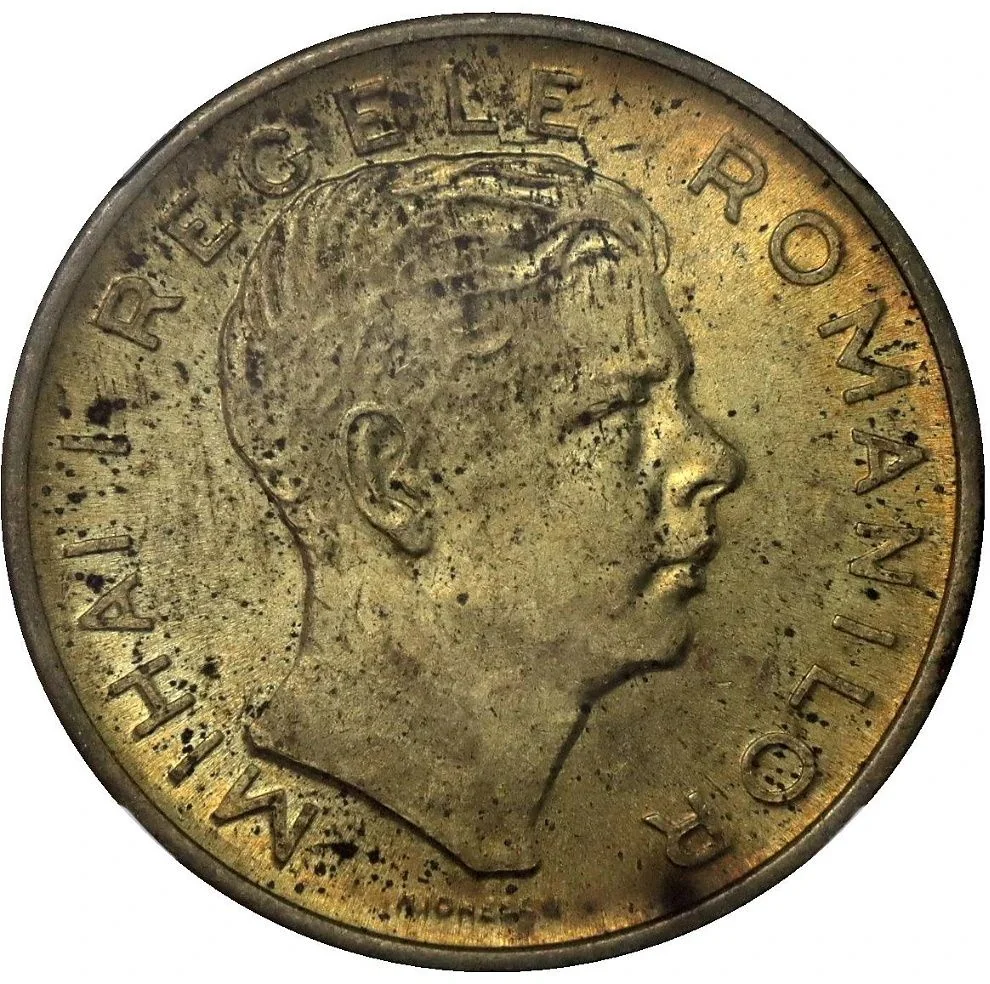
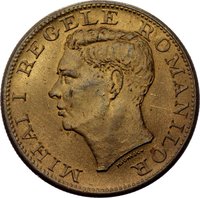
Right profile of King Mihai I. Circular caption: "MIHAI I KING OF ROMANS". Engraver's name.
Inscription:
MIHAI I REGELE ROMANILOR
H. IONESCU
H. IONESCU
Translation:
Michael I King of the Romanians
H. Ionescu
H. Ionescu
Script: Latin
Language: Romanian
Engraver: Haralambie Ionescu
Reverse
Description:
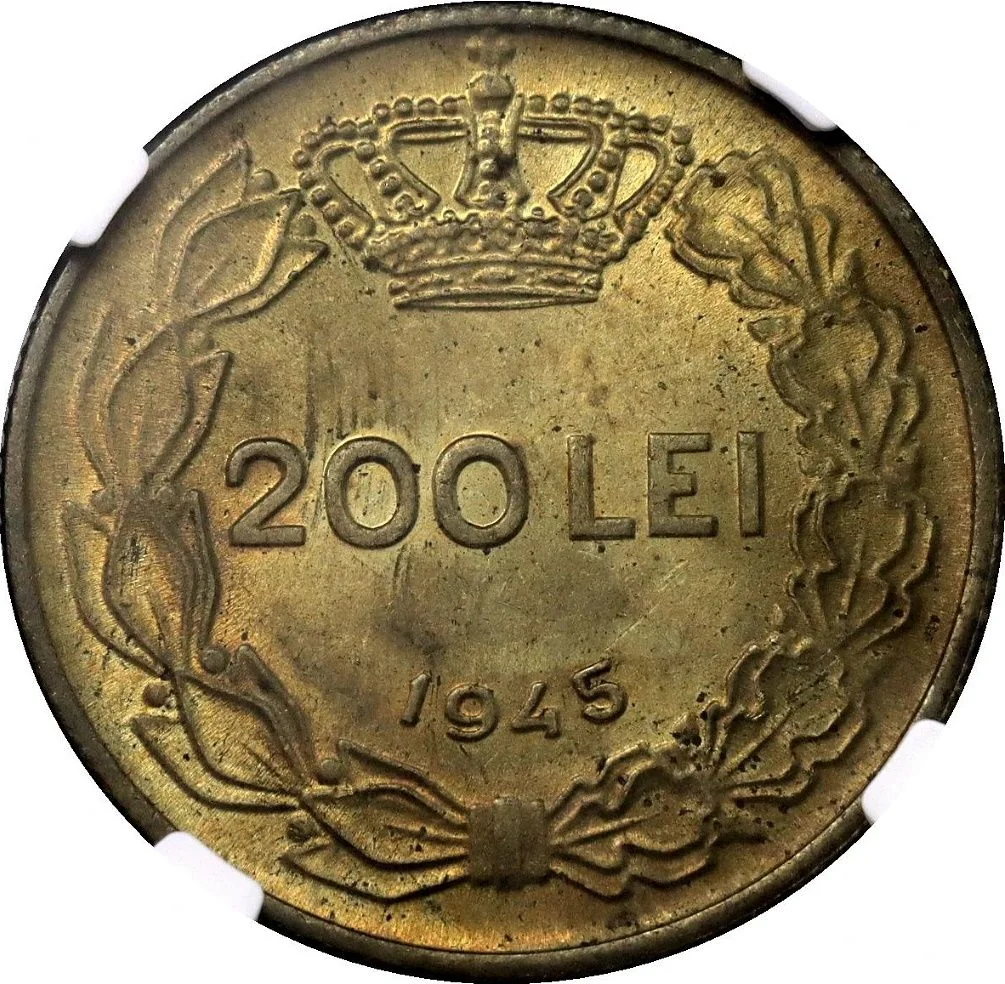
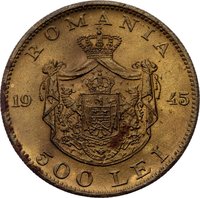
"200 LEI" and vintage within a laurel and oak wreath above.
Inscription:
200 LEI
1945
1945
Script: Latin
Edge
Reeded
Mints
| Name | Mark |
|---|---|
| State Mint | — |
Mintings
| Year | Mint Mark | Mintage | Quality | Collection |
|---|---|---|---|---|
| 1945 | — | 1,399,000 |
Historical background
In 1945, Romania’s currency situation was one of severe instability and hyperinflation, a direct legacy of the war and the preceding National Bank financing of the fascist Antonescu regime’s military expenditures. The Romanian leu had been massively devalued, with prices skyrocketing and the money supply exploding to meet budgetary shortfalls. This economic chaos was compounded by the physical and administrative devastation of the country, a crippling war reparations burden owed to the Soviet Union, and the disruption of traditional economic networks.
Politically, the year was one of transition under Soviet military occupation, with a communist-dominated coalition government gradually consolidating power. While official monetary policy was still nominally managed by the National Bank, Soviet influence was paramount. A critical step was the introduction of a new currency reform in 1947, but the groundwork was laid in 1945-46 through policies that increasingly aligned the economy with Soviet needs, including the establishment of the Soviet-Romanian joint companies (SovRoms) which further drained resources.
Consequently, the population suffered from acute shortages, a thriving black market where goods were exchanged for valuables or stable foreign currencies, and a rapid erosion of savings and wages. The currency’s collapse was not merely an economic phenomenon but a key tool in the social upheaval that facilitated the communist takeover, as it destroyed the wealth of the middle and professional classes and created a desperate dependence on the state apparatus that was being constructed. The leu’s instability in 1945 was thus both a symptom of national crisis and a catalyst for the radical political and economic transformation to come.
Politically, the year was one of transition under Soviet military occupation, with a communist-dominated coalition government gradually consolidating power. While official monetary policy was still nominally managed by the National Bank, Soviet influence was paramount. A critical step was the introduction of a new currency reform in 1947, but the groundwork was laid in 1945-46 through policies that increasingly aligned the economy with Soviet needs, including the establishment of the Soviet-Romanian joint companies (SovRoms) which further drained resources.
Consequently, the population suffered from acute shortages, a thriving black market where goods were exchanged for valuables or stable foreign currencies, and a rapid erosion of savings and wages. The currency’s collapse was not merely an economic phenomenon but a key tool in the social upheaval that facilitated the communist takeover, as it destroyed the wealth of the middle and professional classes and created a desperate dependence on the state apparatus that was being constructed. The leu’s instability in 1945 was thus both a symptom of national crisis and a catalyst for the radical political and economic transformation to come.
🌱 Common