



Obverse
Description:
Wheat ear beside an opening corn shoot, with small flowers (lily of the valley?) behind.
Inscription:
REPUBLICA POPULARA ROMANA
Translation:
ROMANIAN PEOPLE'S REPUBLIC
Script: Latin
Language: Romanian
Engraver: Haralambie Ionescu
Reverse
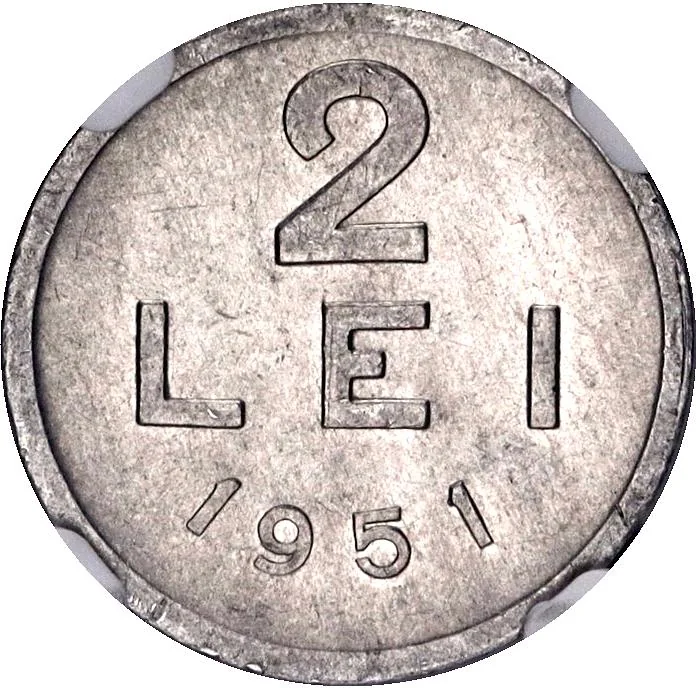
Description:
Denomination and date below.
Inscription:
2 LEI
1951
1951
Script: Latin
Engraver: Haralambie Ionescu
Edge
Plain
Mintings
| Year | Mint Mark | Mintage | Quality | Collection |
|---|---|---|---|---|
| 1951 | — | — | ||
| 1952 | — | — |
Historical background
In 1951, Romania underwent a drastic and coercive currency reform as part of the communist regime's consolidation of power and its shift toward a fully centralized, Soviet-style command economy. The reform, announced abruptly on January 28-29, was not a simple redenomination but a confiscatory measure aimed at wiping out private savings and dismantling the last vestiges of the former market system. Old lei were exchanged for new at wildly discriminatory rates: for small amounts needed for basic transactions, the rate was 100 old lei to 1 new leu, but for larger holdings—deemed the "capital" of the former bourgeoisie—the rate plummeted to as harsh as 400 to 1. This effectively destroyed the financial reserves of peasants, former entrepreneurs, and professionals overnight.
The primary political and economic objectives were multifaceted. The regime sought to absorb the massive liquidity injected into the economy during the preceding years of nationalization and reconstruction, thereby halting rampant inflation. More crucially, it was a tool of social engineering to eliminate any independent economic base and force the entire population into dependence on the state as the sole employer and provider. The reform coincided with the final push for collectivization in agriculture and the acceleration of heavy industrialization, funded by extracting resources from the populace.
The impact on ordinary Romanians was devastating and traumatic. People queued for hours at banks only to see their life savings rendered nearly worthless, a stark demonstration of the state's total power over individual lives. The reform solidified the party's control, but it also bred deep-seated resentment and a lasting distrust of the government and the banking system. This event remains a dark chapter in Romania's economic history, exemplifying the brutal methods used to impose a planned economy and the severe social costs paid by the population during the early Stalinist period.
The primary political and economic objectives were multifaceted. The regime sought to absorb the massive liquidity injected into the economy during the preceding years of nationalization and reconstruction, thereby halting rampant inflation. More crucially, it was a tool of social engineering to eliminate any independent economic base and force the entire population into dependence on the state as the sole employer and provider. The reform coincided with the final push for collectivization in agriculture and the acceleration of heavy industrialization, funded by extracting resources from the populace.
The impact on ordinary Romanians was devastating and traumatic. People queued for hours at banks only to see their life savings rendered nearly worthless, a stark demonstration of the state's total power over individual lives. The reform solidified the party's control, but it also bred deep-seated resentment and a lasting distrust of the government and the banking system. This event remains a dark chapter in Romania's economic history, exemplifying the brutal methods used to impose a planned economy and the severe social costs paid by the population during the early Stalinist period.



🌱 Common