

5 euro cents – Greece
Add to wishlist
Greece
Obverse
Description:
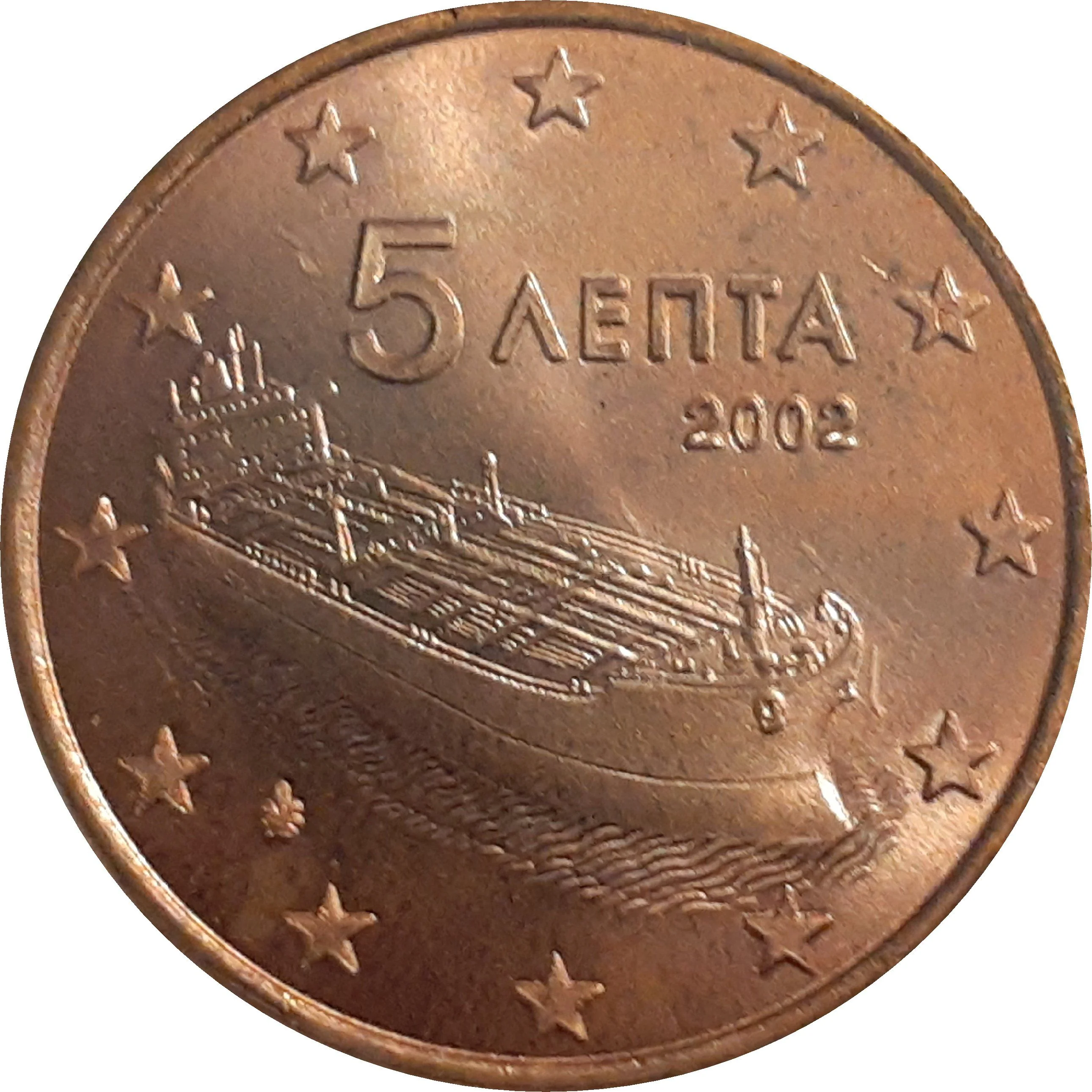
A modern Greek tanker, symbolizing shipping innovation, within the European stars.
Inscription:
5 ΛΕΠΤΑ
2002
ΓΣ
2002
ΓΣ
Translation:
5 Lepta
2002
GS
2002
GS
Script: Greek
Language: Greek
Engravers: Maria Andonatou, Geórgios Stamatópoulos
Reverse
Edge
Plain
Categories
| Transportation> Watercraft |
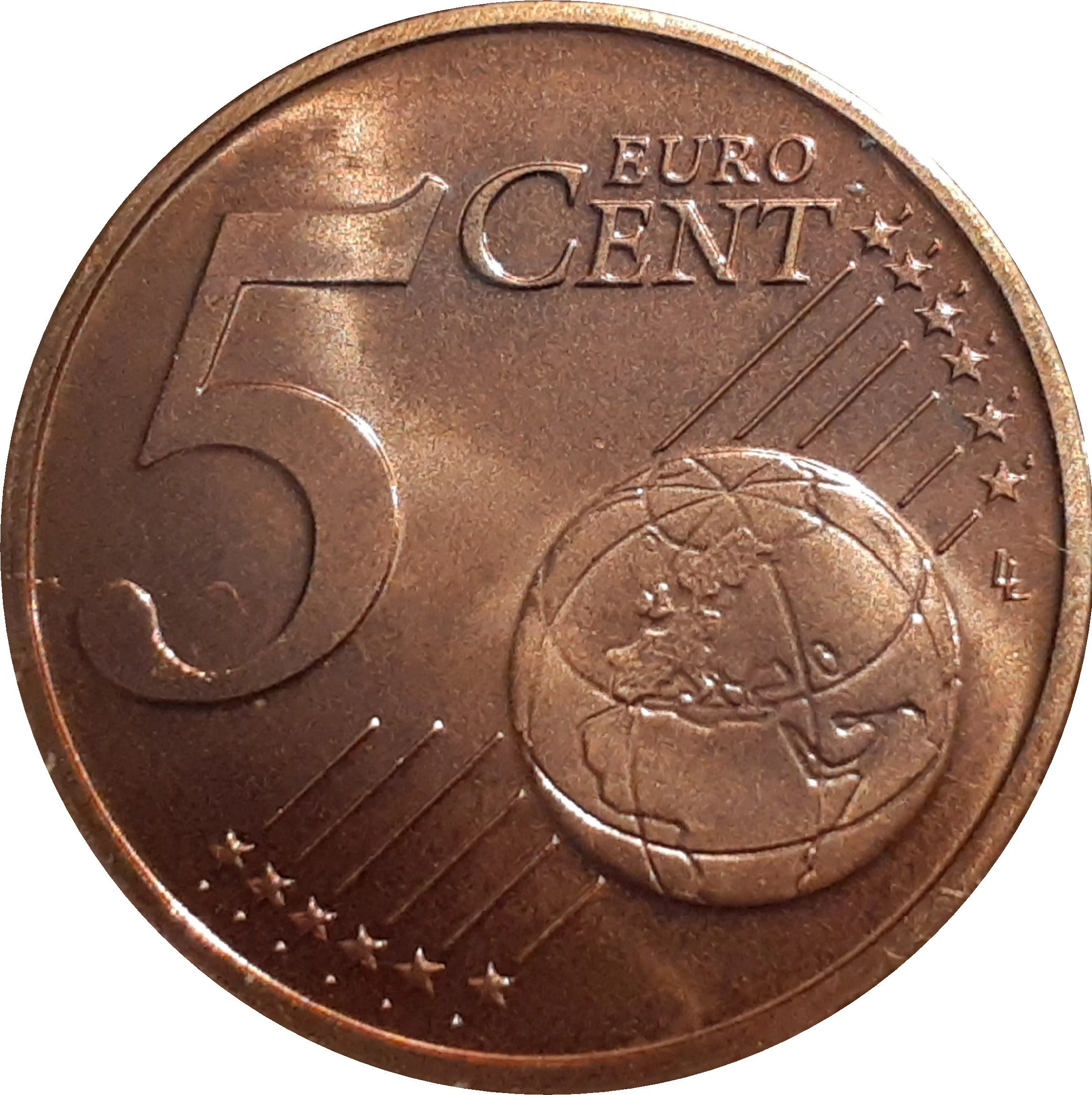
| Symbol> Globe |
| Map |
Mints
| Name | Mark |
|---|---|
| National Mint of the Bank of Greece | — |
| Royal Dutch Mint | — |
| Monnaie de Paris | F |
Mintings
| Year | Mint Mark | Mintage | Quality | Collection |
|---|---|---|---|---|
| 2002 | — | 211,000,000 | ||
| 2002 | — | 5,000 | BU | |
| 2002 | F | 90,000,000 | ||
| 2003 | — | 99,300 | BU | |
| 2003 | — | 750,000 | ||
| 2004 | — | 250,000 | ||
| 2004 | — | 30,000 | BU | |
| 2005 | — | 1,000,000 | ||
| 2005 | — | 50,000 | BU | |
| 2006 | — | 50,000,000 | ||
| 2006 | — | 50,000 | BU | |
| 2007 | — | 55,005,598 | ||
| 2007 | — | 25,000 | BU | |
| 2008 | — | 50,000,000 | ||
| 2008 | — | 25,000 | BU | |
| 2009 | — | 38,000,000 | ||
| 2009 | — | 25,000 | BU | |
| 2010 | — | 5,000,000 | ||
| 2010 | — | 25,000 | BU | |
| 2011 | — | 2,500 | Proof | |
| 2011 | — | 34,000,000 | ||
| 2011 | — | 35,000 | BU | |
| 2012 | — | 1,000,000 | ||
| 2012 | — | 32,500 | BU | |
| 2012 | — | 2,500 | Proof | |
| 2013 | — | 20,000 | BU | |
| 2013 | — | 4,000 | Proof | |
| 2014 | — | 18,000,000 | ||
| 2014 | — | 13,000 | BU | |
| 2014 | — | 2,500 | Proof | |
| 2015 | — | 10,000,000 | ||
| 2015 | — | 15,000 | BU | |
| 2015 | — | 2,000 | Proof | |
| 2016 | — | 27,000,000 | ||
| 2016 | — | 2,000 | Proof | |
| 2016 | — | 15,000 | BU | |
| 2017 | — | 8,000,000 | ||
| 2017 | — | 15,000 | BU | |
| 2017 | — | 1,200 | Proof | |
| 2018 | — | 2,000 | Proof | |
| 2018 | — | 15,000,000 | ||
| 2018 | — | 15,000 | BU | |
| 2019 | — | 36,000,000 | ||
| 2019 | — | 10,000 | BU | |
| 2019 | — | 1,500 | Proof | |
| 2020 | — | 13,000,000 | ||
| 2020 | — | 10,000 | BU | |
| 2021 | — | 16,000,000 | ||
| 2021 | — | 10,000 | BU | |
| 2022 | — | 24,000,000 | ||
| 2022 | — | 7,500 | BU | |
| 2023 | — | 7,500 | BU | |
| 2023 | — | 13,000,000 | ||
| 2024 | — | 7,000,000 | ||
| 2024 | — | 5,000 | BU | |
| 2025 | — | 55,000,000 | ||
| 2025 | — | 5,000 | BU |
Historical background
In 2002, Greece underwent a monumental economic and symbolic transition as it adopted the euro, replacing the historic drachma as its national currency. This move was the culmination of a long and determined effort to meet the strict convergence criteria of the European Union's Maastricht Treaty, including targets for inflation, public debt, budget deficits, and exchange rate stability. The changeover was executed smoothly over a two-month period, with the euro becoming the sole legal tender by March 1st, marking Greece's full integration into the core of the European project.
This adoption, however, occurred against a backdrop of underlying economic vulnerabilities. To qualify for eurozone entry, the Greek government had engaged in significant fiscal tightening in the late 1990s, but there were lingering concerns regarding the sustainability of its public finances. Crucially, it was later revealed that the Greek deficit and debt figures for the 1997-1999 qualification period had been significantly underreported with the help of complex financial swaps arranged by investment banks. This obscured the true scale of the country's fiscal challenges at the very moment it was joining the currency union.
Consequently, while 2002 was celebrated as a year of national achievement and modernisation, the currency situation sowed the seeds for future crisis. Access to low-interest rates in the eurozone fueled a credit boom and increased government borrowing, without the disciplining mechanism of a standalone currency. The obscured fiscal data meant Greece entered the euro on a flawed foundation, a reality that would erupt dramatically during the global financial crisis of 2008-2009, leading to a severe sovereign debt crisis that threatened the stability of the entire eurozone.
This adoption, however, occurred against a backdrop of underlying economic vulnerabilities. To qualify for eurozone entry, the Greek government had engaged in significant fiscal tightening in the late 1990s, but there were lingering concerns regarding the sustainability of its public finances. Crucially, it was later revealed that the Greek deficit and debt figures for the 1997-1999 qualification period had been significantly underreported with the help of complex financial swaps arranged by investment banks. This obscured the true scale of the country's fiscal challenges at the very moment it was joining the currency union.
Consequently, while 2002 was celebrated as a year of national achievement and modernisation, the currency situation sowed the seeds for future crisis. Access to low-interest rates in the eurozone fueled a credit boom and increased government borrowing, without the disciplining mechanism of a standalone currency. The obscured fiscal data meant Greece entered the euro on a flawed foundation, a reality that would erupt dramatically during the global financial crisis of 2008-2009, leading to a severe sovereign debt crisis that threatened the stability of the entire eurozone.
Series: 2002 Greece circulation coins
🌱 Very Common