

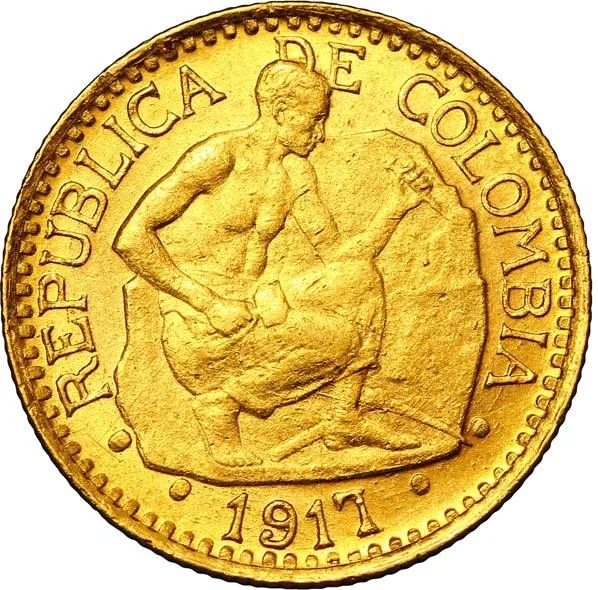
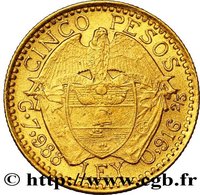
Obverse
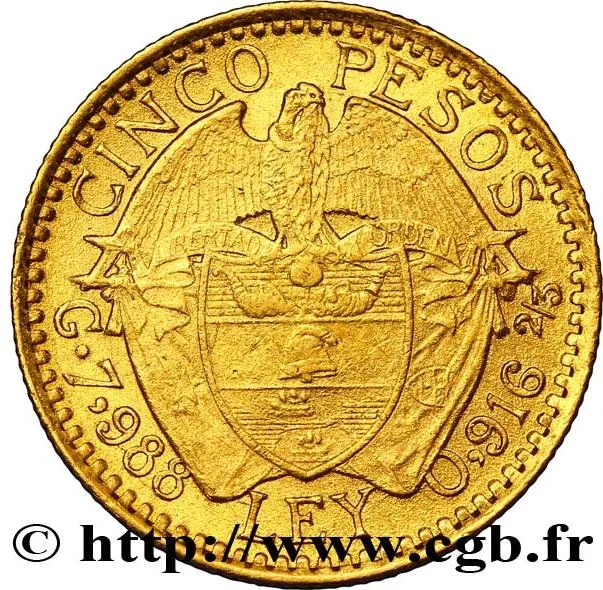
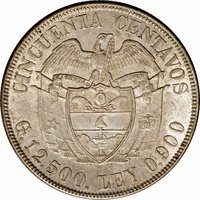
Reverse
Edge
Reeded
Mintings
| Year | Mint Mark | Mintage | Quality | Collection |
|---|---|---|---|---|
| 1913 | — | 17,000 | ||
| 1917 | — | 43,000 | ||
| 1918 | — | 423,000 | ||
| 1919 | — | 2,181,000 |
Historical background
In 1913, Colombia's currency system was in a state of transition and instability, still reeling from the profound economic and political shocks of the previous decade. The most significant event was the Thousand Days' War (1899-1902), a devastating civil war that bankrupted the treasury, destroyed infrastructure, and led to the collapse of the longstanding papel moneda (paper money) issued by private banks. Following the war and the subsequent loss of Panama in 1903, the government struggled with massive external debt and a severe lack of monetary control, with various depreciated paper notes and coins circulating without a unified standard.
The monetary landscape was a complex patchwork. The official currency was the Colombian peso, but its value was highly volatile and it was not tied to a precious metal standard. Gold and silver coins, both domestic and foreign (particularly British sovereigns and U.S. dollars), circulated alongside depreciated paper bills, leading to a dual system where transactions were often negotiated based on the type of currency used. In 1905, President Rafael Reyes attempted reform by introducing the peso oro (gold peso) as a unit of account for international trade and debt repayment, but this did not replace the circulating paper currency, creating confusion between a theoretical gold standard and the reality of a fiduciary system.
Consequently, by 1913, Colombia lacked a central bank and a stable, uniform currency. The economy was effectively dollarized in many commercial sectors, especially for large transactions and foreign trade, due to a lack of confidence in the domestic peso. This fragmented and insecure monetary environment hindered both domestic commerce and foreign investment. The situation would only begin to resolve with the founding of the Banco de la República in 1923, which established a true central bank and a managed gold standard, finally providing the stability that was conspicuously absent in the pre-World War I era.
The monetary landscape was a complex patchwork. The official currency was the Colombian peso, but its value was highly volatile and it was not tied to a precious metal standard. Gold and silver coins, both domestic and foreign (particularly British sovereigns and U.S. dollars), circulated alongside depreciated paper bills, leading to a dual system where transactions were often negotiated based on the type of currency used. In 1905, President Rafael Reyes attempted reform by introducing the peso oro (gold peso) as a unit of account for international trade and debt repayment, but this did not replace the circulating paper currency, creating confusion between a theoretical gold standard and the reality of a fiduciary system.
Consequently, by 1913, Colombia lacked a central bank and a stable, uniform currency. The economy was effectively dollarized in many commercial sectors, especially for large transactions and foreign trade, due to a lack of confidence in the domestic peso. This fragmented and insecure monetary environment hindered both domestic commerce and foreign investment. The situation would only begin to resolve with the founding of the Banco de la República in 1923, which established a true central bank and a managed gold standard, finally providing the stability that was conspicuously absent in the pre-World War I era.
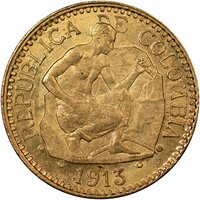
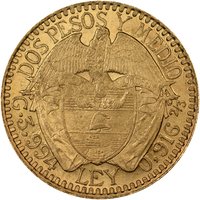
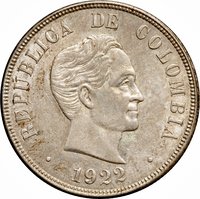
💎 Very Rare