

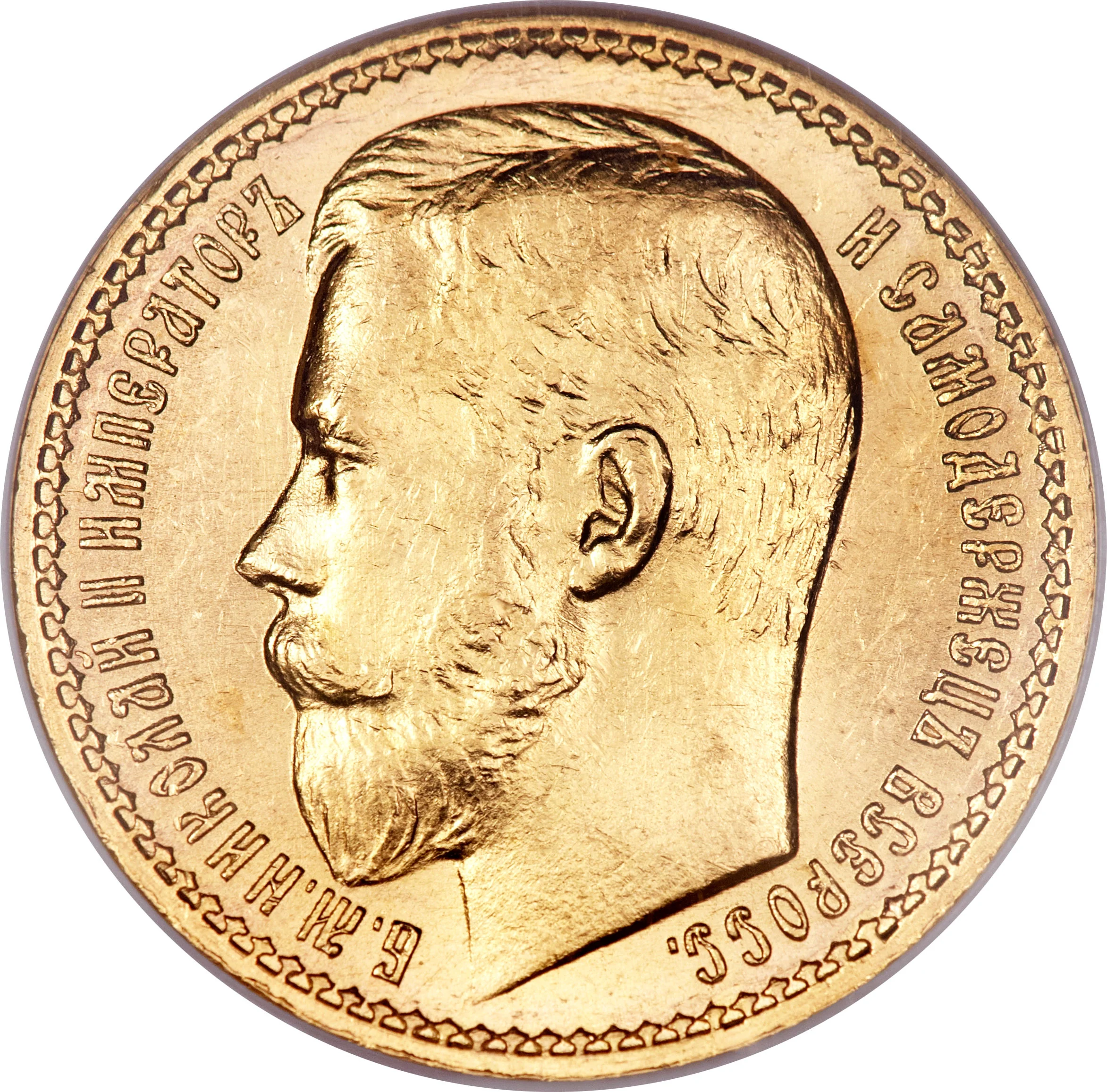
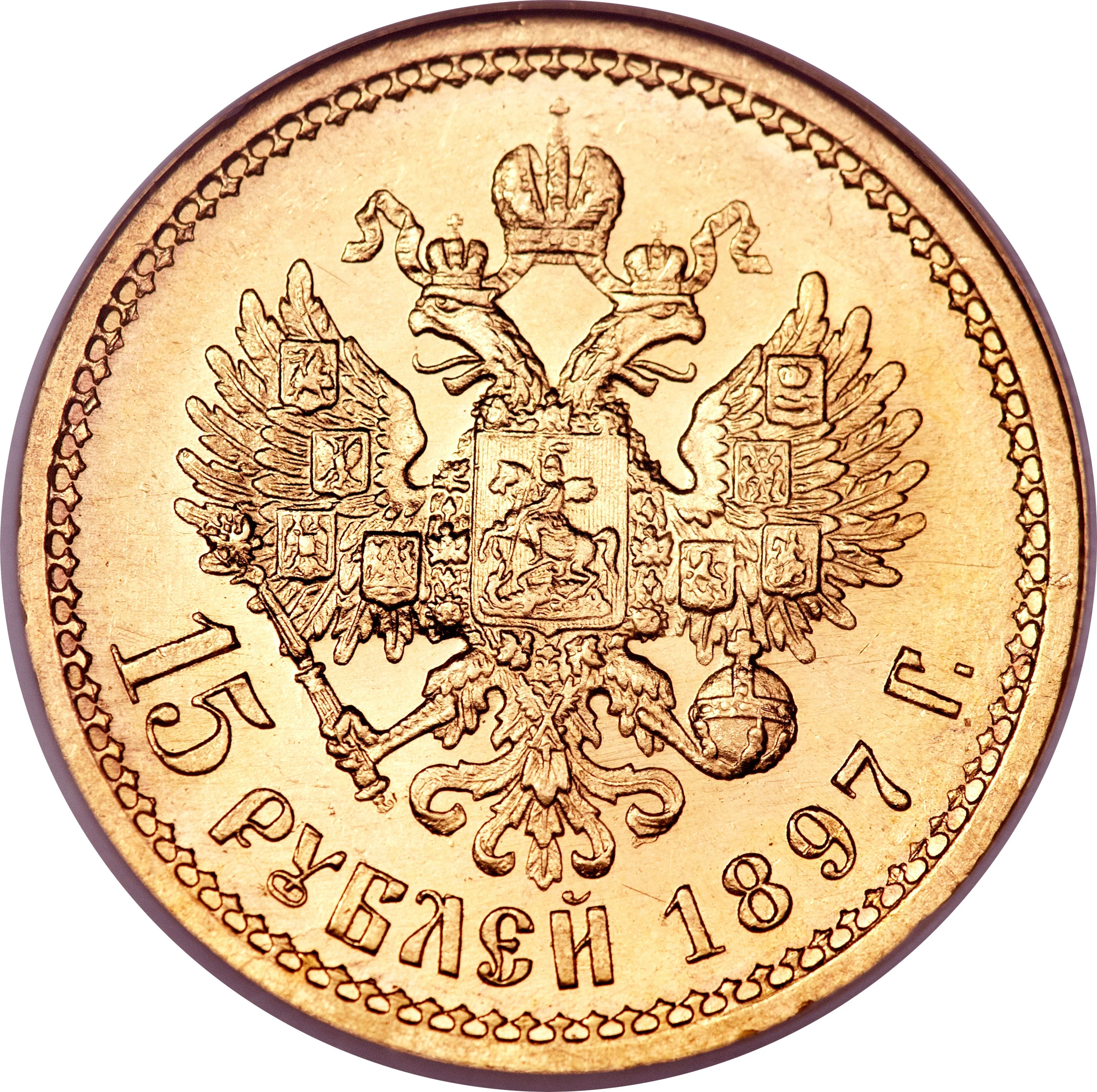
15 rubles – Russian Empire
Add to wishlist
Russia
Context
Year: 1897
Country: Russia
Issuer: Russian Empire
Ruler: Nicholas II
Currency:
(1700—1917)
Demonetized: Yes
Material
References
Y: #
Numista: #90655
Value
Bullion value: $1771.39
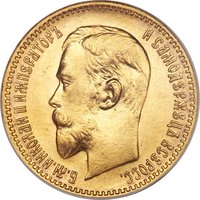
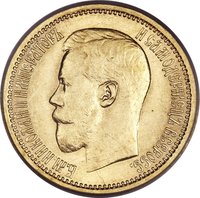
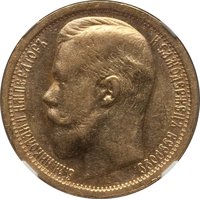
Obverse
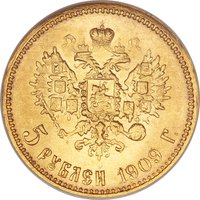
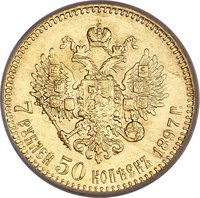
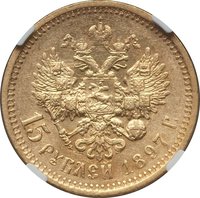
Reverse
Edge
Smooth with inscription
Legend:
ЧИСТАГО ЗОЛОТА 2 ЗОЛОТНИКА 69.36 ДОЛЕЙ (А·Г)
Translation:
PURE GOLD 2 ZOLOTNIKS 69.36 PARTS (A·G)
Language: Russian
Categories
| Mustache/Beard |
| Symbols> Coat of Arms |
| Symbol> Double-headed eagle |
| Object> Globus cruciger |
Mints
| Name | Mark |
|---|---|
| Saint Petersburg | — |
Mintings
| Year | Mint Mark | Mintage | Quality | Collection |
|---|---|---|---|---|
| 1897 | АГ | — |
Historical background
In 1897, the Russian Empire, under Finance Minister Sergei Witte, undertook a monumental monetary reform that fundamentally transformed its financial system by placing the ruble on the gold standard. Prior to this, Russia's currency was based on a devalued paper ruble (credit notes) that fluctuated significantly, which discouraged foreign investment and hampered economic modernization. Witte's goal was to stabilize the ruble, attract international capital for industrialization, particularly for the railway network, and integrate Russia more firmly into the global economy.
The reform established a fixed gold ruble, defining its value as 0.774235 grams of pure gold. State credit notes became freely convertible into gold coins, and the State Bank was required to hold substantial gold reserves to back the paper currency in circulation. This move immediately stabilized the exchange rate, ended a century of currency volatility, and restored international confidence in the Russian financial system. The gold-backed ruble became a symbol of imperial prestige and economic strength.
The consequences were profound but mixed. The reform successfully spurred a massive influx of foreign investment, particularly from France and Belgium, which fueled a rapid industrial boom in the late 1890s and early 1900s. However, it also tied the Russian economy to global gold markets and required stringent fiscal policies, including high taxes and tariffs, to accumulate and protect the gold reserve. This placed a heavy burden on the peasantry and contributed to social tensions that would erupt in the 1905 Revolution, demonstrating that financial modernization came at a significant social cost.
The reform established a fixed gold ruble, defining its value as 0.774235 grams of pure gold. State credit notes became freely convertible into gold coins, and the State Bank was required to hold substantial gold reserves to back the paper currency in circulation. This move immediately stabilized the exchange rate, ended a century of currency volatility, and restored international confidence in the Russian financial system. The gold-backed ruble became a symbol of imperial prestige and economic strength.
The consequences were profound but mixed. The reform successfully spurred a massive influx of foreign investment, particularly from France and Belgium, which fueled a rapid industrial boom in the late 1890s and early 1900s. However, it also tied the Russian economy to global gold markets and required stringent fiscal policies, including high taxes and tariffs, to accumulate and protect the gold reserve. This placed a heavy burden on the peasantry and contributed to social tensions that would erupt in the 1905 Revolution, demonstrating that financial modernization came at a significant social cost.
⭐ Rare