

Peru
Context
Material
References
KM: #Click to copy to clipboard221.2b
Numista: #9057
Value
Exchange value: 0.20 PEH
Obverse
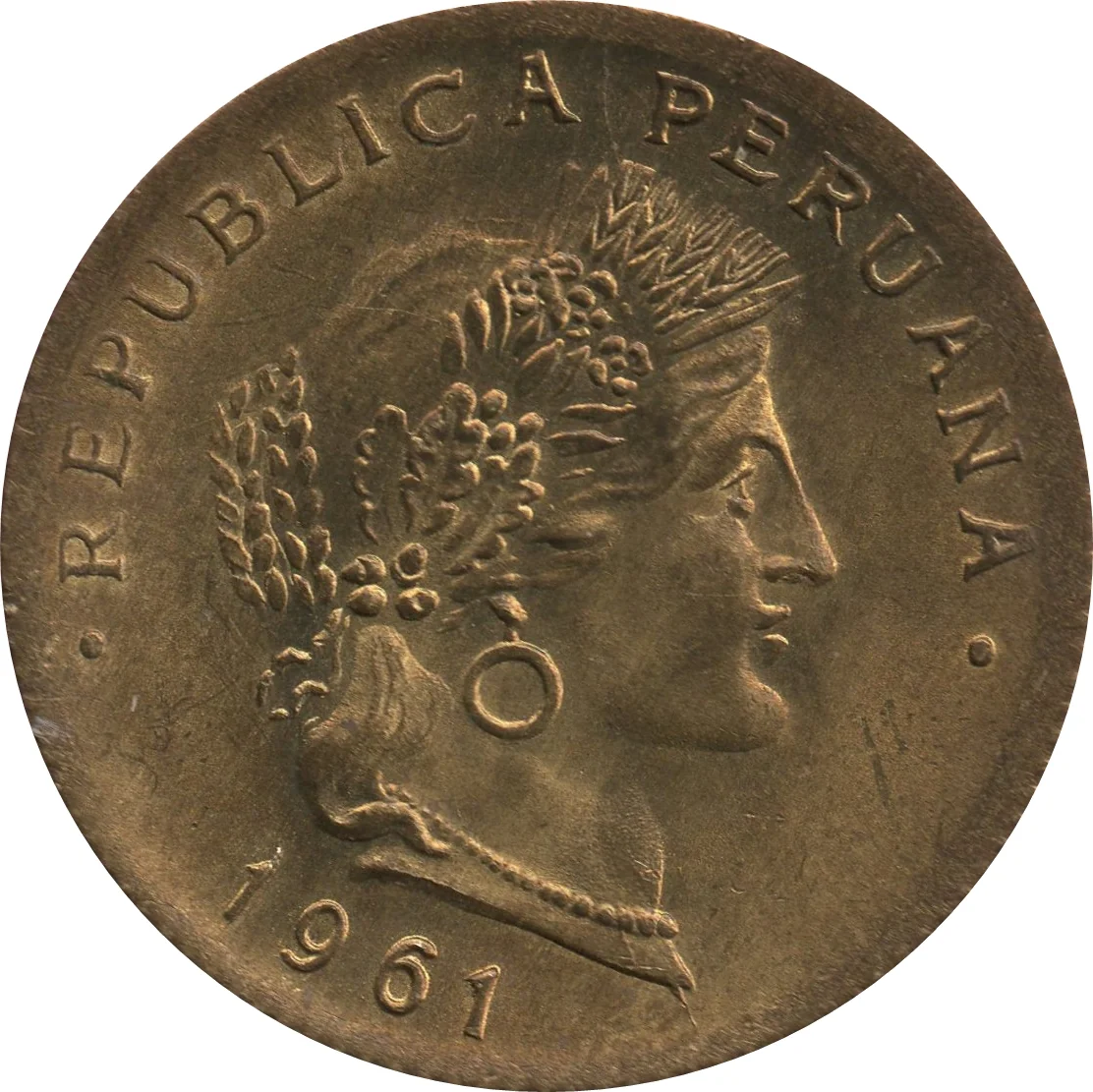
Description:
Head right, date below, lettering around. Engraver's initials (AFP), if present, are at the bottom left of the neck truncation.
Inscription:
· REPUBLICA PERUANA ·
AFP
1961
AFP
1961
Translation:
PERUVIAN REPUBLIC
AFP
1961
AFP
1961
Script: Latin
Language: Spanish
Engraver: AFP= Armando Florentino Pareja
Reverse
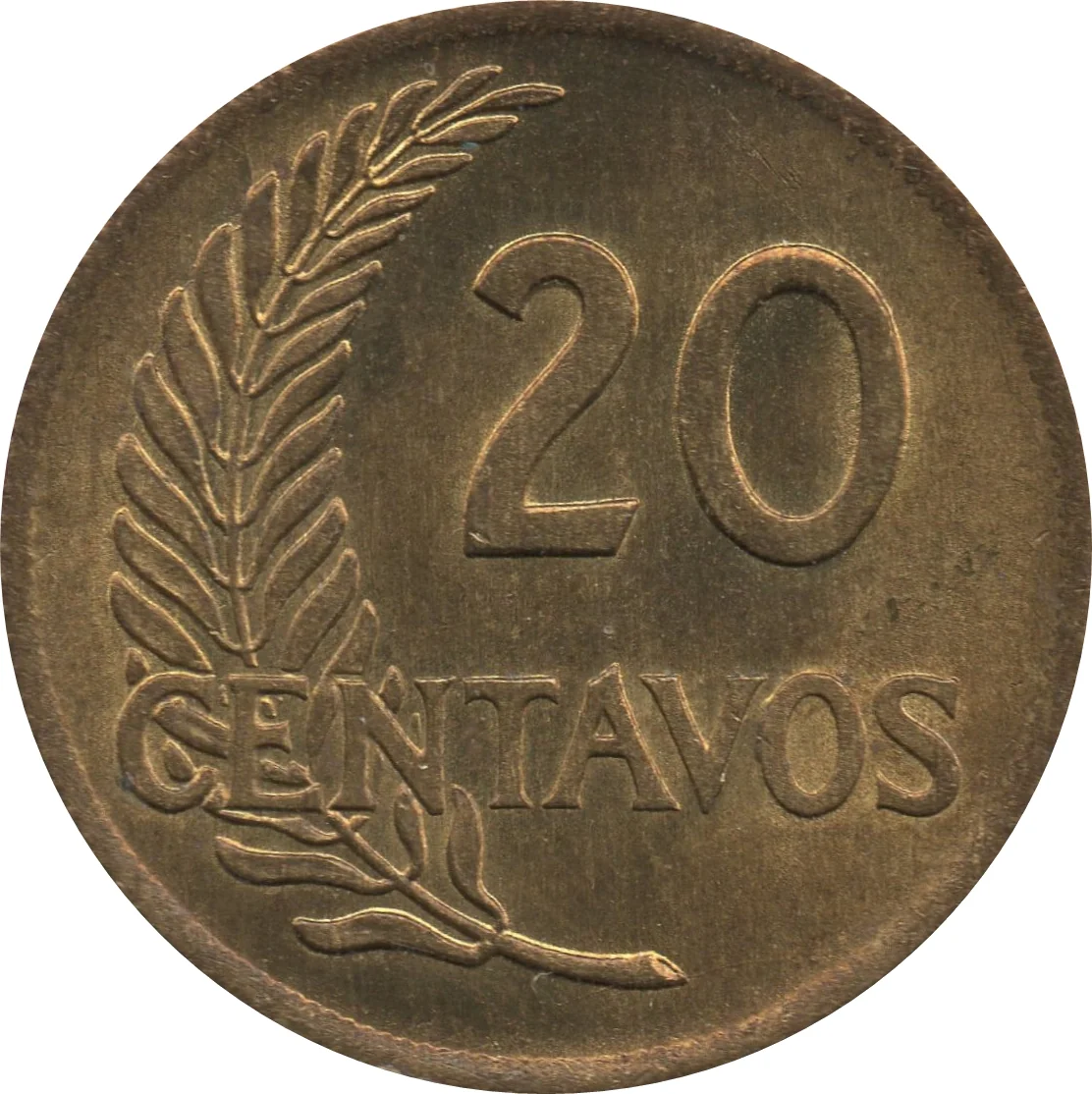
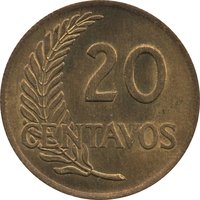
Description:
Value right of sprig, two lines over.
Inscription:
20
CENTAVOS
CENTAVOS
Script: Latin
Engraver: AFP= Armando Florentino Pareja
Edge
Reeded
Mints
| Name | Mark |
|---|---|
| Lima | — |
Mintings
| Year | Mint Mark | Mintage | Quality | Collection |
|---|---|---|---|---|
| 1951 | — | — | ||
| 1952 | — | — | ||
| 1953 | — | — | ||
| 1954 | — | — | ||
| 1955 | — | — | ||
| 1956 | — | 3,760,000 | ||
| 1957 | — | 3,680,000 | ||
| 1958 | — | 3,100,000 | ||
| 1959 | — | — | ||
| 1960 | — | — | ||
| 1961 | — | — | ||
| 1962 | — | — | ||
| 1963 | — | — | ||
| 1964 | — | — | ||
| 1965 | — | — | Proof | |
| 1965 | — | — |
Historical background
In 1951, Peru operated under a managed currency system anchored to the U.S. dollar, with the sol as its national currency. The exchange rate was officially fixed by the Central Reserve Bank of Peru, but a complex system of multiple exchange rates and controls was in place. This structure, a legacy of World War II and the early post-war period, was designed to manage foreign exchange reserves, control capital flows, and protect specific sectors of the economy. Imports and other international transactions were often subject to different official rates or required special licenses, creating a bureaucratic environment for trade.
Economically, the early 1950s were a period of relative stability and growth for Peru, fueled by strong exports of primary commodities like copper, cotton, and sugar. High global demand, particularly due to the Korean War (1950-1953), boosted export earnings and helped maintain the country's foreign reserves. This favorable external context provided a buffer for the currency system, allowing the government to maintain the sol's official parity without severe strain. Inflation was moderate by historical standards, though the controlled system did mask some underlying economic pressures.
However, the rigidity of the fixed exchange rate and the multi-tier system also sowed the seeds for future difficulties. The controls encouraged a black market for dollars where the sol traded at a significant discount, reflecting a divergence between the official and perceived market value. Furthermore, the economy's heavy dependence on volatile commodity prices made the currency vulnerable to external shocks. While not in crisis in 1951, this inflexible framework would later prove unsustainable, contributing to the devaluation pressures and monetary reforms that characterized the late 1950s and 1960s in Peru.
Economically, the early 1950s were a period of relative stability and growth for Peru, fueled by strong exports of primary commodities like copper, cotton, and sugar. High global demand, particularly due to the Korean War (1950-1953), boosted export earnings and helped maintain the country's foreign reserves. This favorable external context provided a buffer for the currency system, allowing the government to maintain the sol's official parity without severe strain. Inflation was moderate by historical standards, though the controlled system did mask some underlying economic pressures.
However, the rigidity of the fixed exchange rate and the multi-tier system also sowed the seeds for future difficulties. The controls encouraged a black market for dollars where the sol traded at a significant discount, reflecting a divergence between the official and perceived market value. Furthermore, the economy's heavy dependence on volatile commodity prices made the currency vulnerable to external shocks. While not in crisis in 1951, this inflexible framework would later prove unsustainable, contributing to the devaluation pressures and monetary reforms that characterized the late 1950s and 1960s in Peru.
🌱 Very Common